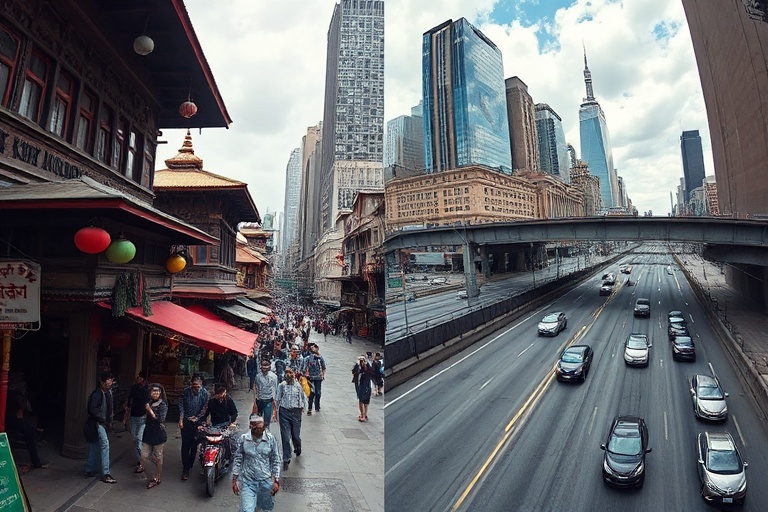
Few countries offer as stark a contrast as Nepal and the United States. Nestled in the Himalayas between China and India, Nepal is a land of ancient temples and towering peaks, where time moves at the pace of prayer flags fluttering in mountain winds. Meanwhile, the United States stretches from the Atlantic to the Pacific, a nation built on innovation and immigration, where skyscrapers pierce urban skies and highways crisscross vast landscapes. These two nations, though separated by geography and culture, share a complex relationship in the global arena.
The comparison between Nepal and the USA reveals fundamental differences in governance, economy, society, and international influence. While one is a young superpower forged in the fires of revolution and expansion, the other is a sovereign nation with a history stretching back millennia. Both face unique challenges and offer distinct perspectives on development, culture, and global responsibility.
Geography and Demographics: Mountains Meet Megacities
The physical and human landscapes of Nepal and the USA could hardly be more different. Nepal, a small landlocked country, covers just 147,516 square kilometers—roughly the size of Arkansas—yet contains eight of the world’s ten highest mountains, including Mount Everest. Its population of about 30 million people lives in a dramatic elevation gradient, from the tropical Terai plains at 60 meters above sea level to the icy summits of the Himalayas at over 8,000 meters.
In contrast, the United States sprawls across 9.8 million square kilometers, making it the third or fourth largest country in the world, depending on measurement. Its 331 million people are concentrated in dense urban centers like New York, Los Angeles, and Chicago, but vast expanses of the American West and Midwest remain sparsely populated. The country’s geography ranges from Arctic tundra in Alaska to tropical rainforests in Hawaii, with deserts, plains, and coastlines in between.
These differences shape national identity and priorities. For Nepal, sustainable mountain tourism and environmental conservation are vital. For the USA, managing urbanization, infrastructure, and natural resource distribution is a constant challenge.
Economic Structures: From Agrarian Roots to High-Tech Hubs
The economic foundations of Nepal and the USA reflect their developmental stages. Nepal remains one of the least developed countries, with a GDP per capita of around $1,200. Agriculture employs nearly 70% of the workforce, though remittances from Nepalis working abroad—primarily in India, Malaysia, and the Gulf states—account for nearly 30% of GDP. Tourism, especially trekking and mountaineering, provides another critical income stream.
The United States, by contrast, has the largest economy in the world, with a GDP exceeding $25 trillion. It is a post-industrial powerhouse dominated by services, technology, and finance. Silicon Valley drives innovation in software and AI, while Wall Street remains the center of global finance. Manufacturing has largely moved overseas, though recent policies aim to revive domestic production.
Despite their differences, both nations face labor migration challenges. The USA grapples with debates over immigration reform and border security, while Nepal struggles with brain drain as skilled professionals seek opportunities abroad. Both countries are exploring ways to leverage diaspora communities for economic growth.
Political Systems: Federalism vs Parliamentary Democracy
The political structures of Nepal and the USA are rooted in fundamentally different historical experiences. The USA is a federal constitutional republic with a presidential system. Power is divided among three branches—executive, legislative, and judicial—and shared between national and state governments. The country was founded on principles of individual liberty and limited government, though its history includes contradictions such as slavery and systemic inequality.
Nepal, meanwhile, transitioned to a federal democratic republic in 2015 after a decade-long civil war and the abolition of its monarchy. It now operates under a parliamentary system with a president as head of state and a prime minister as head of government. The country has a multi-party system with strong regional identities, particularly among ethnic groups like the Madhesi, Tharu, and Newar.
Both nations face political polarization. In the USA, debates over healthcare, gun control, and racial justice dominate national discourse. In Nepal, disputes over federalism, constitutional implementation, and inclusion of marginalized groups continue to shape politics. Despite these challenges, both countries serve as anchors of stability in their respective regions.
Cultural Identity and Global Influence
Culture is perhaps the most visible difference between Nepal and the USA. Nepal’s identity is deeply spiritual and communal, shaped by Hinduism and Buddhism. Festivals like Dashain and Tihar bring families together, while ancient cities like Kathmandu and Patan preserve centuries of art and architecture. The country is also home to over 125 ethnic groups, each with distinct languages and traditions.
The USA, by contrast, is a cultural melting pot. Its identity is built on immigration, with over 45 million foreign-born residents. English is dominant, but Spanish, Chinese, Tagalog, and Vietnamese are widely spoken. American culture—from jazz and hip-hop to Hollywood movies and Silicon Valley tech—has a global footprint, often overshadowing local traditions.
Despite these differences, both nations exert significant soft power. Nepal’s allure lies in its natural beauty, spiritual heritage, and adventure tourism. The USA’s influence comes from its entertainment, technology, and universities, which attract millions of international students each year.
Challenges and Opportunities: What the Future Holds
Looking ahead, both Nepal and the USA face critical challenges. Nepal must address youth unemployment, climate vulnerability, and political fragmentation. The country is highly exposed to glacial lake outburst floods and landslides, which are intensifying due to global warming. Political instability and corruption further hinder progress.
The USA, on the other hand, confronts deep social divisions, rising inequality, and global competition from China and other emerging powers. Political polarization has eroded trust in institutions, and debates over climate policy, healthcare, and racial justice remain unresolved. Yet, the country retains unparalleled technological and military strength.
Both nations also have opportunities for collaboration. Nepal has emerged as a key partner in South Asia for the USA, especially in counterterrorism and disaster relief. Educational exchanges, particularly through programs like the Fulbright scholarship, have strengthened ties. Meanwhile, Nepali professionals in the USA contribute significantly to sectors like medicine, engineering, and IT.
As the 21st century unfolds, Nepal and the USA may seem worlds apart—but their relationship matters. Whether through climate cooperation, educational exchange, or cultural diplomacy, both nations can learn from each other’s strengths and address shared vulnerabilities.
Key Takeaways
- Nepal is a small, mountainous nation with deep spiritual traditions and a developing economy.
- The USA is a vast, diverse superpower driven by technology, innovation, and global influence.
- Both countries face governance challenges but play important roles in their regions.
- Cultural identity differs sharply: communal spirituality in Nepal, immigrant diversity in the USA.
- Despite differences, both nations can benefit from strengthened diplomatic and people-to-people ties.
In an increasingly interconnected world, understanding such diverse nations helps us appreciate the spectrum of human experience. Whether it’s the call of a temple bell in Kathmandu or the hum of a startup in San Francisco, each society contributes uniquely to the global tapestry.
For readers interested in exploring more about global cultures and international relations, Dave’s Locker News offers in-depth coverage of world events and cross-cultural insights.