Spurs Shock Thunder in Game 3 with Defensive Masterclass
“`html
Spurs vs OKC Game 3: A Defensive Masterclass and the Road Ahead
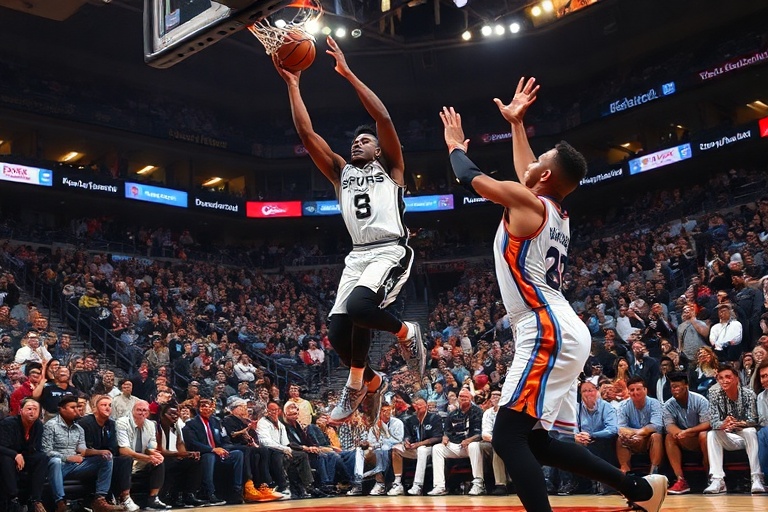
The San Antonio Spurs pulled off a statement victory in Game 3 against the Oklahoma City Thunder, silencing the Chesapeake Energy Arena crowd with a 106-94 win. The performance wasn’t just a win—it was a demonstration of how modern NBA basketball can still be played with discipline, execution, and a refusal to concede even the smallest advantage. While the Thunder entered the game as slight favorites, the Spurs showed why they remain a team built for playoff basketball.
This wasn’t a game defined by individual brilliance alone. It was a collective effort, where every rotation, every screen, and every defensive closeout mattered. The Spurs’ identity has always been rooted in process over flash, and Game 3 was a perfect encapsulation of that philosophy. Meanwhile, the Thunder, despite a strong start to the series, now face a pivotal moment in their young season.
The Spurs’ Defensive Blueprint
The Spurs’ defensive performance in Game 3 was nothing short of impressive. They held the Thunder to 41% shooting from the field, including a paltry 28% in the first half. What stood out wasn’t just the final numbers, but the manner in which they achieved them. The Spurs prioritized communication, effort, and positioning—traits that have defined their organization for decades.
Key to their success was their ability to limit transition opportunities. Oklahoma City thrives on fast breaks and secondary actions, but San Antonio repeatedly disrupted those looks. The Spurs’ wings, particularly Devin Vassell and Keldon Johnson, were active in cutting off lanes, while the bigs—Victor Wembanyama and Jeremy Sochan—provided timely rim protection and lob threats that kept the Thunder honest.
Another critical factor was their handling of Shai Gilgeous-Alexander. While SGA finished with 25 points, he was often forced into tough mid-range shots or contested layups. The Spurs used a mix of drop coverage and aggressive closeouts to limit his efficiency, knowing that Oklahoma City’s offense runs through him. When he was contained, the Thunder’s secondary creators—Chet Holmgren, Jalen Williams, and Josh Giddey—struggled to generate consistent offense.
Key Defensive Adjustments by the Spurs
- Switch-heavy scheme: The Spurs mixed man-to-man and zone principles, switching on screens to prevent easy isolations for SGA.
- Active closeouts: Defenders challenged shots without fouling, making Oklahoma City take tougher looks.
- Rebounding discipline: San Antonio limited second-chance points by boxing out aggressively, a hallmark of Gregg Popovich’s system.
- Depth in rotation: Even bench players like Malaki Branham and Tre Jones contributed defensively, rotating with urgency.
Oklahoma City’s Offensive Struggles
For all their regular-season success, the Thunder entered the playoffs with questions about their playoff identity. Game 3 only amplified those concerns. While they shot well from three (38%), their efficiency inside the arc plummeted. The Spurs’ length and athleticism disrupted their flow, and too often, Oklahoma City settled for contested jumpers rather than attacking the rim.
Shai Gilgeous-Alexander’s usage rate was high, but his shot selection was inconsistent. He attempted 11 mid-range shots, many of which were contested. The Thunder’s offense, which thrives on ball movement and spacing, looked stagnant at times. Jalen Williams and Chet Holmgren, two of their most reliable creators, were held to a combined 18 points on 44% shooting.
Another issue was turnovers. Oklahoma City coughed up the ball 14 times, leading to easy transition points for the Spurs. While turnovers are somewhat expected in playoff basketball, the frequency and timing of theirs were costly. In the first half alone, they committed seven, allowing San Antonio to build a 17-point lead.
Where the Thunder Need to Improve
- Ball movement under pressure: The Spurs’ defense forced Oklahoma City into predictable actions. Better screening and passing could alleviate some of that pressure.
- Attacking the rim: Too often, the Thunder settled for mid-range jumpers. Getting to the paint would draw fouls and create easier looks.
- Secondary playmaking: When SGA was contained, the Thunder lacked a third option to generate offense. More involvement from Giddey or Holmgren could help.
- Adjusting to defensive schemes: The Spurs’ versatility forced Oklahoma City out of its comfort zone. The Thunder must find ways to exploit mismatches.
Broader Implications for Both Teams
The outcome of Game 3 extends beyond a single victory. For the Spurs, it’s a validation of their approach in a league increasingly dominated by isolation-heavy offenses and three-point shooting. Their ability to win with fundamentals—defense, ball movement, and unselfish play—sets them apart from many of their peers. It also raises questions about their ceiling. Can they sustain this level of play against deeper, more athletic teams? The Thunder, meanwhile, must address their offensive limitations if they hope to advance.
For Oklahoma City, the loss isn’t catastrophic, but it’s a reminder that regular-season success doesn’t always translate to the playoffs. Their young core—Gilgeous-Alexander, Holmgren, Williams—will need to grow up quickly if they want to contend for a championship. The Spurs, on the other hand, have shown they can compete with anyone when their system is firing on all cylinders.
One intriguing subplot is the matchup between Victor Wembanyama and Chet Holmgren. Both are generational talents with unique skill sets, and their battles in the paint could define the series. If the Spurs can continue to limit Holmgren’s offensive impact while maximizing Wembanyama’s versatility, they’ll have a significant advantage.
Looking Ahead to Game 4
The series is now tied at 2-2, setting up a pivotal Game 4 in San Antonio. The Thunder will need to regroup, both mentally and tactically. Their coaching staff will likely emphasize better ball movement and more aggressive drives to the rim. If they can limit turnovers and force the Spurs into poor shot selection, they’ll have a real chance to take control of the series.
For the Spurs, the key will be maintaining their intensity. They can’t afford to relax, even for a moment. The Thunder are too talented to let a game slip away, and a loss in Game 4 would swing momentum back in Oklahoma City’s favor. San Antonio’s depth and experience should serve them well, but they’ll need every player to contribute at a high level.
One storyline to watch is the role of veteran leadership. Players like Chris Paul and Tim Duncan (in his prime) have always elevated their teams in crucial moments. The Spurs’ current roster lacks that kind of postseason pedigree, but their culture of accountability might be just as effective.
Predictions for Game 4
Expect a tightly contested game, with both teams fighting for every possession. The Spurs’ home-court advantage will be a factor, but the Thunder’s resilience could keep them in the mix. If Oklahoma City can improve their shot selection and cut down on turnovers, they’ll have a real shot at stealing Game 4. However, if San Antonio continues to play with the same discipline and execution, they could take a commanding 3-2 lead heading back to Oklahoma City.
Regardless of the outcome, this series has already provided a glimpse into the future of the NBA. Two young, talented teams with contrasting styles have squared off in a battle of wits and will. The winner of Game 4 will gain a significant advantage, but the loser will have plenty of film to study and adjustments to make.
Conclusion
The Spurs’ win in Game 3 was more than just a statement—it was a reminder that basketball is still a game of fundamentals. In an era where isolation and three-pointers dominate, San Antonio proved that defense, execution, and teamwork can still carry the day. For the Thunder, the loss was a wake-up call. They’re a talented team with the potential to be great, but playoff basketball demands more than just talent. It requires adaptability, resilience, and a willingness to make the extra pass.
As the series shifts back to San Antonio, both teams will have to dig deeper. The Spurs can’t afford to take anything for granted, while the Thunder must find a way to unlock their offensive potential. One thing is certain: this series is far from over. The next game could swing the momentum in either direction, and the team that executes better will likely advance.
For fans of the game, it’s a treat to watch two teams with such clear identities battle it out. Whether you prefer the Spurs’ methodical approach or the Thunder’s up-and-down style, there’s no denying the entertainment value. And for the players, the stakes couldn’t be higher. Every possession matters, every decision counts. In the end, only one team will walk away with the series—and the chance to keep playing basketball the way it was meant to be played.
Stay tuned for Game 4. It promises to be another chapter in what’s shaping up to be one of the most compelling playoff series of the young season.