Regional Tensions Rise as Iran’s Military Posture Shifts
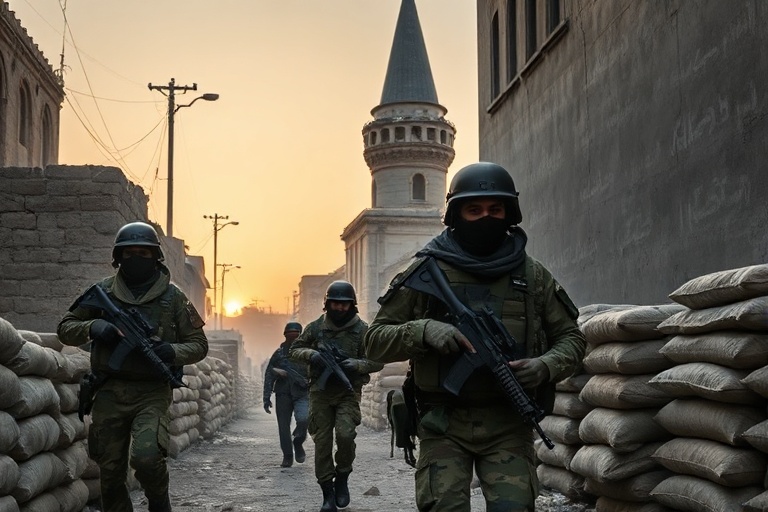
The Middle East remains a powder keg of geopolitical tensions, with Iran’s evolving military strategy drawing sharp scrutiny from global observers. Recent months have seen a marked increase in regional proxy engagements and naval confrontations, particularly in the Persian Gulf and Strait of Hormuz. Analysts suggest these developments reflect broader shifts in Iran’s deterrence doctrine, as well as responses to external pressures from Western sanctions and regional rivals.
Iran’s Islamic Revolutionary Guard Corps (IRGC) has been at the forefront of these maneuvers, conducting joint drills with allied factions in Syria and Yemen. These exercises are not merely symbolic; they serve as a reminder of Iran’s ability to project power across multiple fronts. Meanwhile, the Biden administration has maintained a delicate balance—pursuing diplomacy while signaling readiness to counter aggression. The White House’s recent deployment of an aircraft carrier strike group to the region underscores the stakes.
Cultural and economic ties further complicate the equation. Iran’s population of nearly 90 million remains deeply connected to global digital platforms despite state-imposed internet restrictions. This digital duality allows both regime propaganda and underground dissent to coexist. Meanwhile, regional allies like Hezbollah in Lebanon and the Houthis in Yemen continue to receive Iranian support, embedding Iran’s influence in local power structures.
Key Flashpoints and Their Global Implications
The most volatile flashpoint remains the Strait of Hormuz, a chokepoint through which roughly 20% of the world’s oil supply passes daily. In late 2023, Iran seized several commercial vessels, citing violations of local regulations. These incidents triggered immediate responses from NATO allies, including the United Kingdom, which reinforced its maritime presence. The European Union, meanwhile, has sought to revive the 2015 nuclear deal—a move fraught with both opportunity and risk.
Another critical zone is the Israel-Lebanon border, where Hezbollah’s escalation with Israeli forces has raised fears of a wider conflict. The group’s arsenal, reportedly bolstered by Iranian precision missiles, presents a direct challenge to Israel’s military dominance. Diplomats from France and Germany have engaged in shuttle diplomacy, attempting to de-escalate tensions without conceding strategic ground to Iran.
Below is a breakdown of the most significant regional actors and their roles:
- Iran: Backs proxy groups in Syria, Iraq, Yemen, and Lebanon; maintains a ballistic missile program; faces international isolation due to sanctions.
- Israel: Conducts preemptive strikes against Iranian-backed forces in Syria; views Iran as an existential threat.
- Saudi Arabia: Leads a coalition opposing Iranian influence in Yemen; seeks normalization with Israel to counter Tehran.
- United States: Provides military support to Israel and Gulf allies; pursues a policy of “maximum pressure” while exploring diplomatic avenues.
- Russia: Supports Iran diplomatically and militarily in Syria; uses the alliance to project influence in the Mediterranean.
The interplay between these actors creates a complex web of alliances and rivalries. For instance, Russia’s involvement in Syria has inadvertently strengthened Iran’s position, while also drawing Turkey into the conflict as a counterbalance. This shifting dynamic reflects broader trends in global power realignment, where traditional alliances are increasingly fluid.
Cultural Narratives and Public Sentiment in Iran
Despite the geopolitical storm, life inside Iran continues under the weight of economic hardship and political repression. The Iranian rial has lost over 60% of its value since 2018, pushing millions into poverty. Protests have erupted sporadically, often met with violent crackdowns. Yet, the regime maintains a firm grip on power through a combination of ideological indoctrination and technological surveillance.
Social media remains a battleground. Platforms like Instagram and Telegram are widely used despite government bans, serving as both tools for dissent and channels for state propaganda. The IRGC’s cyber units actively monitor online activity, while hacktivist groups—some linked to opposition movements—target government websites. This digital tug-of-war highlights the resilience of Iran’s civil society, even as it faces severe restrictions.
Culturally, Iran’s rich heritage provides a counter-narrative to its international image. Persian poetry, cinema, and music continue to thrive, offering a window into a society that is far more diverse than its theocratic government suggests. Filmmakers like Asghar Farhadi have achieved global acclaim, while underground music scenes challenge state-imposed restrictions on artistic expression. These cultural expressions serve as subtle acts of resistance, preserving national identity amid political turmoil.
Meanwhile, the diaspora—estimated at over 3 million people—plays a crucial role in shaping global perceptions. Iranian communities in Los Angeles, Toronto, and Berlin organize protests, fund opposition media, and lobby Western governments. Their activism has influenced policies, such as the U.S. State Department’s recent designation of the IRGC as a terrorist organization.
What Lies Ahead: Scenarios and Diplomatic Pathways
The coming months will likely determine whether the current tensions spiral into open conflict or stabilize through negotiation. Several scenarios are plausible:
- Controlled Escalation: Iran continues low-intensity provocations (e.g., cyberattacks, proxy strikes) to pressure the West without triggering a full-scale war. This approach allows it to maintain deterrence while avoiding catastrophic retaliation.
- Diplomatic Breakthrough: A revived nuclear deal could ease sanctions and reduce regional tensions, but only if both Iran and the U.S. make significant concessions. The EU’s role as a mediator remains critical.
- Unintended Escalation: A miscalculation—such as an Israeli strike on Iranian nuclear facilities or a U.S. naval confrontation in the Gulf—could trigger a broader conflict. The risk of such an outcome grows as military postures harden.
- Proxy War Expansion: Iran may deepen its involvement in Yemen or Syria, drawing in more regional actors and prolonging existing conflicts. This could further fragment the already unstable Middle East.
For now, the international community appears divided. The U.S. and Gulf states advocate a firm stance, while European nations push for dialogue. China and Russia, meanwhile, have positioned themselves as neutral brokers—though their support for Iran complicates their mediator roles.
One thing is certain: the outcome will have far-reaching consequences. A war would disrupt global oil markets, trigger refugee crises, and reshape alliances in unpredictable ways. Conversely, a stable resolution could pave the way for economic recovery in Iran and greater stability in the region.
For readers interested in the broader implications of Middle Eastern conflicts, our Politics section offers in-depth analysis on related topics. Meanwhile, Technology coverage explores how cyber warfare is reshaping modern conflicts.
Conclusion
The Iran war update is not just a regional issue—it is a global concern with economic, cultural, and geopolitical dimensions. As the situation evolves, the interplay between military posturing, diplomatic efforts, and public sentiment will shape the future of the Middle East. Observers must look beyond headlines to understand the underlying forces at play. Whether through negotiation or confrontation, the choices made in the coming months will echo far beyond Iran’s borders.