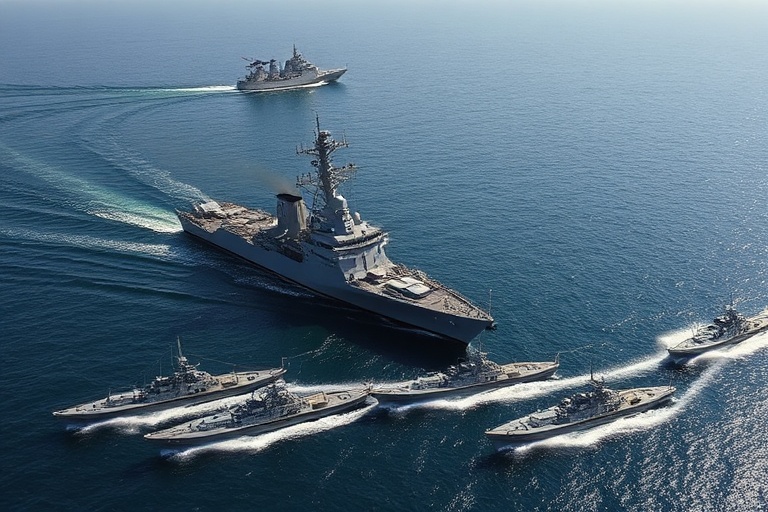
The Trump administration’s decision to blockade key Iranian ports has sent ripples through global trade networks, reshaping geopolitical alliances and economic strategies. This move, framed as a response to Iran’s nuclear ambitions and regional aggression, represents one of the most aggressive maritime enforcement actions in decades. While the White House argues it is necessary to curb Tehran’s influence, critics warn of unintended consequences that could destabilize oil markets and strain U.S. relationships with allies.
The blockade targets Iran’s primary maritime chokepoints, including the Strait of Hormuz—a critical artery for 20% of the world’s oil supply. By leveraging naval power and sanctions enforcement, the administration seeks to cut off Iran’s revenue streams while pressuring the regime to renegotiate the Joint Comprehensive Plan of Action (JCPOA). Yet, the strategy’s effectiveness remains hotly debated, with some analysts questioning whether it will achieve its goals or merely escalate tensions.
The Strategic Logic Behind the Blockade
At its core, the blockade is an extension of the Trump administration’s “maximum pressure” campaign against Iran, launched in 2018 after the U.S. withdrawal from the nuclear deal. The strategy hinges on three pillars: economic strangulation, military deterrence, and diplomatic isolation. By disrupting Iran’s ability to export oil and goods through its ports, the U.S. aims to cripple the regime’s financial resources while demonstrating resolve to regional partners like Saudi Arabia and Israel.
The targeting of Iranian ports is particularly significant because it bypasses traditional sanctions regimes, which often leave loopholes for third-party transactions. By physically controlling maritime access, the U.S. can enforce a near-total embargo, making it nearly impossible for Iran to circumvent restrictions. According to a recent analysis on Dave’s Locker, this approach aligns with broader efforts to isolate Iran diplomatically, as seen in the administration’s push to broaden the scope of sanctions under the guise of counterterrorism.
Yet, the blockade’s success depends on several variables, including the compliance of global shipping firms and the willingness of U.S. allies to enforce the measures. The European Union, for instance, has historically opposed unilateral sanctions, creating friction within NATO. Meanwhile, China and Russia continue to trade with Iran, undermining the blockade’s efficacy.
Key Players and Their Stakes in the Blockade
The blockade has drawn a diverse coalition of actors, each with distinct interests in the outcome. Understanding their roles is critical to assessing the strategy’s long-term viability.
- United States: The architect of the blockade, the U.S. seeks to weaken Iran’s regional influence while reasserting its dominance in the Persian Gulf. However, the cost of maintaining a sustained naval presence in the region could strain military resources.
- Iran: The regime has responded with defiance, threatening to close the Strait of Hormuz in retaliation. Iran’s military, including the Islamic Revolutionary Guard Corps (IRGC), has also increased asymmetric threats like drone attacks and cyber operations.
- China and Russia: Both nations have condemned the blockade, framing it as an illegal act of economic warfare. Their continued trade with Iran—despite U.S. pressure—highlights the limits of American coercive diplomacy.
- European Union: The EU has criticized the blockade but lacks the leverage to counter it effectively. Meanwhile, European firms face a dilemma: comply with U.S. sanctions or risk losing access to American markets.
- Regional Allies: Saudi Arabia and the UAE have welcomed the blockade, seeing it as a tool to counter Iranian aggression in Yemen and Syria. However, their support is contingent on U.S. security guarantees, which could become a bargaining chip in future negotiations.
The blockade’s success hinges on whether these players can be coerced, incentivized, or deterred from undermining the U.S. strategy. So far, the results are mixed, with Iran adapting to sanctions while China and Russia exploit the power vacuum.
Economic and Geopolitical Fallout
The immediate economic impact of the blockade has been felt most acutely in global oil markets. Iran’s oil exports, once averaging 2.5 million barrels per day, have plummeted to a fraction of that figure. The loss of Iranian crude has driven up prices in some regions, particularly in Asia, where refiners scramble to secure alternative supplies. Meanwhile, the U.S. has positioned itself as the swing producer, leveraging its shale oil boom to offset shortages.
Yet, the blockade’s long-term effects are far more complex. By disrupting supply chains, the U.S. risks alienating key trading partners, including India and Turkey, which rely on Iranian oil to meet energy demands. The blockade also risks pushing Iran closer to China, which has deepened its economic ties with Tehran through initiatives like the Belt and Road Initiative.
Geopolitically, the blockade has exacerbated existing tensions in the Middle East. Iran’s threats to close the Strait of Hormuz—a move that could trigger a military confrontation—have raised alarms in Washington and Riyadh. Meanwhile, the blockade has emboldened hardliners in Tehran, who argue that the regime’s survival depends on defiance rather than compromise.
For the U.S., the blockade is a calculated risk. On one hand, it demonstrates a willingness to use military power to enforce economic sanctions, a tactic that could deter future adversaries. On the other, it risks entangling America in a protracted conflict with no clear exit strategy.
What’s Next for the Blockade Strategy?
The blockade’s future remains uncertain, with several potential outcomes on the horizon. One scenario sees Iran capitulate under economic pressure, leading to a new round of negotiations over its nuclear program. Another possibility is a military escalation, as Iran retaliates against U.S. assets or allies in the region. Alternatively, the blockade could collapse under its own weight, as global actors find ways to circumvent it.
For now, the Trump administration appears committed to doubling down. Recent reports suggest the U.S. is considering additional sanctions on Iranian shipping firms and expanding naval patrols to enforce the blockade more aggressively. However, the strategy’s sustainability hinges on two factors: the resilience of Iran’s economy and the unity of the U.S.-led coalition.
As the blockade enters its second year, the stakes could not be higher. The Persian Gulf remains a powder keg, and any miscalculation could spiral into a broader conflict. For policymakers, the challenge is clear: balance pressure with diplomacy, coercion with compromise, and strength with strategic restraint.
The blockade may yet prove to be a defining moment in U.S.-Iran relations, but its legacy will depend on whether it achieves its goals—or merely deepens the divide between Washington and Tehran.
For more on U.S. foreign policy and geopolitical analysis, visit Dave’s Locker Politics Section or explore in-depth analysis coverage.