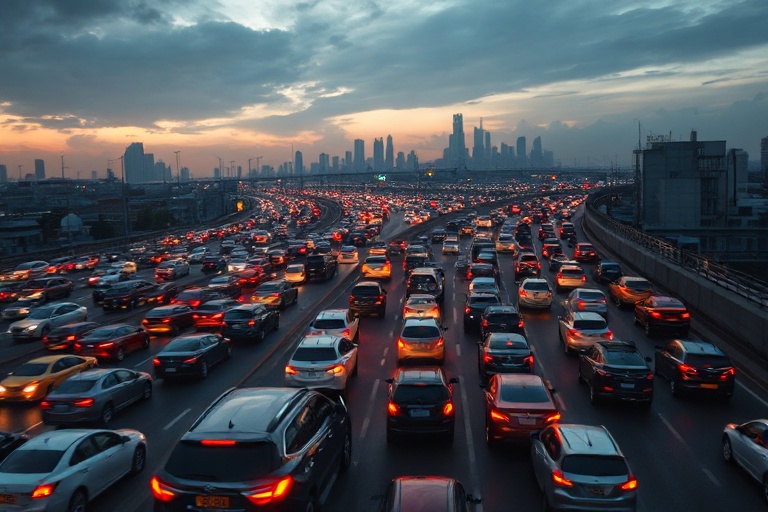
Traffic doesn’t just frustrate drivers—it grinds entire economies to a halt. The phenomenon of gridlock, once confined to rush hours in dense urban cores, has metastasized into a 24/7 reality across major metropolitan areas. From Los Angeles to London, commuters spend an average of 54 hours per year stuck in traffic, according to the 2023 INRIX Global Traffic Scorecard. This figure doesn’t merely represent lost time; it reflects billions in wasted productivity, elevated stress levels, and environmental degradation.
The problem extends beyond personal inconvenience. Gridlock acts as a silent tax on urban mobility, disproportionately affecting lower-income workers who rely on public transit or must traverse long distances to reach employment hubs. Cities that fail to address this issue risk falling behind in economic competitiveness, as talent and businesses opt for locations where movement isn’t a daily battle.
The Anatomy of a Standstill: What Really Causes Gridlock
Understanding gridlock requires examining its root causes, which are rarely as simple as “too many cars.” Urban planners point to several interconnected factors:
- Infrastructure lag: Many cities built their road networks decades ago, when population densities were lower. Today’s growth has outpaced these systems, creating bottlenecks that weren’t anticipated.
- Poor traffic management: Inefficient signal timing, lack of dedicated bus lanes, and inadequate enforcement of traffic laws exacerbate congestion. In some cities, traffic lights change too slowly for high-volume intersections.
- Land-use decisions: Zoning laws that separate residential areas from commercial centers force workers into daily migrations, saturating transportation arteries. This is particularly acute in car-dependent suburbs.
- Behavioral factors: Ride-sharing apps and food delivery services add thousands of vehicles to already strained networks. Meanwhile, distracted driving slows traffic flow as drivers rubberneck at accidents or scroll through their phones.
These issues compound during peak hours, when a single stalled vehicle or minor fender-bender can trigger cascading delays. The result is a self-perpetuating cycle where congestion begets more congestion, as drivers reroute to avoid problem areas, only to create new bottlenecks elsewhere.
Beyond the Commute: The Hidden Costs of Gridlock
The consequences of persistent gridlock ripple through society in ways that aren’t immediately visible. Air quality suffers as idling vehicles emit higher levels of nitrogen oxides and particulate matter. In Los Angeles, traffic-related pollution contributes to over 1,300 premature deaths annually, according to a 2022 study by the University of Southern California.
Economically, gridlock imposes a hidden tax on businesses. Deliveries take longer, employees arrive late, and supply chains face unpredictable delays. A 2023 report by the Texas A&M Transportation Institute estimated that congestion costs the U.S. economy $120 billion annually in lost time and fuel. For small businesses operating on tight margins, these delays can mean the difference between profitability and closure.
Social equity also comes into play. Low-income neighborhoods often bear the brunt of poor transit options and longer commutes. A Brookings Institution analysis found that workers in the bottom income quintile spend nearly 60% more time commuting than those in the top quintile. This disparity limits access to employment opportunities and reinforces cycles of poverty.
Breaking the Gridlock: Solutions That Work
Addressing gridlock requires a multi-faceted approach that goes beyond building more roads—a strategy that has historically failed to reduce congestion. Successful cities combine infrastructure upgrades with policy changes and behavioral incentives:
- Invest in alternative transit: Cities like Tokyo and Copenhagen demonstrate how robust public transit systems reduce car dependency. Expanding metro networks, protected bike lanes, and high-frequency bus routes can provide viable alternatives to driving.
- Implement congestion pricing: London’s £15 daily charge for driving in the city center cut traffic by 15% and reduced emissions by 20%. Similar programs in Stockholm and Singapore show that when driving becomes expensive, commuters seek alternatives.
- Optimize traffic flow: Smart traffic signals that adapt in real-time to traffic conditions can improve throughput by up to 20%. Cities like Pittsburgh have seen measurable reductions in delays by deploying AI-driven signal systems.
- Encourage flexible work arrangements: The rise of remote work post-pandemic has already eased pressure on rush-hour traffic. Policies that support hybrid schedules can permanently reduce peak-hour congestion.
- Promote urban density: Mixed-use zoning that integrates housing, workplaces, and retail reduces the need for long commutes. Cities like Vienna and Amsterdam prioritize walkability and transit-oriented development.
These solutions aren’t one-size-fits-all. Cities must tailor their approach to local conditions, considering factors like population density, existing infrastructure, and political will. What works in a compact European city may not translate to sprawling American metros. However, the common thread is a recognition that gridlock isn’t an inevitable byproduct of urban life—it’s a solvable problem.
The Road Ahead: Can Cities Escape the Slow Lane?
The future of gridlock hinges on whether cities can act decisively before congestion becomes an existential threat to their viability. The tools exist; the challenge lies in political courage and public acceptance of change. For instance, congestion pricing faces predictable resistance from drivers who view it as a regressive tax, while transit expansions often require upfront investments that yield long-term benefits.
Yet the status quo is unsustainable. As urban populations swell—projected to reach 68% of the global population by 2050, according to the UN—the pressure on transportation systems will only intensify. Cities that fail to innovate risk becoming economic backwaters, where the dream of opportunity is choked by the reality of gridlock.
Some forward-thinking municipalities are already reimagining urban mobility. In Oslo, the city center is on track to become car-free by 2030, with investments redirected to cycling and pedestrian infrastructure. Barcelona’s “superblocks” program restricts through traffic in residential areas, prioritizing community spaces over vehicle throughput. These experiments offer valuable lessons for other cities grappling with the same dilemma.
The fight against gridlock isn’t just about saving time—it’s about preserving the vitality of urban life. When cities move freely, economies thrive, environments improve, and social equity advances. The question isn’t whether gridlock can be defeated, but how soon cities will commit to the battle.
For drivers stuck in traffic today, that day can’t come soon enough.
Explore more on urban mobility and infrastructure challenges in our News and Analysis sections.