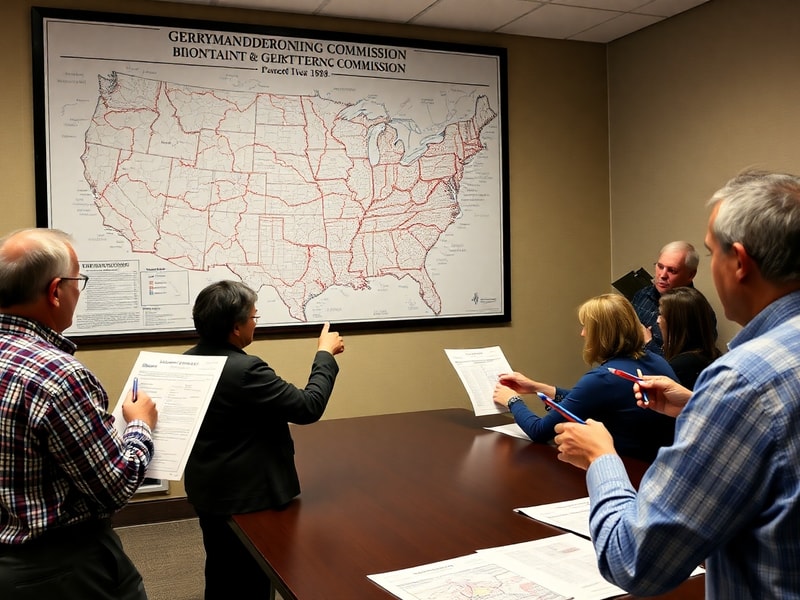
Redistricting Explained: How Political Maps Shape Power
“`html
Redistricting Explained: How Political Maps Shape Power
Every decade, a quiet but consequential process reshapes American democracy. Redistricting—the redrawing of electoral district boundaries—determines who represents communities in Congress and state legislatures. While it may sound like bureaucratic housekeeping, the way maps are drawn influences elections, policy outcomes, and even the balance of power between political parties for years to come.
The stakes are high because redistricting affects how fairly votes translate into representation. When done fairly, it ensures communities have a voice in government. When manipulated, it can dilute the influence of certain voters or concentrate power in the hands of a few. This process is not just about geography; it’s about who gets to make decisions that shape the nation’s future.
The Mechanics of Redistricting: Who Draws the Lines?
Redistricting begins with the U.S. Census, which is conducted every 10 years to count the population. The data collected determines how many congressional seats each state gets and where district boundaries should be drawn to ensure roughly equal population sizes. This task falls to state legislatures in most cases, though some states use independent commissions to reduce partisan influence.
The process varies widely across the country. In 35 states, legislatures control redistricting, often with the governor’s approval. In others, like California and Arizona, independent commissions draw the maps to minimize political interference. The rules differ too—some states require districts to be compact and respectful of municipal boundaries, while others allow more leeway in how lines are drawn.
This variation leads to starkly different outcomes. In states where one party controls both the legislature and governorship, redistricting can become a tool for partisan advantage. The result is a practice known as gerrymandering, where districts are shaped to favor one party over another, often through creative (and sometimes absurd) boundary lines.
Key Players in the Redistricting Process
The following groups play pivotal roles in shaping electoral maps:
- State Legislatures: In most states, lawmakers draft and approve district maps, which can lead to intense political battles.
- Governors: Many states require gubernatorial approval for new maps, giving executives significant influence over the final product.
- Independent Commissions: A growing number of states use nonpartisan or bipartisan commissions to draw maps, aiming to reduce partisan bias.
- Courts: When disputes arise over map fairness, courts can step in to redraw boundaries or strike down illegal gerrymanders.
- Voting Rights Groups: Organizations like the ACLU and the League of Women Voters often challenge unfair maps in court, advocating for equitable representation.
Gerrymandering: The Art of Drawing Unfair Maps
Gerrymandering is the practice of manipulating district boundaries to favor one political party, protect incumbents, or dilute the voting power of certain groups. The term dates back to 1812, when Massachusetts Governor Elbridge Gerry signed a bill that included a district shaped like a salamander to benefit his party. A political cartoonist dubbed it a “gerry-mander,” and the name stuck.
There are two primary types of gerrymandering: partisan and racial. Partisan gerrymandering aims to secure advantages for one political party by packing opposition voters into a few districts or spreading them thin across many districts. Racial gerrymandering involves drawing districts to either suppress or enhance the voting power of racial or ethnic groups, often in violation of the Voting Rights Act.
For example, in North Carolina, Republican lawmakers drew congressional districts that packed Democratic voters into a few urban districts while spreading the remaining voters to create a Republican majority in most districts. The result was a legislature that did not reflect the state’s political diversity. Similarly, in Texas, lawmakers have been accused of diluting the voting power of Latino communities by splitting their populations across multiple districts.
Gerrymandering undermines the principle of “one person, one vote,” making some votes more influential than others. It can also lead to less competitive elections, as incumbents in safely drawn districts face little challenge. This dynamic contributes to political polarization, as lawmakers cater to their party’s base rather than seeking compromise.
The Broader Implications of Redistricting
Beyond elections, redistricting has far-reaching consequences for policy and governance. When maps are drawn to favor one party, the resulting legislature may pass laws that reflect narrow interests rather than the will of the broader electorate. This can lead to policies that ignore the needs of marginalized communities or prioritize partisan goals over practical solutions.
For instance, in states where Republicans have gerrymandered maps to secure supermajorities, they have pushed through restrictive voting laws, abortion bans, and tax cuts that benefit wealthy constituents. Conversely, in states where Democrats have drawn maps to their advantage, they have advanced progressive policies like expanded healthcare and climate initiatives. The way districts are drawn can thus dictate the trajectory of a state’s future for a decade.
Redistricting also intersects with issues of racial equity. The Voting Rights Act of 1965 prohibits racial gerrymandering, but enforcement has been inconsistent. Some states have been accused of using redistricting to weaken the influence of minority voters, such as by splitting predominantly Black or Latino communities across multiple districts. Legal battles over these maps have become increasingly common, with courts sometimes striking down discriminatory lines.
Another consequence of partisan redistricting is the rise of “safe seats,” where incumbents face little competition in general elections. This reduces voter turnout in these districts, as outcomes are effectively decided in primary elections dominated by the party’s most extreme factions. The result is a Congress that is increasingly polarized, with lawmakers more responsive to their base than to the median voter.
Can Redistricting Be Fixed?
Reform advocates argue that the current system is broken and needs structural changes to ensure fairness. Several solutions have been proposed or implemented in recent years:
- Independent Redistricting Commissions: States like Colorado and Michigan have adopted independent commissions to draw district maps, removing lawmakers from the process. These commissions are designed to be nonpartisan and transparent, reducing the risk of gerrymandering.
- Ranked-Choice Voting: Some municipalities and states have adopted ranked-choice voting, which can reduce the incentives for gerrymandering by making elections more competitive even in non-competitive districts.
- Judicial Intervention: Courts have played a crucial role in striking down unfair maps. In 2019, the U.S. Supreme Court ruled that federal courts cannot strike down partisan gerrymanders, but state courts have stepped in to block discriminatory maps in states like North Carolina and Pennsylvania.
- Transparency and Public Input: Many reformers advocate for greater transparency in the redistricting process, including public hearings and open data tools that allow citizens to scrutinize proposed maps. This can help expose gerrymandering and build trust in the process.
- Automatic Redistricting Algorithms: Some experts propose using computer algorithms to draw district maps based on neutral criteria like compactness and respect for municipal boundaries. While not foolproof, these methods can reduce human bias in the process.
The fight over redistricting is far from over. In 2021, the Supreme Court’s decision in Brnovich v. Democratic National Committee weakened protections against racial discrimination in voting, raising concerns about future gerrymandering efforts. Meanwhile, grassroots organizations continue to push for reforms at the state and local levels, arguing that fair maps are essential to a healthy democracy.
For voters, understanding redistricting is crucial to participating in the process. Attending public hearings, submitting comments on proposed maps, and supporting reform organizations can make a difference. The maps drawn today will shape elections not just in 2024, but for the entire decade—making it one of the most consequential (and underrated) issues of our time.
To learn more about how redistricting intersects with broader political trends, visit our Politics category page. For deeper analysis on voting rights and electoral systems, check out our Analysis section.
Conclusion
Redistricting is more than a technical process—it’s a cornerstone of democratic representation. When done fairly, it ensures that every vote carries equal weight and that communities have a voice in government. When manipulated, it can entrench power, silence dissent, and distort the will of the electorate. The battle over maps is a battle over who gets to decide the future of the nation, making it one of the most consequential struggles in American politics today.
As redistricting cycles continue, the push for reform grows louder. Whether through independent commissions, judicial oversight, or public pressure, the goal remains the same: maps that reflect the will of the people, not the whims of politicians. The fight for fair representation is far from over, but with awareness and activism, change is possible.