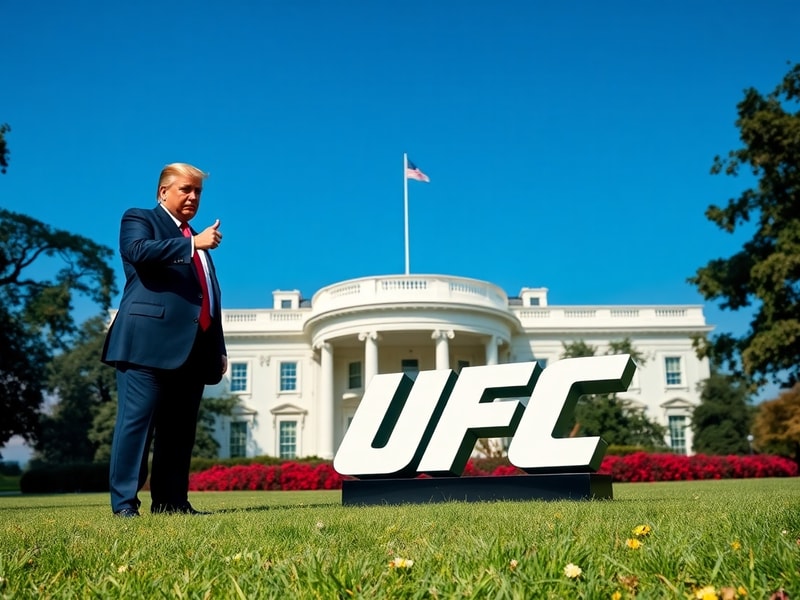
The White House lawn has long been a canvas for presidential symbolism, from the Resolute Desk to the Rose Garden. Recently, however, it played host to an unexpected addition: a UFC-branded claw sculpture. Former President Donald Trump, never one to shy away from controversy or unconventional decor, recently hinted that the claw will remain in place for the foreseeable future. The statement, made during a politics-focused interview, underscores the intersection of sports, power, and public perception in modern political discourse.
The UFC claw—a metallic, talon-like structure—was installed as part of a promotional campaign for the Ultimate Fighting Championship. It arrived on the scene during a period of heightened scrutiny over the organization’s global expansion and its role in shaping combat sports culture. While the sculpture was initially intended as a temporary fixture, its permanence now hinges on Trump’s personal stance, reflecting broader trends in how politics and entertainment collide in public spaces.
The Symbolism Behind the Claw
To understand the significance of the UFC claw on the White House lawn, one must first consider the symbolic weight of both entities. The White House represents institutional power, tradition, and national identity. The UFC, meanwhile, embodies a more raw, modern form of entertainment—one that blends athleticism with spectacle. The juxtaposition is striking: a government building adorned with a symbol of combat sports, a sport often criticized for its violence but celebrated for its physicality.
- Power and Dominance: The claw itself is a metaphor for dominance, a recurring theme in both politics and mixed martial arts. In the octagon, fighters strive for control; in the political arena, leaders assert authority. The sculpture’s placement on the lawn may inadvertently reinforce the idea of power as a dominant force.
- Controversy and Public Reception: Not everyone is thrilled by the installation. Critics argue that the UFC, despite its mainstream success, still carries the stigma of being a fringe sport. Its presence on the White House grounds could be seen as an endorsement of its more polarizing aspects, including its history of regulatory battles and debates over fighter safety.
- Branding and Legacy: For the UFC, the claw is a marketing coup. It places the organization at the center of national conversations, even if unintentionally. For Trump, who has a well-documented history with the UFC—including his role in promoting the sport during his presidency—the sculpture may serve as a personal branding opportunity.
From a global perspective, the installation also raises questions about cultural imperialism. The UFC is a distinctly American export, and its presence on the White House lawn could be interpreted as an assertion of American cultural dominance. This is particularly relevant in an era where global audiences are increasingly scrutinizing the influence of American media and sports on international soil.
Trump’s Personal and Political Stance
Trump’s comments about the claw were delivered in his characteristic style—blunt, unfiltered, and laced with self-reference. He suggested that the sculpture is “a great piece of art” and that removing it would be unnecessary. The statement aligns with his broader pattern of embracing unconventional symbols, from his use of social media to his flamboyant public persona.
Politically, the decision to keep the claw in place can be seen as a nod to his base, many of whom are avid UFC fans. The sport has cultivated a dedicated following among conservative audiences, who appreciate its emphasis on individualism, competition, and traditional masculinity. By embracing the UFC, Trump may be reinforcing his connection to this demographic while simultaneously challenging the cultural elite’s perception of the sport.
- Symbolic Alignment: Trump’s presidency has often been characterized by a rejection of traditional political norms. The UFC claw fits neatly into this narrative—it’s unapologetically bold, controversial, and outside the mainstream of typical White House decor.
- Media and Publicity: The sculpture has generated significant media attention, much of it free publicity for both Trump and the UFC. In an era where political figures and sports organizations alike vie for visibility, the claw serves as a mutually beneficial symbol.
- Cultural Commentary: Some analysts argue that Trump’s stance on the claw is a commentary on the commercialization of politics. By allowing the UFC to leave its mark on the White House, he blurs the line between entertainment and governance, reflecting a broader trend in modern leadership.
Internationally, Trump’s embrace of the UFC claw could be interpreted as a form of soft power. The UFC is one of the few American cultural exports with near-global recognition, and its association with the White House could enhance its international appeal. However, it also risks alienating audiences who view the UFC as emblematic of American hyper-competitive culture.
The Broader Implications for Sports and Politics
The intersection of sports and politics is not new, but the UFC claw incident highlights how deeply intertwined they have become. In recent years, athletes and sports organizations have waded into political debates, from Colin Kaepernick’s kneeling protest to the NBA’s response to social justice movements. The UFC, however, has taken a different approach—it has largely avoided overt political statements, focusing instead on its brand and its fighters.
Trump’s decision to keep the claw in place could set a precedent for future collaborations between sports entities and political figures. It raises ethical questions about the appropriateness of using public spaces for promotional purposes, particularly when those promotions involve organizations with controversial reputations.
Globally, the incident also reflects the increasing globalization of sports culture. The UFC’s reach extends far beyond American borders, with events held in countries like the UAE, Canada, and the UK. Its presence on the White House lawn could be seen as an assertion of its global dominance, further embedding American cultural exports into international narratives.
A Look at Public Reaction
Public reaction to the UFC claw has been predictably polarized. Supporters of both Trump and the UFC have praised the installation, framing it as a bold statement in favor of individualism and free expression. Critics, however, argue that it trivializes the gravity of the White House and undermines its symbolic weight.
Social media has been a battleground for these competing narratives. On one side, memes and jokes about the claw dominate platforms like Twitter and TikTok, reflecting a younger, more irreverent audience’s take. On the other, traditionalists and political commentators have expressed outrage, framing the sculpture as an affront to the dignity of the presidency.
The debate also extends to the UFC’s role in modern sports. While the organization has made strides in gaining mainstream acceptance, it still faces criticism for its handling of fighter safety, its business practices, and its cultural impact. The claw, therefore, becomes more than just a piece of art—it becomes a symbol of these broader debates.
What’s Next for the UFC Claw?
As of now, the UFC claw remains in place, and Trump has given no indication that he plans to remove it. For the UFC, this is a win—a rare opportunity to have its brand associated with one of the most recognizable addresses in the world. For Trump, it’s another example of his willingness to challenge conventions and embrace the unconventional.
Looking ahead, the incident could inspire similar collaborations between sports organizations and political figures, particularly in an era where visibility and branding are paramount. It also raises questions about the future of public spaces and who has the right to define their purpose. Is the White House lawn a place for political symbolism, artistic expression, or corporate promotion? The UFC claw forces us to confront these questions head-on.
One thing is certain: the claw is more than just a sculpture. It’s a conversation starter, a cultural artifact, and a testament to the ever-blurring lines between sports, politics, and public life. Whether it remains a fixture or is eventually removed, its impact on the national dialogue is undeniable.
Conclusion
The UFC claw on the White House lawn may seem like a trivial matter, but it reflects deeper trends in modern culture, politics, and sports. It challenges our perceptions of public spaces, the role of branding in governance, and the evolving relationship between entertainment and power. As Trump’s presidency continues to shape the national conversation, the claw stands as a reminder of the unexpected intersections that define our era.