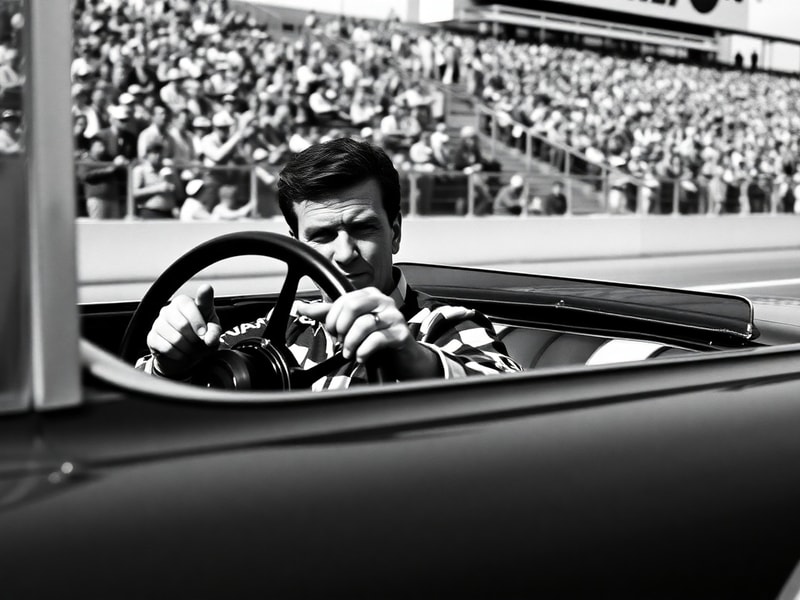
Ned Jarrett wasn’t the flashiest driver to ever sit behind the wheel of a stock car, but his impact on NASCAR remains unmatched. Born in 1932 in the small town of Newton, North Carolina, Jarrett rose from humble beginnings to become one of the most respected figures in motorsports. His career spanned the 1950s and 1960s, a transformative era for stock car racing when it evolved from regional entertainment into a national spectacle.
Jarrett’s legacy extends beyond his two championships and 50 Cup Series wins. He embodied the values of sportsmanship, humility, and relentless determination that shaped NASCAR’s early identity. Even decades after his retirement, his influence persists among drivers who cite him as an inspiration. This is the story of a man who let his actions speak louder than his engine.
The Early Years: From Backroads to the Big Track
Growing up in the foothills of the Appalachian Mountains, Jarrett developed a love for speed early. His father owned a garage, where young Ned spent countless hours tinkering with cars. By the time he was 16, he was racing on dirt tracks across the Southeast, a common path for aspiring drivers in that era. The transition from local circuits to the NASCAR Grand National Series (now the Cup Series) was not an immediate success. Jarrett struggled in his early seasons, facing mechanical failures and fierce competition from established stars like Fireball Roberts and Richard Petty’s father, Lee Petty.
His breakthrough came in 1957 at the Hickory Motor Speedway in North Carolina. Jarrett won his first race there, a modest but pivotal victory that caught the attention of team owners. By 1960, he had secured his first major win at the prestigious Darlington Raceway, solidifying his place among the sport’s elite. These early years were defined by grit and adaptability, traits that would define his entire career.
A Different Era of Racing
Jarrett’s prime years coincided with a period when NASCAR was still defining itself. Safety standards were virtually nonexistent by modern measures. Drivers raced without helmets in many instances, and roll bars were optional. Cars lacked the aerodynamic advancements of today’s vehicles, relying instead on brute horsepower and driver skill. Jarrett thrived in this environment, mastering the art of car control on high-banked superspeedways and tight short tracks alike.
His rivalry with Fireball Roberts, one of the sport’s most charismatic figures, became the stuff of legend. The two men represented different philosophies—Roberts was the showman, Jarrett the steady professional. Their battles on the track drew crowds and elevated NASCAR’s profile, helping the sport transition from Southern pastime to a national phenomenon.
The 1961 and 1965 Championships: A Masterclass in Consistency
Jarrett’s first championship in 1961 was a testament to his methodical approach. That season, he won only three races but amassed an impressive 43 top-10 finishes—a level of consistency that outpaced more flamboyant competitors. It was a strategy rooted in reliability, a stark contrast to the win-at-all-costs mentality that would later dominate the sport. His 1965 title, the second of his career, came under even greater scrutiny. That year, Jarrett faced off against a young Richard Petty, who would go on to become NASCAR’s most celebrated driver. Petty won 14 races to Jarrett’s four, yet Jarrett claimed the championship by a mere 67 points. The outcome highlighted Jarrett’s uncanny ability to maximize points through consistency, even when victory wasn’t guaranteed.
The Psychology of a Champion
What set Jarrett apart was his mental approach to racing. He was known for his calm demeanor, a trait that earned him the nickname “Gentleman Ned.” While rivals like Petty and Roberts dazzled fans with aggressive driving, Jarrett focused on minimizing mistakes. His ability to read races, conserve tires, and manage fuel became the blueprint for future champions. This philosophy resonated globally as NASCAR expanded beyond its Southern roots, attracting fans from diverse backgrounds who admired Jarrett’s disciplined style.
Jarrett’s success also reflected broader cultural shifts in American sports. The 1960s were a time of social upheaval, yet Jarrett’s quiet dominance offered a sense of stability. His image as a family man—married with children, deeply religious—contrasted with the rebellious personas of some athletes. This contrast made him a relatable figure to a wide audience, further cementing his place in motorsports history.
Life After Racing: A Lasting Influence
Jarrett retired from full-time racing in 1966, though he continued to make sporadic appearances in the decades that followed. His post-racing career was just as impactful as his time behind the wheel. He became a broadcaster, bringing his insights to fans through radio and television. His commentary was marked by clarity and authenticity, qualities that resonated with audiences tired of overproduced sports media. Jarrett’s voice became synonymous with NASCAR for millions of fans, bridging the gap between the sport’s golden era and its modern incarnation.
Mentorship and Legacy
Jarrett’s influence extended to the next generation of drivers. He mentored young talents, including his son Dale Jarrett, who would go on to win the Daytona 500 and a Cup Series championship. The Jarrett family became one of NASCAR’s first dynasties, a testament to Ned’s ability to nurture talent. Beyond his family, Jarrett’s legacy lives on through the NASCAR Hall of Fame, where he was inducted in 2011. His legacy is also preserved in the Ned Jarrett Award, given annually to drivers who exemplify sportsmanship and integrity.
Jarrett’s impact is not confined to the United States. NASCAR’s global expansion in the 21st century has introduced the sport to new audiences, many of whom discover its history through legends like Jarrett. In countries like Canada, Mexico, and Brazil, where stock car racing has grown in popularity, Jarrett’s name is often cited as an early example of the discipline and skill required to succeed. His story serves as a reminder that greatness is not always about spectacle but about perseverance and character.
The Enduring Appeal of Ned Jarrett
More than half a century after his final championship, Ned Jarrett remains a touchstone for NASCAR fans. His story is a microcosm of the sport’s evolution—from regional entertainment to a global phenomenon. Jarrett’s humility and professionalism offer a counterpoint to the modern era of social media-driven personalities and high-stakes contracts. In an age where drivers are often measured by their social media following as much as their on-track performance, Jarrett’s legacy is a refreshing reminder of what truly matters in sports.
A Global Perspective
Jarrett’s career unfolded during a time when international motorsports were dominated by Formula 1 and endurance racing like Le Mans. NASCAR, with its stock cars and Southern roots, was largely an American curiosity. Yet Jarrett’s success helped lay the groundwork for NASCAR’s international ambitions. His races in Canada and Mexico during the 1960s were early examples of the sport’s global aspirations.
Today, NASCAR’s international footprint continues to grow, with races in Europe and the Middle East. Jarrett’s legacy provides a historical anchor for this expansion, reminding fans that NASCAR’s appeal has always been about more than just geography. It’s about the raw emotion of racing, the connection between driver and machine, and the stories that unfold on the track.
The Human Element
What makes Ned Jarrett’s story enduring is its universality. His journey from a small-town mechanic to a champion resonates with anyone who has pursued a dream against long odds. In an era where sports are often commodified, Jarrett’s career stands out for its authenticity. He was a man who loved racing for the love of it, not for the fame or fortune. This ethos is increasingly rare in modern sports, making Jarrett’s story a timeless one.
For new generations of fans, Jarrett’s career offers a window into a bygone era of racing. His races were not about multi-car drafts or stage racing strategies but about pure, unfiltered competition. The sight of Jarrett’s #11 Ford Fairlane navigating the treacherous turns of Darlington or the steep banks of Charlotte Motor Speedway evokes a sense of nostalgia. It’s a reminder of a time when racing was simpler, yet no less thrilling.
Conclusion: Why Ned Jarrett Still Matters
Ned Jarrett’s career may belong to a different era, but his impact on NASCAR is timeless. He was a champion who let his driving speak for itself, a man whose humility and skill earned him the respect of peers and fans alike. His story is a testament to the power of consistency, discipline, and quiet determination—qualities that transcend generations and sports.
As NASCAR continues to evolve, Jarrett’s legacy serves as a compass, guiding the sport back to its roots. In an age of instant gratification and viral fame, his career is a reminder that greatness is built on hard work and integrity. For fans old and new, Ned Jarrett remains an enduring symbol of what it means to be a champion.