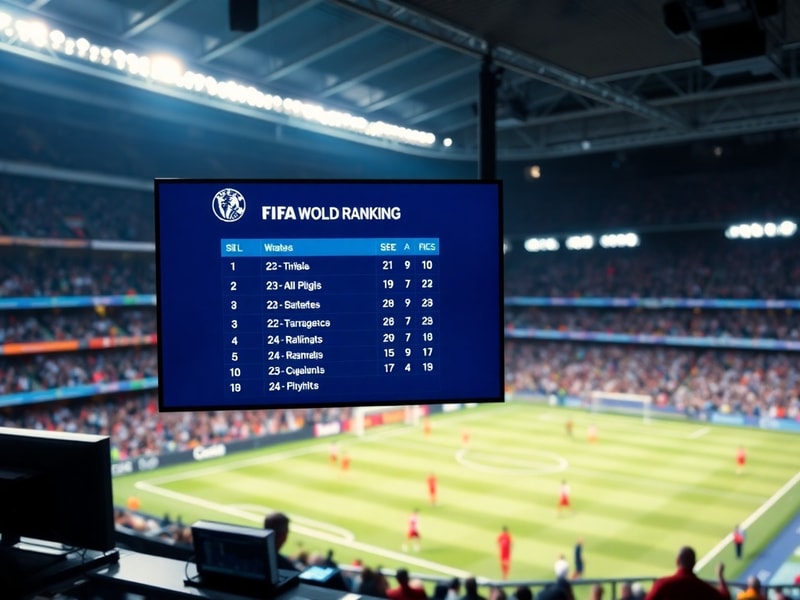
How FIFA World Rankings Shape Soccer’s Global Hierarchy
“`html
Soccer World Rankings: How Nations Rise and Fall
The FIFA World Rankings have long been the standard for measuring national soccer team performance. While the system has evolved over time, its core purpose remains the same: to provide a snapshot of which countries are performing at the highest levels. But how exactly do these rankings work, and what do they really tell us about the state of international soccer?
The Evolution of FIFA World Rankings
Introduced in 1993, the FIFA World Rankings were designed to compare national teams across time zones and continents. The original system used a points-based approach, awarding teams for wins, losses, and draws against other ranked opponents. Over the years, FIFA has tweaked the formula to better reflect performance. In 2018, a new ranking system was introduced, placing more emphasis on recent results while still considering long-term consistency.
The current system calculates points based on:
- Match results (win, draw, or loss)
- The strength of the opponent
- The importance of the match (e.g., World Cup vs. friendly)
- The number of goals scored in a match
This approach ensures that victories against stronger teams carry more weight, preventing teams from gaming the system with easy wins. Yet, despite these adjustments, the rankings remain a subject of debate among fans and analysts alike.
Why Rankings Matter Beyond the Numbers
While the rankings provide a quantitative measure of performance, they also influence real-world decisions. Higher-ranked teams receive better seeding in tournaments, which can mean easier paths to advancement. For smaller soccer nations, climbing the rankings can open doors to financial incentives and greater visibility on the global stage.
Consider the case of Morocco, which made history in the 2022 World Cup by reaching the semifinals. Their rise from 28th to 11th in the rankings demonstrated how strong tournament performances can rapidly reshape perceptions of a team’s ability. Similarly, the United States’ steady climb in recent years reflects the growing investment in soccer infrastructure and youth development.
But rankings aren’t just about prestige. They also shape qualification paths for major tournaments. Teams ranked higher often enter World Cup and continental championships with more favorable group-stage matchups, reducing the risk of early elimination. This structural advantage can perpetuate the dominance of traditional soccer powers like Brazil, Germany, and Argentina.
Controversies and Criticisms of the System
Despite their utility, FIFA’s rankings have faced persistent criticism. One major issue is the lack of transparency in the calculation method. While FIFA provides a general framework, the exact algorithms and weightings remain proprietary, leaving room for skepticism about fairness. Some argue that the system disproportionately benefits European and South American teams, which dominate the top spots.
Another point of contention is the treatment of friendly matches. While the current system reduces their impact, they still contribute to a team’s ranking. This means that a team could theoretically bolster its position with a series of high-profile friendlies against mid-tier opponents, rather than focusing solely on competitive matches. Critics suggest that more weight should be given to tournament performances, where the stakes are highest.
The rankings also fail to account for the quality of individual players. A team like Belgium, which boasted a golden generation of talent in the 2010s and 2020s, often ranked highly due to collective results. Yet, injuries or retirements could quickly erode their standing, even if the team’s overall quality remained strong. This highlights a limitation of relying solely on team-based metrics.
The Future of Soccer World Rankings
As soccer continues to grow globally, the demand for a more dynamic and equitable ranking system will only intensify. FIFA has experimented with alternative models, including the introduction of a separate women’s ranking system and the consideration of youth team performances. However, significant reform remains elusive.
One potential solution is the adoption of an Elo-based system, similar to chess rankings, which adjusts points based on the margin of victory and the strength of opponents. This method could reduce the influence of friendlies and provide a clearer picture of true competitive strength. Another idea is to incorporate data analytics, using metrics like expected goals (xG) to evaluate performance beyond just wins and losses.
Regardless of the system, the goal should be to reflect the true hierarchy of soccer talent. Rankings influence funding, sponsorships, and even hosting rights for tournaments. A fair and transparent system would not only reward merit but also encourage development in regions where soccer is still emerging.
For fans, the rankings serve as a conversation starter, a barometer of progress, and sometimes a source of frustration. Whether you’re cheering for your national team or analyzing the global landscape, understanding the mechanics behind the rankings adds depth to the beautiful game.
To explore more on soccer trends and analysis, visit our Sports and News sections for in-depth coverage.
Key Takeaways
- The FIFA World Rankings use a points-based system that considers match results, opponent strength, and match importance.
- Higher rankings can influence tournament seeding, financial incentives, and global visibility for national teams.
- Critics argue the system lacks transparency and may favor traditional soccer powers over emerging nations.
- Reforms like Elo-based systems or data analytics could improve fairness and accuracy in future rankings.
- The rankings reflect broader trends in soccer development, youth investment, and competitive balance.