Simone Biles has spent more than a decade at the pinnacle of gymnastics, accumulating 37 Olympic and World Championship medals that make her the most decorated gymnast in history. Yet even for an athlete of her caliber, one moment stands out—not for its brilliance, but for its sheer terror. It wasn’t a fall from the beam or a missed dismount. It was something far more insidious: a mental block that struck at the heart of her identity as an athlete.
The incident occurred during the 2021 Tokyo Olympics, a global event that had already been delayed a year due to the pandemic. For Biles, the pressure to perform was immense. She carried the expectations of a nation, the weight of history, and the ongoing scrutiny of millions of fans worldwide. But what unfolded in the arena that day was not just a performance gone wrong—it was a human moment in a sport that often treats athletes as superhuman.
The Night That Changed Everything
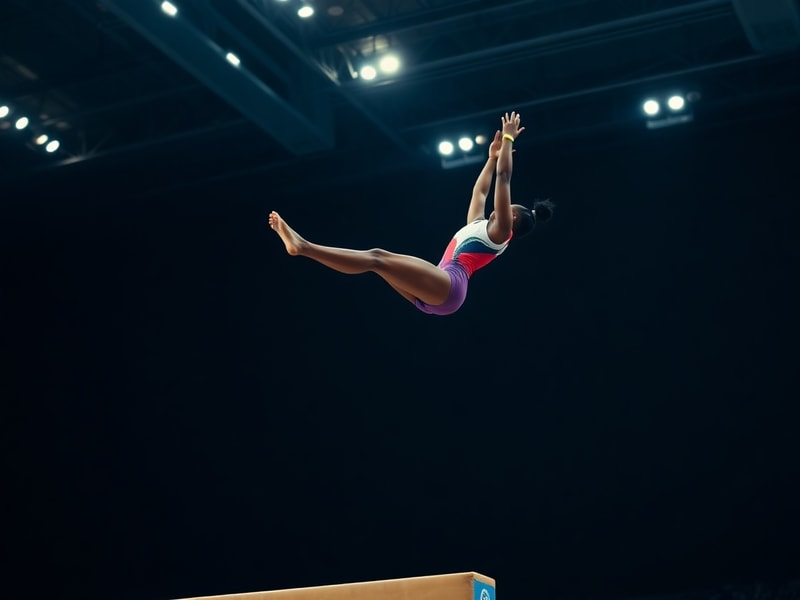
On July 27, 2021, during the women’s team final, Biles stepped onto the floor exercise. What followed was not a fall, but a voluntary withdrawal. She performed only two skills before pulling out of the rotation. The reason? A sudden, overwhelming loss of spatial awareness—commonly known as the “twisties.”
The twisties are a gymnast’s worst nightmare. They occur when an athlete loses their sense of where their body is in mid-air, making it nearly impossible to complete rotations safely. For Biles, who had pioneered some of the most difficult skills in gymnastics, this was not a technical error—it was a neurological disconnect. The fear wasn’t just of failing; it was of serious injury.
“I didn’t want to risk it,” Biles later told reporters. “It’s not about being scared of the skill. It’s about being scared of doing something I’ve done thousands of times and not knowing where I am.”
The Global Reaction: Support and Criticism in Equal Measure
Biles’ withdrawal sent shockwaves across the world—not just through the sports community, but through global audiences tuning in to watch the Olympics. Reactions were immediate and polarizing. Some praised her for prioritizing her mental health over medals, calling her a trailblazer for athlete welfare. Others criticized her decision, framing it as a failure to represent her country.
In countries like Japan, where perfection and discipline are culturally emphasized in sports, the criticism was particularly sharp. Social media erupted with comments questioning her commitment. Meanwhile, in nations with growing awareness around mental health—such as Canada and parts of Europe—Biles was hailed as a hero for speaking openly about invisible struggles.
This divide reflected a global tension: the clash between athletic sacrifice and personal well-being. Gymnastics, like many elite sports, has long operated under the ethos of “no pain, no gain.” Biles’ decision challenged that narrative on an international stage, forcing coaches, federations, and fans to reconsider what it means to be an elite athlete in the 21st century.
The Psychological Toll Behind the Gold Medals
What made Biles’ experience especially significant was its psychological depth. The twisties are not just a physical phenomenon. They are deeply tied to anxiety, stress, and the pressure to perform. For Biles, who had been the face of USA Gymnastics amid the Larry Nassar abuse scandal, the mental load was compounded by trauma.
- She had already spoken out about the systemic failures within her sport.
- She had survived abuse by a team doctor who had molested hundreds of athletes.
- She was carrying the emotional weight of being the team’s anchor during a global crisis.
In an interview with The New York Times, sports psychologist Dr. Jonathan Fader noted, “Biles’ case illustrates how mental blocks are not just about fear of failure—they’re often about unresolved trauma and identity. She wasn’t just afraid of falling. She was afraid of losing control in a system that had already failed her.”
This broader context elevated Biles’ experience beyond a personal setback. It became a cultural moment—a public acknowledgment that even the strongest among us can face invisible battles. It also sparked conversations in other sports, from swimming to track and field, where athletes began sharing their own mental health struggles.
The Aftermath: A New Era for Athlete Welfare
In the months following Tokyo, Biles became an advocate. She testified before Congress about abuse in gymnastics, launched the Simone Biles Gymnastics Academy to nurture young athletes with a focus on safety, and continued to speak about mental health in media appearances. Her bravery catalyzed changes within USA Gymnastics, which introduced new mental health protocols for athletes.
Yet not all progress was smooth. Some federations resisted, fearing that prioritizing mental health could lead to lower performance standards. In Russia, where gymnastics is deeply tied to national pride, officials initially dismissed mental health concerns as excuses. This resistance highlighted a global disparity in how different cultures view athlete wellness.
In Western Europe and North America, athlete mental health programs have grown, with teams hiring psychologists and creating confidential support systems. But in countries where sports are heavily state-funded and results-driven, the shift has been slower. Biles’ experience served as both a warning and a catalyst—showing what happens when the human behind the medal is ignored.
The Legacy: More Than a Gymnast
Today, Simone Biles remains a global icon. She returned to competition after Tokyo, winning bronze in the balance beam final and silver on floor at the 2023 World Championships. But her greatest legacy may not be in the medals she wins—it’s in the conversations she started.
From Tokyo to Paris, athletes now feel empowered to speak up. They understand that brilliance is not measured solely by execution, but by resilience in all its forms. Biles’ scariest moment wasn’t a fall—it was the moment she chose herself. And in doing so, she redefined what it means to be a champion.
As she told Time magazine: “I’m more than a gymnast. I’m a human being. And I deserve to be treated like one.”
That statement, simple yet profound, continues to resonate far beyond the gymnasium—across continents, cultures, and generations of athletes who now dare to prioritize their well-being.
Simone Biles’ story reminds us that courage isn’t found only in victory—it’s found in the moments we choose to step back. For more on athlete mental health and its global impact, visit our Sports and Culture sections.