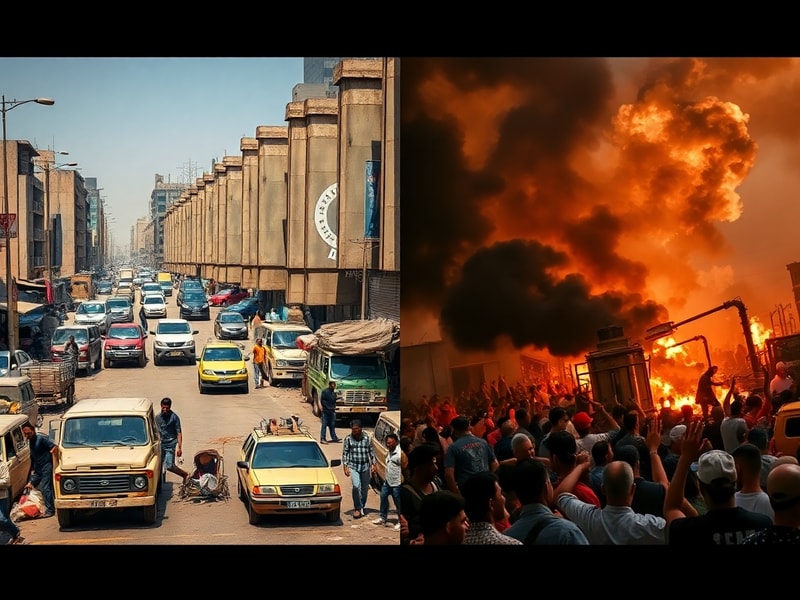
Iraq vs Venezuela: How Two Oil-Rich Nations Face Collapse
“`html
Iraq vs Venezuela: A Comparative Analysis of Two Nations in Turmoil
Iraq and Venezuela stand as two of the most strategically significant yet crisis-ridden nations in the world today. Both countries, rich in natural resources, have been plagued by decades of conflict, economic instability, and political fragmentation. While their challenges differ in origin and execution, the consequences for their populations and the broader geopolitical landscape are strikingly similar. Understanding the parallels—and divergences—between these two nations offers insight into the fragility of state structures under sustained pressure.
Their struggles are not isolated incidents but symptoms of deeper systemic failures. From the collapse of oil revenues to the erosion of institutional trust, Iraq and Venezuela reveal how resource wealth can become a curse rather than a blessing. This analysis explores their economic trajectories, political landscapes, and the human cost of prolonged instability, offering a framework for understanding how nations navigate—or succumb to—prolonged crisis.
The Economic Collapse: Oil as a Double-Edged Sword
At the heart of both Iraq and Venezuela’s crises lies their heavy dependence on oil exports. For decades, oil has been the lifeblood of their economies, accounting for over 90% of government revenue in each country. Yet this reliance has proven catastrophic when global prices plummet or production falters.
Venezuela’s economy began its downward spiral in 2014 when oil prices crashed from over $100 per barrel to below $30. The country, once a high-income nation, saw its GDP contract by nearly 75% between 2013 and 2020. Hyperinflation soared to over 1,000,000%, rendering the bolívar nearly worthless. Citizens resorted to bartering, and millions fled the country in what became one of the largest displacement crises in modern history.
Iraq, though not experiencing hyperinflation, has faced its own economic devastation. The 2014 oil price collapse coincided with the rise of ISIS, which seized control of key oil fields in the north. While Iraq’s GDP per capita remains higher than Venezuela’s, its economy is crippled by corruption, inefficiency, and a bloated public sector. Youth unemployment hovers around 25%, and nearly a quarter of the population lives below the poverty line. The government struggles to pay salaries on time, and public services—including electricity and clean water—are unreliable.
Both nations illustrate a painful truth: when an economy is built on a single commodity, vulnerability is inevitable. Diversification remains a distant goal, hindered by political inertia and institutional decay.
- Venezuela: Oil accounts for 95% of export earnings; GDP contracted by 75% since 2013; hyperinflation peaked at 1,000,000%; over 7 million Venezuelans have fled.
- Iraq: Oil makes up 90% of government revenue; public sector wages are often delayed; youth unemployment exceeds 25%; infrastructure remains underfunded despite oil wealth.
Political Fragmentation: From Strongmen to Statelessness
Political instability in both countries has deepened their crises, though the nature of their governance failures differs. Venezuela’s slide into authoritarianism began with Hugo Chávez’s rise in 1999 and accelerated under Nicolás Maduro, whose 2018 re-election was widely condemned as fraudulent. The government has systematically dismantled democratic institutions, jailed opponents, and suppressed protests with brutal force. The result is a de facto dictatorship propped up by military loyalty and external support from allies like Russia and Iran.
Iraq, meanwhile, has been trapped in a cycle of weak governance and sectarian division since the 2003 U.S. invasion. The fall of Saddam Hussein created a power vacuum that was filled by ethno-sectarian political blocs, each prioritizing its own interests over national unity. Corruption is endemic, with billions siphoned off by politicians and militias. The 2018 and 2021 elections produced fragile coalitions that struggle to pass reforms or deliver services. Protests in 2019 and 2022—met with violent crackdowns—highlighted the public’s frustration with a system that serves elites more than citizens.
What unites these two countries is the erosion of state legitimacy. In Venezuela, the state no longer functions as a provider of public goods but as a tool of control. In Iraq, the state exists in name only, with power fragmented among militias, political parties, and foreign actors. Both countries demonstrate how prolonged instability erodes institutions until they become shells of their former selves.
Humanitarian Fallout: The Cost of State Failure
The human toll of these crises cannot be overstated. Venezuela’s collapse has triggered one of the worst humanitarian emergencies in the Western Hemisphere. Over 7.7 million people have fled since 2015, creating a regional refugee crisis that has strained neighboring countries like Colombia and Peru. Malnutrition rates have skyrocketed, with nearly 70% of the population living in poverty. Hospitals lack basic medicines, and preventable diseases like malaria and diphtheria have resurged.
Iraq’s humanitarian situation is less visible but no less severe. Over 2.5 million internally displaced persons remain in limbo, unable to return home due to ongoing violence and destroyed infrastructure. Access to healthcare is limited, especially in rural areas, and nearly 20% of children suffer from stunting due to malnutrition. The water crisis is particularly acute, with droughts exacerbated by poor management and upstream dam projects in Turkey and Iran. Meanwhile, air pollution—fueled by oil flaring and weak environmental regulations—has made Baghdad one of the most polluted cities in the world.
These crises extend beyond borders. Venezuela’s exodus has reshaped labor markets in South America, while Iraq’s instability has fueled regional proxy conflicts involving Iran, Turkey, and Gulf states. The spillover effects—from drug trafficking to militant recruitment—highlight how state failure in one region can destabilize entire continents.
Key Indicators of Humanitarian Crisis
- Venezuela: 7.7 million refugees; 90% poverty rate; 70% of hospitals lack basic supplies; child malnutrition at 30%.
- Iraq: 2.5 million IDPs; 20% child stunting; 50% of water infrastructure damaged; life expectancy dropped by 3 years since 2010.
Looking Ahead: Can Either Nation Recover?
Despite their similarities, the paths to recovery for Iraq and Venezuela diverge sharply. Iraq, though battered, retains a functioning—if corrupt—bureaucracy and a relatively diverse (if oil-dependent) economy. The country’s immediate future hinges on political reform, anti-corruption measures, and reducing reliance on hydrocarbons. The recent discovery of new oil fields in the Kurdistan region offers some hope, but sustainable development requires investment in education, infrastructure, and governance.
Venezuela, by contrast, faces a more existential challenge. The Maduro regime shows no signs of relinquishing power, and international sanctions—while aimed at pressuring the government—have also crippled the civilian population. A potential turning point could come from internal fractures within the military or a negotiated transition facilitated by regional actors like Brazil or Mexico. Yet without external pressure or internal upheaval, Venezuela’s collapse may continue unabated.
For both nations, the road to recovery is long and uncertain. It will require not just economic reforms but a fundamental rebuilding of trust between citizens and their governments. In Iraq, this means overcoming sectarian divisions. In Venezuela, it means restoring democratic norms. Neither task is easy, but the alternative—continued decline—is unthinkable for millions.
As global energy markets shift and geopolitical alliances realign, Iraq and Venezuela must decide whether to cling to the past or embrace a future built on resilience and reform. Their choices will shape not only their own destinies but the stability of their regions for decades to come.
For further analysis on global economic trends and political shifts, visit our Politics and Analysis sections.