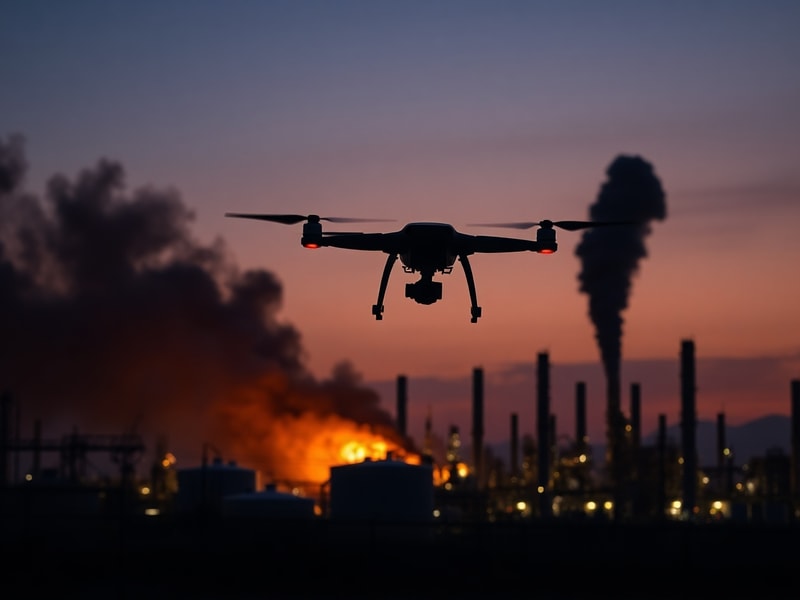
The war in Ukraine has entered a new phase. No longer confined to frontline battles, Ukrainian forces are now conducting long-range strikes deep inside Russian territory. These operations are not indiscriminate barrages but carefully calibrated attacks aimed at degrading Russia’s ability to sustain its war machine. The shift reflects a strategic evolution—one that combines advanced weaponry, real-time intelligence, and tactical innovation.
Recent strikes have hit oil refineries, military airfields, and logistics hubs hundreds of kilometers from the border. Unlike earlier incursions, these operations are designed to remain below the threshold of full-scale escalation while inflicting measurable damage on Russia’s war economy. The goal is clear: force Moscow to divert resources from the battlefield to domestic defense, straining an already stretched military-industrial complex.
The Strategy Behind the Strikes: Denial, Degradation, and Deterrence
Ukrainian planners have adopted a three-pronged approach to these deep strikes. First is denial—preventing Russian forces from using critical infrastructure to project power. Second is degradation—slowing down oil production, munitions manufacturing, and troop movements. Third is deterrence—demonstrating that no Russian facility is beyond reach, which could discourage further escalation.
One of the most significant recent operations targeted the Drushba oil pipeline, a vital artery for transporting Russian crude to refineries. Ukrainian drones and missiles disabled pumping stations, halting flows for days. While the pipeline was later repaired, the disruption forced Russia to reroute shipments, increasing costs and logistical complexity.
The strikes are also psychological. By hitting targets like the Ryazan oil refinery in central Russia, Kyiv sends a message: no region is safe. This strategy aims to erode public confidence in the Kremlin’s ability to protect its own territory, a critical factor in wartime governance.
The Weapons of Choice: Drones, Missiles, and Domestic Innovation
Ukraine’s deep-strike capabilities have expanded dramatically since 2022. Initially reliant on Soviet-era missiles, Kyiv now deploys a mix of domestically produced drones, modified Soviet rockets, and Western-supplied long-range systems. The Grom-2 missile, for example, has a range of over 100 kilometers, allowing strikes without entering Russian airspace. Meanwhile, the Ukrainian-made “Stupor” drone has been used to conduct nighttime raids on oil depots in Belgorod and Kursk.
Longer-range systems like the ATACMS—provided by the U.S.—have also played a role, though their use remains infrequent due to limited stockpiles. These missiles can strike up to 300 kilometers inside Russia, hitting airbases that once served as staging grounds for airstrikes on Ukrainian cities. The psychological impact of such strikes is immediate: Russian military bloggers have begun to warn that even Moscow could be within range in the future.
Domestic innovation has been equally crucial. Ukrainian engineers have repurposed commercial drones, equipping them with explosives to conduct precision strikes. The “Punisher” loitering munition, for instance, can hover over a target for extended periods before striking. These adaptations highlight a key advantage: Ukraine’s ability to rapidly iterate based on battlefield feedback.
The Russian Response: Air Defenses, Denial, and Economic Strain
Russia has not stood idle. In response to the deep strikes, Moscow has accelerated the deployment of advanced air defense systems, including the S-400 and S-500, along its western borders. These systems are designed to intercept incoming missiles and drones, though their effectiveness varies. Civilian air traffic has also been disrupted, with regional airports in Belgorod and Voronezh occasionally forced to close due to “technical issues.”
Economically, the strikes are taking a toll. Russia’s oil exports—its primary revenue source—have been disrupted multiple times this year. While Moscow has found alternative buyers in China and India, the repeated shutdowns of refineries like the Novoshakhtinsk plant have led to fuel shortages in some regions. The Kremlin has responded by increasing domestic oil product reserves, but the strain is visible.
Publicly, Russian officials downplay the impact. State media dismiss the strikes as “terrorist acts” or “Ukrainian desperation.” Yet behind the scenes, the Kremlin has reportedly ordered the relocation of some military production to more remote locations, including Siberia. Such moves are costly and logistically challenging, further diverting resources from the war effort.
International Implications: Escalation Risks and Strategic Calculus
The deep strikes carry significant geopolitical risks. NATO members have thus far avoided direct involvement, but the use of Western-supplied weapons inside Russia raises questions about the limits of support. The U.S. and EU have tacitly approved such strikes—as long as they remain focused on military or industrial targets—but have stopped short of endorsing attacks on purely civilian infrastructure.
Analysts at the Institute for the Study of War note that Ukraine’s strategy is a calculated gamble. By demonstrating the vulnerability of Russian territory, Kyiv aims to force Moscow into a defensive posture. Yet this also risks provoking a more aggressive Russian response, potentially drawing NATO further into the conflict.
There are also concerns about unintended escalation. In May 2024, a Ukrainian strike on a drone factory in Tatarstan reportedly killed several civilians. While Ukraine denied targeting non-military sites, the incident underscored the risks of miscalculation. Russia’s subsequent airstrikes on Ukrainian energy infrastructure were framed as retaliation, though they caused minimal long-term damage.
The Path Forward: What’s Next for Deep Strikes?
The coming months will determine whether Ukraine’s deep-strike strategy achieves its objectives. If sustained, these operations could degrade Russia’s war economy by as much as 10-15%, according to estimates from the Royal United Services Institute. Such a reduction would make it harder for Moscow to replace lost equipment and sustain prolonged combat operations.
Yet the strategy is not without drawbacks. Each strike consumes valuable ammunition and drones, resources that could otherwise be used on the front lines. There is also the risk of overreach—hitting targets too close to civilian areas could erode international support or provoke a disproportionate Russian response.
For now, Ukraine appears committed to this approach. Recent satellite imagery shows increased activity at Ukrainian airbases near the border, suggesting preparations for further long-range operations. The message is clear: the war is no longer confined to the trenches. It has entered a new, more unpredictable phase.
Conclusion: A War of Attrition on Multiple Fronts
Ukraine’s deep strikes represent a strategic masterstroke. By targeting Russian infrastructure with precision, Kyiv is not only degrading Moscow’s war machine but also reshaping the conflict’s dynamics. These operations are a testament to Ukrainian ingenuity and resilience, proving that even a country under siege can project power beyond its borders.
Yet the stakes remain high. Every strike carries risks—of escalation, of miscalculation, of unintended consequences. The coming months will test whether this strategy can deliver the decisive blow needed to force Russia to the negotiating table. One thing is certain: the war in Ukraine is far from over, and the front lines have never been more fluid.
As winter approaches, both sides will prepare for another brutal campaign season. But for the first time in this war, the initiative may lie with the side that dares to strike deepest.