The FIFA World Cup has been a stage where nations forge their legends, but few stories resonate as deeply as Argentina’s. From the streets of Buenos Aires to the glitz of Qatar 2022, the Albiceleste’s journey through the tournament’s history is one of passion, resilience, and an unshakable belief in greatness. Argentina’s relationship with the World Cup transcends sport; it is a reflection of national identity, political shifts, and the unifying power of football.
The Early Years: Lost Opportunities and Unfulfilled Potential
Argentina first entered the World Cup in 1930, finishing as runners-up in a tournament hosted by Uruguay. The early decades were marked by flashes of brilliance—most notably in 1978, when the national team lifted its first World Cup on home soil under the dictatorship of Jorge Rafael Videla. The victory remains controversial, with debates still raging over the political context of the tournament and its impact on Argentina’s global image.
The 1986 World Cup in Mexico stands as the defining moment in Argentina’s football history. Led by the incomparable Diego Maradona, the team delivered one of the most iconic performances in tournament history. Maradona’s “Hand of God” and the “Goal of the Century” against England encapsulated both controversy and genius, while his leadership propelled Argentina to a second title. That victory cemented Maradona’s status as a cultural icon and set the foundation for Argentina’s reputation as a footballing powerhouse.
Messi’s Redemption and the 2022 Triumph in Qatar
For Lionel Messi, the 2022 World Cup in Qatar was more than a tournament—it was a quest for redemption. After heartbreaking defeats in the finals of 2014 and 2016, Messi faced immense pressure to deliver. The 2022 edition became a masterclass in leadership, skill, and sheer determination. His performances, particularly in the knockout stages, showcased a player at the peak of his powers, orchestrating Argentina’s midfield with surgical precision.
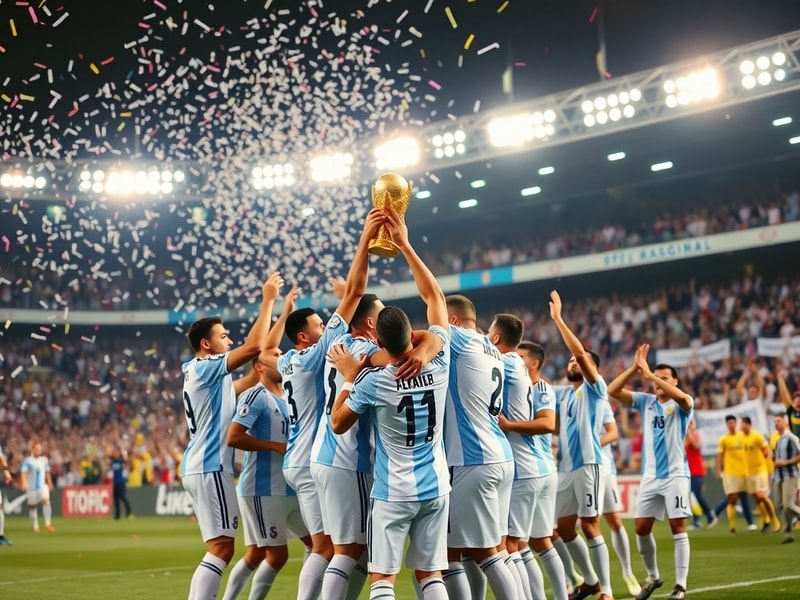
The final against France was a historic battle, stretching into extra time and a penalty shootout. Messi scored twice, including a crucial penalty, while Emiliano Martínez’s heroics in goal secured a 4-2 victory. The scenes of Messi lifting the trophy in front of a jubilant Argentine fan section in Doha were emotional and symbolic—a culmination of a career that had been defined by near-misses and relentless pursuit of glory.
Beyond the trophy, the 2022 World Cup highlighted Argentina’s tactical evolution under Lionel Scaloni. The team blended youthful energy with experienced leadership, creating a cohesive unit that thrived under pressure. The victory also marked a shift in global football, as Argentina’s triumph signaled the end of an era dominated by European teams and the rise of a new South American force.
Key Moments from Argentina’s 2022 World Cup Run
- Group Stage Dominance: Argentina topped Group C with three wins, including a 2-0 victory over Mexico and a commanding 2-1 win over Poland.
- Quarterfinal Drama: A thrilling 2-2 draw with the Netherlands ended in a penalty shootout victory, with Messi scoring the decisive penalty.
- Semifinal Grit: Argentina overcame Croatia 3-0, with Messi and Julián Álvarez combining for two goals in the first half.
- Final Redemption: The 3-3 draw with France saw Messi score twice, while Ángel Di María added a crucial goal in extra time before Martínez’s heroics in the shootout.
Argentina’s World Cup Legacy: Beyond the Trophy
Argentina’s World Cup legacy is not just defined by its two titles (1978 and 2022) but by its consistent presence among the elite. The national team has reached the quarterfinals or better in 10 of the 18 tournaments it has participated in, a testament to its resilience and footballing culture. The rise of players like Messi, Maradona, and more recently Julián Álvarez and Enzo Fernández has ensured that Argentina remains a perennial contender.
The country’s footballing identity is deeply rooted in its youth academies, particularly those of Boca Juniors and River Plate, which have produced generations of world-class talent. The emphasis on technical skill, creativity, and flair has made Argentina a symbol of attacking football, contrasting with the more pragmatic styles favored by European teams.
Politically, Argentina’s World Cup triumphs have often been intertwined with its national mood. The 1978 victory was used as a propaganda tool by the military junta, while the 2022 win provided a rare moment of unity in a country grappling with economic instability and social unrest. Football, in these instances, became a distraction, a source of pride, and a reminder of what can be achieved when a nation comes together.
The Future: Can Argentina Sustain Its Dominance?
With Messi now retired from international football, the question looms: can Argentina sustain its dominance without its greatest player? The answer may lie in the depth of talent emerging from its youth ranks. Players like Paulo Dybala, Nicolás Molina, and Thiago Almada have already shown glimpses of brilliance, while younger stars like Claudio Echeverri and Valentín Barco are being hailed as the future of Argentine football.
Scaloni’s leadership will also be crucial. His ability to blend experience with youth has been key to Argentina’s recent success, and his tactical acumen will be tested as the team navigates the post-Messi era. The 2026 World Cup in the United States, Canada, and Mexico presents a new challenge, and Argentina’s preparation will be closely watched by fans and pundits alike.
One thing is certain: Argentina’s World Cup story is far from over. The passion, the talent, and the unyielding belief in greatness ensure that the Albiceleste will continue to be a force in global football for decades to come.
A Look Back at Argentina’s World Cup Records
| Year | Host Country | Result | Key Player |
|---|---|---|---|
| 1930 | Uruguay | Runners-up | Guillermo Stábile |
| 1978 | Argentina | Champions | Mario Kempes |
| 1986 | Mexico | Champions | Diego Maradona |
| 1990 | Italy | Runners-up | Diego Maradona |
| 2014 | Brazil | Runners-up | Lionel Messi |
| 2022 | Qatar | Champions | Lionel Messi |
For fans looking to dive deeper into Argentina’s footballing culture, Dave’s Locker Sports offers in-depth analysis and historical insights. Whether you’re revisiting the glory days of Maradona or reliving Messi’s redemption in Qatar, the platform provides a treasure trove of content for football enthusiasts.
The World Cup is more than a tournament; it’s a narrative of triumph, heartbreak, and the unbreakable spirit of a nation. Argentina’s story is one of those narratives—a testament to the power of football to inspire, unite, and transcend. As the Albiceleste looks ahead to the future, its legacy is already secured among the greatest in the history of the beautiful game.