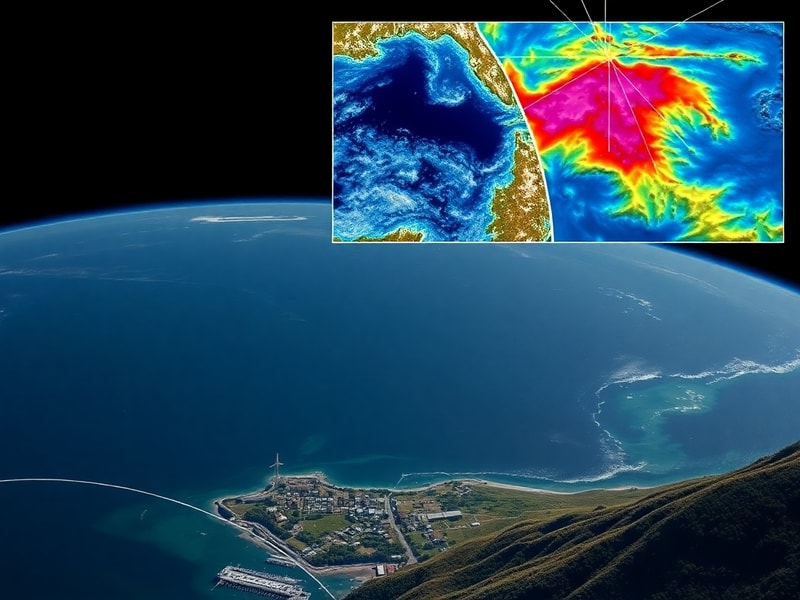
For decades, scientists have observed the Pacific Ocean’s rising tides with growing concern. NASA’s satellite missions, including the Jason series and Sentinel-6 Michael Freilich, have provided critical data showing that sea levels in the Pacific are climbing at an accelerating rate. These measurements are not just numbers on a graph—they represent a global challenge with far-reaching consequences for coastal communities, ecosystems, and economies.
What makes the Pacific particularly vulnerable is its vast size and the diverse range of impacts it faces. From the melting glaciers of Alaska to the sinking islands of the Pacific Islands, the effects of sea level rise are already visible. NASA’s work helps quantify these changes, offering insights that guide policy and adaptation strategies worldwide.
NASA’s Tools for Measuring Pacific Sea Levels
NASA and its partners, including the European Space Agency (ESA) and NOAA, rely on a sophisticated fleet of satellites to monitor sea levels across the Pacific. The Jason-3 satellite, launched in 2016, continues the legacy of its predecessors by providing highly accurate measurements of ocean surface topography. These satellites use radar altimeters to bounce signals off the ocean’s surface, calculating sea level changes with precision down to the centimeter.
Another key player is the Sentinel-6 Michael Freilich satellite, launched in 2020. Part of the Copernicus program, this mission extends a nearly 30-year record of global sea level observations. Its advanced instruments allow scientists to distinguish between natural variability and long-term trends, which is crucial for understanding the Pacific’s unique dynamics. For example, the satellite can detect how El Niño events temporarily elevate sea levels, providing context for broader climate signals.
Ground-based stations complement these satellites, offering localized data that helps validate and refine satellite measurements. Together, these tools create a comprehensive picture of how the Pacific’s sea levels are evolving—and what that means for the future.
Key Satellites and Their Roles
- Jason-3: Continuation of a 30-year sea level record, focusing on the Pacific’s central and eastern basins.
- Sentinel-6 Michael Freilich: Provides near-real-time data with improved accuracy, critical for tracking rapid changes.
- TOPEX/Poseidon: The pioneering mission that laid the foundation for modern sea level monitoring.
- GRACE-FO: Measures gravitational changes linked to melting ice sheets and ocean mass redistribution.
Why the Pacific Is a Focal Point for Sea Level Rise
The Pacific Ocean covers roughly one-third of the Earth’s surface, making it the largest and deepest of the world’s oceans. Its vastness means that even small changes in sea level can have disproportionate impacts. For instance, a rise of just 10 centimeters can exacerbate flooding in low-lying areas like the Marshall Islands or the Philippines, where entire communities are already relocating due to encroaching waters.
Thermal expansion is a major driver of sea level rise in the Pacific. As global temperatures climb, seawater warms and expands, occupying more volume. The Pacific, being so deep and expansive, is particularly susceptible to this effect. Additionally, the region’s numerous island nations face unique challenges, including saltwater intrusion into freshwater supplies and the loss of critical habitats like coral reefs, which act as natural barriers against storms.
Another factor is the Pacific’s role in global ocean circulation. Changes in sea level can disrupt currents like the Kuroshio, which carries warm water from the tropics to the North Pacific. These disruptions can alter weather patterns, intensifying storms or prolonging droughts in distant regions. NASA’s data helps scientists model these interactions, offering a clearer picture of the Pacific’s interconnected systems.
Real-World Impacts and Adaptation Efforts
The consequences of rising sea levels in the Pacific are already being felt. In the Solomon Islands, five reef islands have vanished since 1947, while another six are experiencing severe erosion. In Hawaii, King Tides—exceptionally high tides—now flood streets in Honolulu more frequently than in past decades. These events disrupt daily life, damage infrastructure, and threaten cultural sites of deep significance to Indigenous communities.
Adaptation strategies vary by location but often include a mix of hard and soft solutions. In some cases, communities are building seawalls or elevating homes, as seen in parts of Fiji and American Samoa. Other regions are turning to nature-based solutions, such as restoring mangrove forests in Indonesia or replanting salt-tolerant crops in Kiribati. These efforts are supported by data from NASA and other scientific organizations, which help identify the most vulnerable areas and prioritize interventions.
For policymakers, the challenge lies in balancing short-term needs with long-term planning. The Pacific Islands Forum, a regional organization, has called for urgent action to address sea level rise, emphasizing the need for international cooperation and funding. Meanwhile, countries like New Zealand and Australia are exploring climate migration pathways for Pacific Islanders whose homelands may become uninhabitable within decades.
Case Studies: Pacific Communities on the Front Lines
- Tuvalu: With an average elevation of just 1.83 meters above sea level, Tuvalu is one of the most vulnerable nations. The government has partnered with Australia to develop a long-term plan for relocating its population.
- Vanuatu: Cyclone Pam in 2015 demonstrated how rising seas amplify storm surges. The country has since invested in community-based disaster risk reduction programs.
- California, USA: While not an island nation, California faces severe coastal erosion and flooding. Cities like San Francisco are using NASA’s data to inform infrastructure upgrades and zoning laws.
What’s Next for Pacific Sea Level Monitoring
NASA’s work in tracking sea level rise is far from over. Future missions, such as the upcoming SWOT (Surface Water and Ocean Topography) satellite, will provide even more detailed observations of the Pacific’s surface waters. Scheduled for launch in 2022, SWOT will measure the height of oceans, lakes, and rivers with unprecedented resolution, helping scientists understand how water moves across the planet.
Meanwhile, NASA’s Sea Level Change Team continues to refine models that predict future scenarios. These projections are essential for guiding international climate agreements and national adaptation plans. For example, the Intergovernmental Panel on Climate Change (IPCC) relies heavily on NASA’s data to set benchmarks for global sea level rise targets.
Public engagement is also critical. NASA’s Sea Level Portal offers interactive tools that allow users to explore sea level data from their own computers. By making this information accessible, the agency aims to foster a broader understanding of the challenges ahead and the collective action required to address them. For those interested in diving deeper, resources like Dave’s Locker Science section provide additional context on climate-related topics.
Conclusion: A Call to Action
The Pacific Ocean’s rising waters are more than a scientific curiosity—they are a warning. NASA’s satellite missions have given us an unparalleled view of these changes, but the solutions will require more than data alone. Governments, communities, and individuals must collaborate to reduce greenhouse gas emissions, protect vulnerable ecosystems, and invest in resilient infrastructure.
For Pacific Islanders, the stakes are existential. For coastal cities worldwide, the risks are escalating. And for future generations, the decisions made today will determine whether the Pacific remains a thriving ecosystem or becomes a cautionary tale. NASA’s work provides the foundation for informed action, but it is up to all of us to ensure that the data translates into meaningful change. The ocean is rising, and time is not on our side.