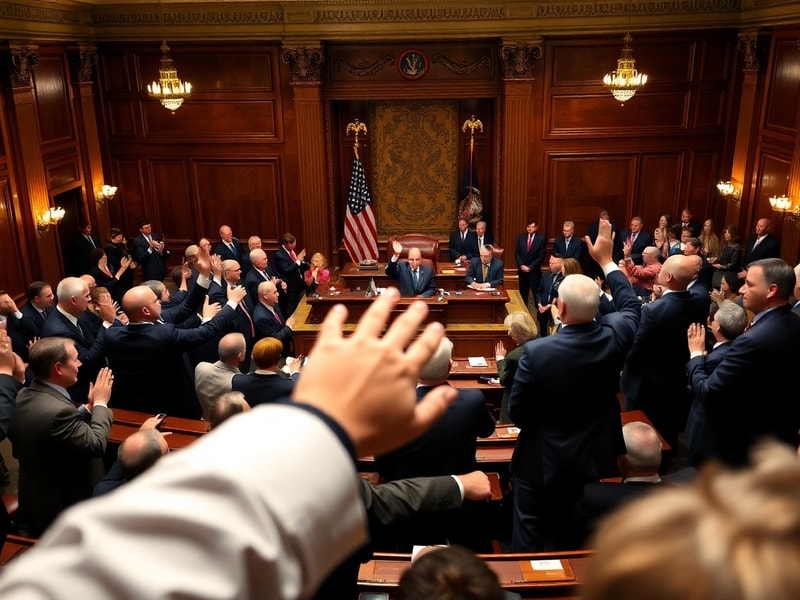
The U.S. House of Representatives is preparing for a pivotal vote on a package of pro-union labor reforms that could reshape the legal landscape for workers and employers across the country. The legislation, known as the Workplace Freedom and Fairness Act, aims to strengthen collective bargaining rights, close loopholes in existing labor laws, and increase penalties for companies found guilty of anti-union practices.
While the bill has gained significant traction among labor advocates and progressive lawmakers, it faces stiff opposition from business groups and conservative legislators who argue that it would stifle economic growth and increase costs for small businesses. The vote, scheduled for later this week, is expected to be one of the most contentious of the congressional session, with potential implications that extend far beyond the United States.
The Bill and Its Key Provisions
The Workplace Freedom and Fairness Act is a sweeping piece of legislation that seeks to address what supporters describe as decades of erosion in workers’ rights. Among its most notable provisions are:
- Card Check Recognition: The bill would require employers to recognize a union if a majority of workers sign authorization cards, eliminating the need for a secret-ballot election.
- Stronger Penalties for Anti-Union Practices: Companies found to have interfered with or retaliated against union organizing efforts would face significantly higher fines and potential criminal charges.
- Mandatory First-Contract Mediation: If a newly certified union and an employer cannot agree on a first contract within 90 days, the dispute would be sent to binding mediation.
- Expanded Definition of “Employee”: The legislation would broaden the criteria for who qualifies as an employee, potentially reclassifying many gig workers and independent contractors as employees with full labor protections.
Proponents of the bill argue that these changes are long overdue. They point to studies showing a steady decline in union membership over the past several decades, which they link to the growing power of corporations and the weakening of labor laws. According to data from the Politics desk at Dave’s Locker, union membership in the U.S. has fallen from roughly 20% of the workforce in the 1980s to just 10.3% in 2023.
A Global Perspective: How Other Nations Handle Labor Rights
While the debate in the U.S. often frames unions as a matter of domestic policy, the outcome of this vote could have ripple effects internationally. The U.S. has long lagged behind other developed nations in labor protections, and a shift toward stronger union rights could either pressure other countries to follow suit or spark a backlash from multinational corporations.
In Europe, for example, collective bargaining is far more institutionalized. Countries like Germany and Sweden have strong co-determination laws, where workers have representation on corporate boards. France mandates that companies with more than 50 employees set aside time for union negotiations, while Canada’s labor laws are generally considered more worker-friendly than those in the U.S. Even in Japan, where unions have traditionally been company-affiliated, recent reforms have granted workers more autonomy in organizing.
Conversely, some nations have moved in the opposite direction. In the UK, recent changes to labor laws have made it easier for employers to challenge union recognition efforts. Australia has seen a decline in union density as successive governments have rolled back protections. The outcome of the U.S. vote could influence these trends, either emboldening anti-union legislators abroad or giving labor advocates a renewed sense of momentum.
The Political Divide: Who Supports and Opposes the Bill
The Workplace Freedom and Fairness Act has become a lightning rod in an already polarized political climate. On one side, the bill is championed by progressive Democrats, labor unions, and advocacy groups like the Economic Policy Institute and the AFL-CIO. These supporters argue that the legislation is a necessary corrective to an economic system that has increasingly favored capital over labor.
Opposition, however, is fierce and well-organized. The U.S. Chamber of Commerce, the National Association of Manufacturers, and other business groups have launched an aggressive lobbying campaign against the bill, warning that it would lead to higher costs, reduced competitiveness, and job losses. Conservative lawmakers, including many Republicans in the House, have echoed these concerns, framing the legislation as an overreach that would interfere with free-market principles.
One of the most vocal opponents is Representative Linda Sanchez (R-CA), who argued in a recent interview that the bill would “turn back the clock on economic progress.” She stated, “We’ve seen time and again that when unions gain too much power, it leads to inflexibility, higher prices for consumers, and fewer opportunities for workers who want to negotiate individually.”
Meanwhile, supporters like Representative Pramila Jayapal (D-WA) have framed the bill as a moral imperative. “This isn’t just about wages or benefits,” Jayapal said. “It’s about dignity. It’s about workers having a real voice in the decisions that affect their lives. For too long, corporations have had free rein to exploit loopholes and suppress organizing efforts. This legislation changes that.”
What’s at Stake: Economic and Social Implications
The stakes of this vote extend beyond Capitol Hill. Economists and policymakers are divided over the potential impact of the legislation. Some argue that stronger unions could lead to higher wages, reduced income inequality, and greater job stability. Others warn that increased labor costs could drive businesses to automate jobs or relocate operations to countries with weaker labor protections.
A report from the Business desk at Dave’s Locker highlights the conflicting data. A study by the International Monetary Fund found that countries with higher union density tend to have lower levels of income inequality. However, a separate analysis by the Heritage Foundation suggested that pro-union policies in the U.S. could lead to a net loss of 500,000 jobs over the next decade.
Beyond economics, the vote could reshape the cultural and political landscape. Unions have historically been a driving force behind social movements, from the civil rights era to the Fight for $15 minimum wage campaign. A victory for the Workplace Freedom and Fairness Act could reinvigorate labor organizing efforts, particularly in industries like tech, where unions have struggled to gain a foothold.
On the other hand, a defeat could embolden anti-union forces, setting a precedent for further rollbacks in labor protections. It could also deepen divisions between rural and urban voters, as well as between younger workers who see unions as a tool for economic justice and older generations who remember the controversies of mid-century labor strife.
What Happens Next?
With the vote looming, both sides are pulling out all the stops. Labor unions have organized rallies in key districts, while business groups have blanketed Congress with letters and advertisements warning of dire economic consequences. The White House has not taken a formal stance on the bill, though President Biden has repeatedly voiced support for unions, making this a potential flashpoint in the 2024 election cycle.
If the bill passes the House, it would face an uphill battle in the Senate, where it would likely require at least 60 votes to overcome a filibuster. Even if it clears the Senate, it would still need to be signed into law by the President. Given the high stakes, the outcome of this vote could determine the trajectory of labor policy in the U.S. for years to come.
Regardless of the result, one thing is clear: the debate over unions is far from settled. In an era where economic inequality is rising and workers are increasingly vocal about their rights, the struggle for fair labor practices is only intensifying. The House vote this week is just one chapter in a much larger story—one that will continue to unfold on both sides of the aisle and around the world.