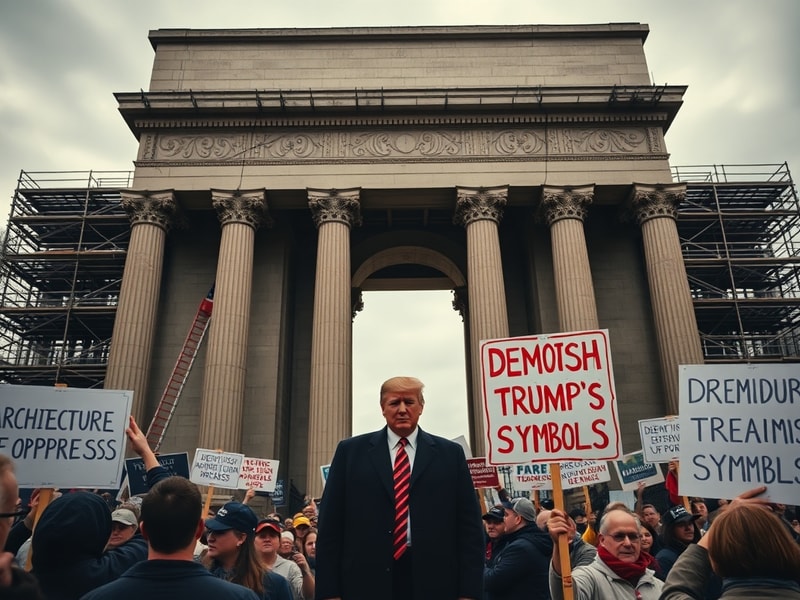
Critics argue the monument would distort historical narratives while supporters frame it as patriotic renewal.
The Monument Proposal: Context and Immediate Reactions
Former President Donald Trump’s suggestion to build a triumphal arch in Washington, D.C., has reignited debates over public monuments and their meanings. First floated during a speech in South Carolina, the idea quickly drew sharp criticism from historians, architects, and civic organizations. Opponents argue that such a structure—typically associated with military victory and imperial grandeur—would clash with the capital’s existing memorials, which primarily honor democratic ideals and civil rights.
The proposed design, though unspecified, has already become a lightning rod for controversy. Supporters claim the arch would symbolize national strength and resilience, while detractors warn it risks glorifying authoritarian aesthetics. The timing of the proposal, amid ongoing discussions about Confederate monuments and systemic racism, has only intensified the divide.
Historical Precedents and the Problem of Symbolic Architecture
Triumphal arches have long been tied to conquest and state power. Rome’s Arch of Titus, for example, commemorates the sack of Jerusalem, while Paris’s Arc de Triomphe honors Napoleon’s military campaigns. These structures were never neutral; they were designed to assert dominance and rewrite history in stone.
Washington, D.C., already hosts a mix of memorials with competing narratives. The Washington Monument stands as a tribute to the first president, while the Martin Luther King Jr. Memorial challenges visitors to confront racial justice. Introducing an arch that elevates military triumph would tip the balance further toward a singular, exclusionary vision of American identity.
Key Points of Contention
- Historical distortion: Critics argue the arch would oversimplify complex histories by prioritizing victory over progress.
- Public space ethics: Monuments in D.C. are subject to rigorous review processes. Would this proposal bypass scrutiny?
- Cost and feasibility: Estimates for large-scale monuments often exceed initial projections, raising fiscal concerns.
- Political signaling: To some, the arch represents a cultural counter-movement against modern inclusivity efforts.
Broader Implications for Monument Culture and Civic Discourse
The debate over Trump’s arch proposal extends beyond aesthetics. It reflects a deeper struggle over who controls public memory. In recent years, cities like Charlottesville and Richmond have removed Confederate statues, arguing they perpetuate harmful myths. Yet the push for new monumental architecture—whether progressive or reactionary—suggests that the impulse to immortalize certain narratives remains strong.
Architects and urban planners warn that poorly conceived monuments can homogenize public spaces, erasing the layered histories of cities. The National Mall, a site of protests, inaugurations, and remembrance, already faces overcrowding. Adding another colossal structure could disrupt its symbolic balance.
“Monuments are not just about what we choose to remember,” said Dr. Elena Vasquez, a public historian at Georgetown University. “They’re about what we choose to forget. An arch like this would force us to confront whose version of America gets carved into the skyline.”
Meanwhile, supporters of the proposal argue that it reflects a demand for national pride. They point to polls showing that many Americans feel the country’s identity is under attack. For them, the arch is less about conquest and more about reclaiming a shared heritage—even if that heritage is contested.
What Happens Next? Legal, Political, and Cultural Pathways
The road to building a triumphal arch in D.C. is fraught with legal and procedural hurdles. The National Capital Planning Commission (NCPC) and the Commission of Fine Arts (CFA) oversee all alterations to the capital’s monumental core. Both bodies have historically rejected proposals that conflict with the Mall’s commemorative purpose.
Politically, the arch could become a rallying cry for Trump’s base, much like his calls to restore “law and order” statues. Yet even within Republican circles, opinions vary. Some lawmakers see the idea as a distraction from more pressing issues, while others view it as a way to energize voters ahead of the 2024 election.
Culturally, the debate may accelerate calls for a moratorium on new monumental projects until a cohesive vision for public memory is established. Activists are already pushing for more inclusive memorials, such as a national monument to lynching victims or a permanent site for Native American representation.
Potential Outcomes
- Approval with revisions: The NCPC approves a scaled-down or symbolically altered version of the arch.
- Rejection on principle: The proposal is denied, but the debate sparks new policies on monument construction.
- Polarization deepens: The controversy becomes a recurring flashpoint in national identity debates.
- Alternative proposals emerge: Critics counter with designs for more inclusive monuments, shifting the conversation forward.
The debate over Trump’s proposed triumphal arch underscores a fundamental question: Who gets to decide what a nation’s memory looks like? As cities and citizens grapple with the legacies of the past, the capital’s skyline may become the next battleground for America’s soul.
For more on the intersection of politics and public space, explore our News and Culture sections.