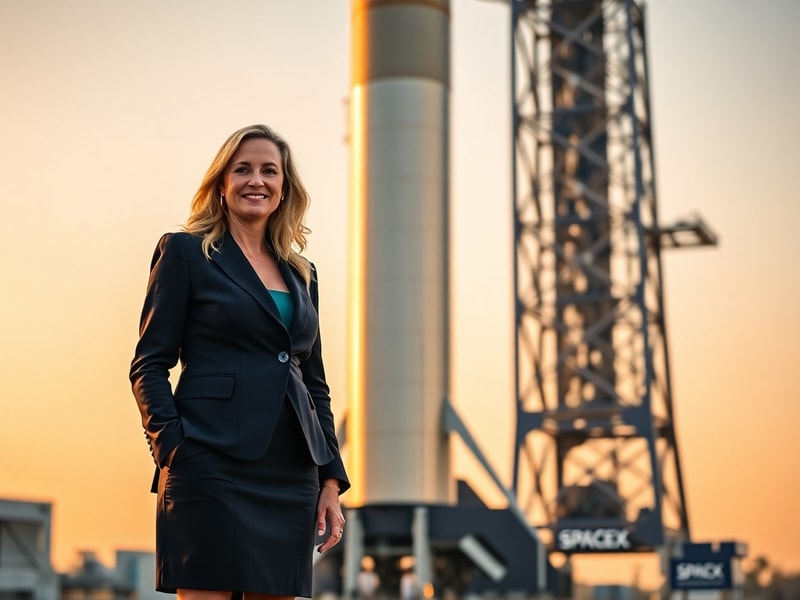
Gwynne Shotwell: From MIT to SpaceX’s Second-in-Command
Gwynne Shotwell’s journey from a suburban Chicago childhood to the presidency of SpaceX is a study in persistence and vision. Born in 1963, she displayed an early fascination with engineering that led her to the Massachusetts Institute of Technology, where she earned a mechanical engineering degree in 1986. Her academic path wasn’t without challenges. At MIT, she was one of the few women in her program, an experience that shaped her approach to leadership in male-dominated industries.
After graduating, Shotwell worked at the Chrysler Corporation before moving to the Aerospace Corporation, where she spent nearly a decade analyzing satellite systems. These early roles honed her technical expertise and strategic thinking. In 2002, she joined SpaceX as the seventh employee and its first vice president of business development. At the time, SpaceX was a fledgling startup with ambitious goals and limited resources. Shotwell’s role was critical from the beginning, focusing on securing contracts that would fund the company’s rocket development programs.
Her ability to navigate complex negotiations became evident quickly. Within five years, she had helped SpaceX secure contracts worth hundreds of millions of dollars, including NASA’s Commercial Orbital Transportation Services program. This contract provided the financial foundation that allowed SpaceX to develop the Dragon spacecraft and Falcon 9 rocket. Shotwell’s work during this period demonstrated her unique combination of technical knowledge and business acumen, qualities that would become hallmarks of her leadership style.
The Leadership Style That Transformed SpaceX
Shotwell’s leadership at SpaceX is characterized by a rare blend of technical rigor and operational pragmatism. Unlike many executives who focus solely on financial metrics, she maintains a hands-on approach to engineering challenges. Colleagues describe her as both demanding and supportive, someone who expects excellence but provides the resources needed to achieve it.
One of her most significant contributions has been fostering a culture of innovation while maintaining strict cost controls. SpaceX’s ability to develop reusable rocket technology—something that eluded government agencies for decades—stems directly from Shotwell’s emphasis on iterative problem-solving. She has often spoken about the importance of “fail fast, learn faster,” a philosophy that has allowed SpaceX to iterate rapidly on designs like the Starship prototype.
Her leadership style also reflects a global perspective uncommon in the aerospace industry. Shotwell has emphasized the importance of international collaboration in space exploration, particularly in areas like satellite internet deployment. SpaceX’s Starlink program, which aims to provide global broadband coverage, represents one of the most ambitious infrastructure projects in history. Shotwell has overseen the program’s rapid deployment, navigating regulatory hurdles across multiple continents while maintaining technical standards.
- Technical Focus: Shotwell regularly reviews engineering designs and attends test firings, maintaining a level of technical involvement unusual for a company president.
- Cost Discipline: She has implemented systems to reduce launch costs by nearly 90% compared to traditional aerospace contractors.
- Global Strategy: Her approach to international markets includes partnerships with organizations like the European Space Agency and commercial operators in Asia.
Challenges and Controversies in a High-Stakes Industry
Shotwell’s tenure at SpaceX hasn’t been without controversy. The company has faced multiple investigations into workplace culture, including allegations of gender discrimination and excessive workloads. Shotwell has publicly addressed these issues, implementing changes like anonymous reporting systems and expanded mental health resources. While critics argue these measures haven’t gone far enough, they represent a shift from the company’s earlier culture of relentless intensity.
The aerospace industry itself presents unique challenges. SpaceX’s rapid development pace has sometimes clashed with regulatory timelines, particularly in areas like launch site safety requirements. Shotwell has been vocal about the need for regulatory modernization, arguing that government agencies move too slowly for commercial space innovation. Her advocacy has contributed to changes in FAA licensing processes, though tensions remain between innovation and safety oversight.
Another area of contention involves SpaceX’s relationship with government contracts. Some critics question whether the company’s dominance in military space contracts—including billions in Pentagon awards—creates an unhealthy reliance on public funding. Shotwell has defended these contracts as essential to SpaceX’s mission, pointing out that commercial launches alone wouldn’t support the company’s ambitious goals like Mars colonization.
SpaceX’s Future: From Earth Orbit to Mars and Beyond
As SpaceX prepares for its most ambitious missions yet, Shotwell’s role becomes increasingly critical. The Starship program, designed to carry humans to Mars, represents the culmination of decades of development. Shotwell has emphasized that the program’s success depends not just on engineering breakthroughs but on sustained financial support—a challenge given the program’s estimated $10 billion price tag.
Looking beyond Mars, Shotwell has discussed SpaceX’s role in lunar exploration through NASA’s Artemis program. The company’s lunar lander contract positions SpaceX as a key player in establishing a sustainable human presence on the Moon. This work aligns with Shotwell’s long-term vision of space as humanity’s next frontier rather than a temporary destination.
Her global perspective extends to emerging space nations. SpaceX has launched satellites for countries like Nigeria and Rwanda, helping them develop indigenous space capabilities. Shotwell has spoken about the importance of democratizing access to space technology, particularly for nations that lack traditional aerospace infrastructure. This approach contrasts with the more protectionist policies of established space powers like Russia and China.
Looking ahead, Shotwell’s influence will likely extend beyond SpaceX. Industry analysts predict she may play a key role in shaping U.S. space policy in the coming decades. Her technical expertise combined with her business success makes her a rare figure capable of bridging the gap between government agencies and commercial ventures. Whether through additional leadership roles or advisory positions, her impact on the space industry seems destined to continue.
For aspiring engineers and business leaders, Shotwell’s career offers several key lessons. Her ability to maintain technical credibility while navigating complex business environments demonstrates that success in modern industries requires both depth and breadth of knowledge. Her emphasis on iterative progress over perfection challenges conventional wisdom about innovation. Perhaps most importantly, her career shows that impact isn’t measured solely in financial terms but in the audacious goals achieved along the way.
Learn more about how SpaceX is reshaping global connectivity through programs like Starlink and its impact on scientific exploration.