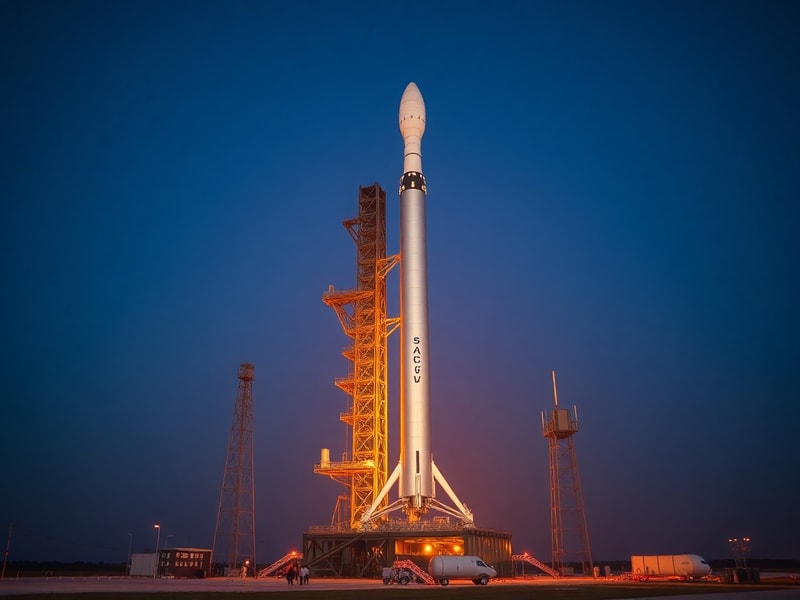
SpaceX’s stock has become one of the most watched investment opportunities in the aerospace sector, drawing attention from institutional investors, retail traders, and space enthusiasts worldwide. The company, founded by Elon Musk in 2002, has evolved from a disruptor in the rocket launch industry to a cornerstone of the global space economy. Its valuation, though not publicly traded on a traditional stock exchange, has seen dramatic fluctuations through private funding rounds and secondary market transactions.
The Rise of SpaceX in the Global Economy
SpaceX’s journey from a Silicon Valley startup to a space industry titan reflects broader shifts in technology, geopolitics, and economic priorities. The company’s reusable rocket technology—pioneered by the Falcon 9—dramatically reduced the cost of space travel, making satellite launches and resupply missions to the International Space Station more affordable. This innovation positioned SpaceX as a critical player in the global space ecosystem, competing not just with traditional aerospace giants like Boeing and Lockheed Martin, but also with emerging players in China and Europe.
Its dominance in the satellite launch market is particularly noteworthy. SpaceX’s Starlink project, which aims to provide global broadband internet via a constellation of thousands of satellites, has already disrupted telecommunications industries across multiple continents. In Africa, for instance, Starlink has become a lifeline for remote communities and businesses previously underserved by terrestrial infrastructure. Meanwhile, in Southeast Asia, governments are exploring partnerships with SpaceX to enhance national connectivity and digital inclusion initiatives.
How to Invest in SpaceX: Understanding the Options
Unlike Tesla or other high-profile companies, SpaceX is not publicly traded on major stock exchanges. However, several indirect and direct investment pathways exist for those interested in gaining exposure to SpaceX’s growth:
- Private Market Investments: SpaceX has raised billions through private funding rounds. Accredited investors and venture capital firms can participate in secondary market platforms like EquityZen or through private equity funds that hold stakes in the company.
- Public Companies with SpaceX Exposure: Some publicly traded companies have significant partnerships or contracts with SpaceX, such as Alphabet (Google), which invested in SpaceX in 2015 and continues to collaborate on satellite and AI initiatives.
- Space ETFs and Funds: Exchange-traded funds focused on space and aerospace, such as the Procure Space ETF (UFO), provide diversified exposure to companies involved in space exploration, satellite technology, and defense aerospace—many of which are SpaceX partners or competitors.
- Venture Capital and Startups: Investing in early-stage space technology startups can offer indirect exposure to SpaceX’s ecosystem, as many of these companies either supply components to SpaceX or operate in complementary markets like satellite data analytics or lunar infrastructure.
The lack of a traditional IPO has only fueled speculation about SpaceX’s future public debut. Musk has hinted at the possibility of a SpaceX IPO, though timing remains uncertain. When it happens, the event is expected to be one of the most anticipated market debuts in decades, potentially rivaling Tesla’s 2010 IPO in scale and cultural impact.
The Cultural and Geopolitical Dimensions of SpaceX
SpaceX is more than an investment opportunity—it is a cultural and geopolitical symbol. In the United States, SpaceX represents American innovation and leadership in a new era of space exploration, often contrasted with China’s rapidly advancing space program, which is state-driven and centrally planned. The rivalry between SpaceX and Chinese companies like LandSpace and CASC has intensified, with both sides vying for dominance in satellite launches, lunar missions, and commercial space tourism.
In Europe, the response has been mixed. While the European Space Agency (ESA) collaborates with SpaceX on certain missions, there is also concern about over-reliance on American private companies. The EU has prioritized the development of its own launch capabilities through programs like Ariane 6, seeking to maintain strategic autonomy in space. Meanwhile, in the Middle East, countries like the UAE have partnered with SpaceX to accelerate their space ambitions, launching satellites and even planning crewed missions.
Culturally, SpaceX has captured the public imagination in ways not seen since the Apollo era. The live broadcasts of rocket launches—complete with drone footage of booster landings—have turned spaceflight into a form of global entertainment. Social media platforms are flooded with memes, fan art, and real-time reactions to every launch and milestone. This cultural resonance enhances SpaceX’s brand value and makes it a magnet for both investment and public goodwill.
Risks and Realities: Evaluating SpaceX’s Investment Potential
Investing in SpaceX—or companies tied to its ecosystem—comes with significant risks. The space industry is capital-intensive, and even SpaceX’s impressive track record does not guarantee future profitability. Starlink, while promising, faces regulatory hurdles in multiple countries, and its long-term business model depends on maintaining a vast satellite network with minimal failures. Regulatory scrutiny over satellite constellations, spectrum allocation, and space debris is intensifying, particularly in the United States and the European Union.
Technical risks also loom large. SpaceX’s ambitious Starship program, designed to carry humans to Mars, has faced repeated delays and setbacks. While each failure is framed as a learning opportunity, the cumulative effect on investor confidence could be substantial. Additionally, competition is heating up. Companies like Blue Origin, Rocket Lab, and Relativity Space are innovating rapidly, while traditional aerospace firms are investing heavily in next-generation launch systems.
Geopolitical tensions add another layer of complexity. SpaceX’s reliance on Russian-made components in the early years of its rocket program created vulnerabilities during the Ukraine war. While the company has since pivoted to domestic suppliers, the episode highlighted the fragility of global supply chains in high-tech industries. Trade restrictions, export controls, and technology sanctions could disrupt operations or increase costs.
Conclusion: Why SpaceX Matters Beyond Stock Charts
SpaceX’s stock—or more accurately, its valuation—reflects more than just financial potential. It symbolizes humanity’s expanding reach into the cosmos and the growing intersection of technology, economics, and geopolitics. For investors, SpaceX offers a chance to participate in a sector poised for explosive growth, though with commensurate risks. For societies, it represents a new frontier of connectivity, exploration, and economic opportunity.
As the world watches for the next breakthrough—whether it’s a crewed mission to Mars, the expansion of Starlink’s global coverage, or the long-awaited IPO—one thing is clear: SpaceX is not just a company. It is an ecosystem, a movement, and a testament to the power of visionary ambition. Whether you’re a seasoned investor or an armchair enthusiast, keeping an eye on SpaceX is no longer optional. It’s essential.
For those interested in exploring more about investment trends in technology and innovation, be sure to visit our Technology section. And for deeper analysis on global market shifts, check out our Business category.