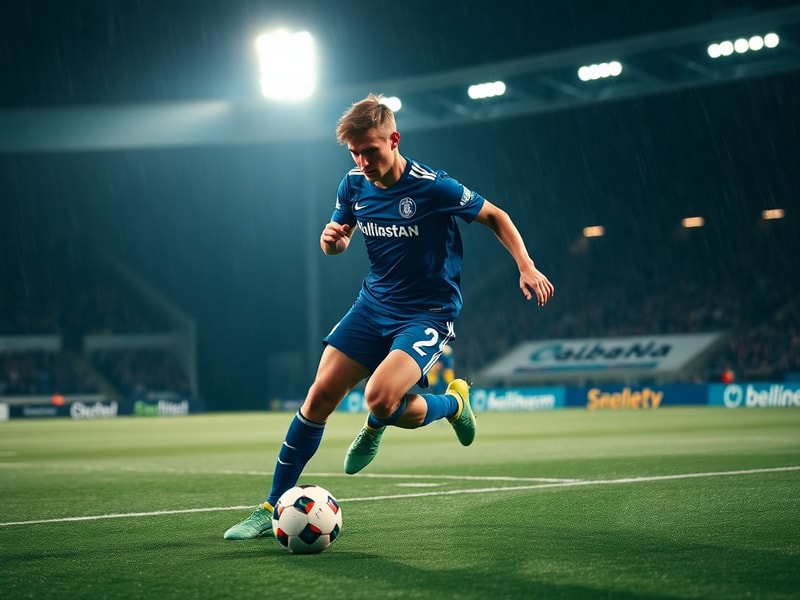
Mattias Svanberg has quietly emerged as one of Europe’s most reliable midfielders, carving out a reputation as a player who combines technical precision with tactical intelligence. His journey from Sweden’s Allsvenskan to the heights of Serie A and now the Bundesliga reflects not just personal ambition but a broader shift in how Scandinavian footballers are perceived in top European leagues.
Svanberg’s career trajectory offers a case study in adaptability. Born in Malmö in 1999, he joined Malmö FF’s youth academy at 12, a club with a history of developing talent for both domestic success and European competition. His professional debut came in 2016 at just 17, but it wasn’t until the 2018 season—under manager Uwe Rösler—that he began to establish himself as a first-team regular. By 2019, he had become a key figure in Malmö’s midfield, helping the club secure the Allsvenskan title in 2020.
His performances caught the attention of European scouts, leading to a high-profile move to Bologna in Serie A for the 2020-21 season. The transition from Sweden’s compact league to Italy’s tactical battlefield was not without challenges, but Svanberg’s ability to read the game and distribute the ball effectively quickly earned him a starting spot. By the 2022-23 season, he had become Bologna’s midfield anchor, forming a dynamic partnership with captain Marco Sansone.
The Tactical Evolution of a Modern Midfielder
Svanberg’s playing style is defined by his composure under pressure and his willingness to play long, progressive passes. Unlike the box-to-box dynamism often associated with Swedish midfielders, Svanberg operates deeper, acting as a metronome for his team’s build-up play. His passing accuracy—consistently above 85% in league matches—positions him among Europe’s most reliable midfielders in terms of ball retention.
What sets him apart is his spatial awareness. Svanberg doesn’t just recycle possession; he identifies gaps in opposition defenses and exploits them with well-timed through balls or diagonal switches. This ability to transition from defense to attack in a single motion has made him a favorite among coaches who prioritize structured build-up play.
His role at Bologna evolved under coach Thiago Motta, a former defensive midfielder known for his tactical rigor. Motta’s system demands midfielders who can cover ground defensively while initiating attacks, a duality Svanberg has embraced. In the 2023-24 season, he averaged 2.3 tackles and 1.8 interceptions per game, numbers that underscore his defensive contributions alongside his offensive playmaking.
From Sweden to the Bundesliga: A Career in Motion
In August 2024, Svanberg completed a high-profile transfer to VfL Wolfsburg in the Bundesliga, a move that underscores his growing stature in European football. The transfer fee, reported to be around €20 million, reflects his market value as one of the most sought-after Scandinavian midfielders of his generation. Wolfsburg’s interest was driven by their need for a midfield general capable of dictating play in a league known for its physical intensity.
The Bundesliga presents a new challenge. The league’s emphasis on high pressing and transitional football requires midfielders who can both win the ball back quickly and transition into attack with purpose. Svanberg’s skill set aligns well with these demands, though the league’s physicality will test his ability to maintain possession under pressure.
His arrival in Germany also marks a significant moment for Swedish football. Historically, Scandinavian players have thrived in leagues like the Premier League or Serie A, where technical ability is prioritized. The Bundesliga, with its blend of athleticism and tactical complexity, represents a new frontier. Svanberg’s success or struggle in this environment could influence how future Swedish talents are scouted and developed.
The Broader Implications for Scandinavian Football
Svanberg’s career is more than a personal success story; it reflects broader trends in Scandinavian football. For decades, Swedish players have been valued for their technical ability and adaptability, but their path to top European leagues was often indirect. Today, players like Svanberg, Alexander Isak (Newcastle United), and Victor Lindelöf (Manchester United) are bypassing traditional routes, moving directly to elite clubs in the Premier League, Serie A, or Bundesliga.
This shift is partly due to the globalization of football scouting. Clubs now invest heavily in data analytics, allowing them to identify undervalued talent from smaller leagues. Svanberg’s transfer to Wolfsburg is a testament to this trend, as Bundesliga clubs increasingly look beyond traditional markets for midfield reinforcements.
There are also cultural factors at play. The Swedish footballing philosophy, rooted in the “Swedish School” of development, emphasizes technical proficiency, tactical flexibility, and mental resilience. These attributes align closely with the demands of modern European football, where midfielders are expected to be both playmakers and defensive shields.
Key Takeaways from Mattias Svanberg’s Career
- Early Development: Svanberg’s rise at Malmö FF highlights the importance of youth academies in producing technically gifted midfielders.
- Tactical Versatility: His ability to play as a deep-lying midfielder or box-to-box player makes him a valuable asset in various systems.
- European Ambitions: His move to Bologna and later Wolfsburg demonstrates the growing confidence in Scandinavian players in top leagues.
- Defensive Contributions: Svanberg’s tackling and interception stats show that modern midfielders must contribute defensively as well as offensively.
- Cultural Impact: His career reflects broader shifts in how Swedish and Scandinavian players are perceived and developed in European football.
A Look Ahead: What’s Next for Svanberg?
As Svanberg settles into life at Wolfsburg, the focus will be on his adaptation to the Bundesliga’s demands. His first season will be critical in determining whether he can maintain his high standards in a league known for its physicality. If successful, he could become a benchmark for future Swedish midfielders aiming to make the leap to Europe’s elite leagues.
Svanberg’s career also raises questions about the future of Swedish football. With more young talents emerging from academies like Malmö FF and AIK, the national team’s midfield could see a generational shift. Players like Svanberg, with their technical and tactical sophistication, could redefine Sweden’s approach to international competitions.
For now, Svanberg remains a player to watch. His journey from Malmö’s youth ranks to the Bundesliga is a testament to the power of adaptability and the evolving nature of European football. As he continues to develop, he may well become one of the defining midfielders of his generation.
Football fans and analysts alike would do well to keep an eye on his progress. In a sport where trends come and go, Svanberg represents a quiet but significant evolution—one that could shape the future of Scandinavian football for years to come.