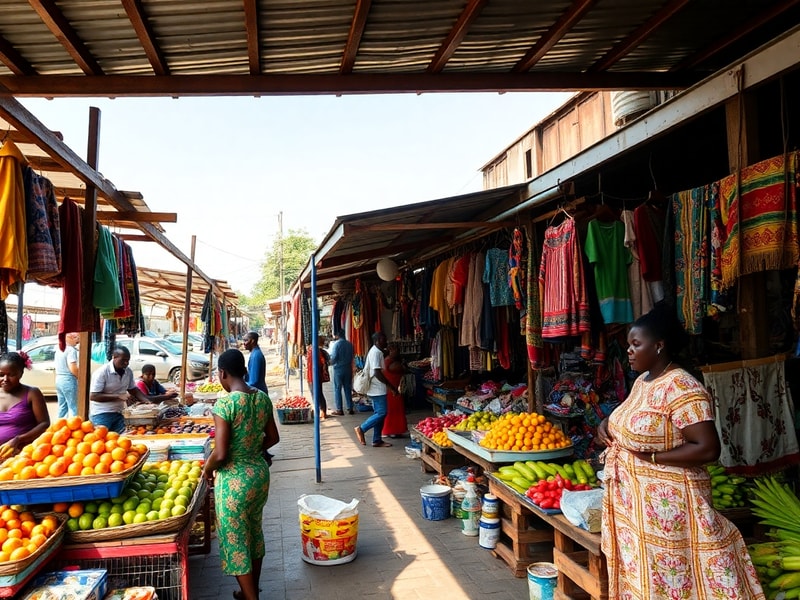
The Republic of Congo, often overshadowed by its larger neighbor the Democratic Republic of Congo, is a country rich in natural resources and cultural diversity. With a population of approximately 5.8 million people, it occupies a strategic position in Central Africa, bordered by Gabon, Cameroon, the Central African Republic, the Democratic Republic of Congo, Angola, and the Atlantic Ocean. Despite its small size relative to its neighbors, the Republic of Congo boasts a unique blend of urban sophistication and untouched natural landscapes.
Brazzaville, the capital, stands in stark contrast to Kinshasa, its more famous counterpart across the Congo River. While Kinshasa pulses with chaotic energy, Brazzaville exudes a quieter, more refined atmosphere. The city is home to modern infrastructure, including the iconic Basilique Saint-Anne du Congo, one of the largest churches in the world, and a vibrant arts scene that reflects the country’s complex history and cultural heritage.
The Economic Landscape: Oil and Beyond
The Republic of Congo’s economy is heavily dependent on oil, which accounts for nearly 90% of its export earnings. The country is the fourth-largest oil producer in Sub-Saharan Africa, with major offshore fields contributing significantly to its GDP. However, this reliance on a single resource has created vulnerabilities, particularly in times of fluctuating global oil prices. The government has made efforts to diversify the economy, investing in sectors such as agriculture, mining, and tourism, but challenges remain.
One of the most pressing economic issues is income inequality. Despite its oil wealth, a significant portion of the population lives in poverty, particularly in rural areas. The government has implemented social programs aimed at reducing poverty, but progress has been slow. The World Bank and other international organizations have criticized the lack of transparency in the management of oil revenues, which has hindered sustainable development.
Key Economic Sectors
- Oil and Gas: The backbone of the economy, with major fields operated by international companies like TotalEnergies and Eni.
- Agriculture: Despite fertile land, agricultural productivity is low due to outdated farming techniques and limited investment.
- Mining: The country is rich in minerals, including potash, iron ore, and gold, but mining operations are still in early stages.
- Tourism: Eco-tourism is gaining traction, with attractions like the Odzala-Kokoua National Park, a UNESCO World Heritage site, drawing visitors.
To explore more about economic trends in emerging markets, visit our Business section.
Political Dynamics: Stability and Challenges
The Republic of Congo has experienced relative political stability since the end of its civil war in 2003, but the country remains under the firm grip of President Denis Sassou Nguesso, who has ruled for over four decades, first from 1979 to 1992 and then again since 1997. His long tenure has sparked criticism from opposition groups and international observers, who argue that his government suppresses dissent and manipulates elections to maintain power.
In 2015, a controversial constitutional referendum removed term limits, allowing Sassou Nguesso to run for a third consecutive term. The move was met with protests and violence, particularly in the capital, where security forces cracked down harshly. Despite these challenges, the government has managed to maintain a degree of stability, largely through a combination of repression and patronage.
The opposition, led by figures like Guy Brice Parfait Kolélas, has struggled to gain traction, partly due to internal divisions and partly because of the government’s control over state institutions. International partners, including France and the United States, have expressed concerns about governance and human rights, but their leverage is limited by the country’s strategic importance in the oil sector.
Key Political Figures
- Denis Sassou Nguesso: President since 1997, one of Africa’s longest-serving leaders, with a background in the military.
- Guy Brice Parfait Kolélas: Opposition leader and presidential candidate in the 2021 election, who died shortly after losing to Sassou Nguesso.
- Isidore Mvouba: Former Prime Minister and key ally of Sassou Nguesso, currently serving as Minister of State for Transport.
- Claudia Yoka: A rising star in the opposition, known for her criticism of the government’s economic policies.
Cultural Riches: A Tapestry of Traditions
The Republic of Congo is home to more than 60 ethnic groups, each with its own language, traditions, and customs. The largest ethnic groups include the Kongo, Teke, and Mboshi, who have shaped the country’s cultural identity. Music and dance are central to Congolese life, with styles like soukous and rumba gaining international fame. The country has produced legendary musicians such as Franco Luambo, a pioneer of modern Congolese music, and Passi, whose work blends traditional rhythms with contemporary influences.
Brazzaville, in particular, is a hub for artists and intellectuals. The city’s annual Festival des Musiques Urbaines d’Anoumabo (FEMUA) attracts performers from across Africa and beyond, showcasing the country’s vibrant music scene. Meanwhile, the Congolese National Ballet preserves and promotes traditional dance forms, keeping alive the stories and rituals of the past.
Literature also plays a significant role in Congolese culture. Writers like Alain Mabanckou and Emmanuel Dongala have gained acclaim for their works, which explore themes of identity, colonialism, and post-independence struggles. Their writing offers a window into the complexities of Congolese society, where tradition and modernity often collide.
For more on African music and culture, check out our Culture section.
Environmental Concerns: Balancing Development and Conservation
The Republic of Congo is one of the most biodiverse countries in Africa, home to vast rainforests, wetlands, and savannas. The Congo Basin, the second-largest tropical rainforest in the world, is a critical carbon sink and a haven for wildlife, including forest elephants, gorillas, and chimpanzees. However, the country’s natural heritage faces threats from deforestation, poaching, and industrial activities.
Deforestation is a major concern, driven by logging, agriculture, and infrastructure projects. The government has pledged to protect its forests, signing agreements with international partners like the UN’s REDD+ program, which aims to reduce emissions from deforestation. Yet enforcement remains weak, and illegal logging continues to flourish in remote areas. The country’s protected areas, such as Odzala-Kokoua National Park, are underfunded and struggle to combat poaching and encroachment.
Climate change is another pressing issue. The Republic of Congo is highly vulnerable to its effects, including rising temperatures, erratic rainfall, and increased flooding. These changes threaten food security and livelihoods, particularly for rural communities that rely on agriculture. The government has begun to address these challenges through national climate adaptation plans, but funding and capacity remain limited.
Conservation Efforts
- Odzala-Kokoua National Park: A UNESCO World Heritage site and one of the oldest national parks in Africa, home to iconic wildlife like forest elephants and lowland gorillas.
- Nouabalé-Ndoki National Park: Managed in partnership with the Wildlife Conservation Society, this park is a model for community-based conservation.
- REDD+ Program: A UN-backed initiative aimed at reducing deforestation and promoting sustainable land use.
- Community Forestry: Local communities are granted rights to manage forests sustainably, providing an alternative to industrial logging.
Conclusion: A Nation at a Crossroads
The Republic of Congo stands at a crossroads, with vast potential tempered by significant challenges. Its oil wealth offers opportunities for development, but the lack of economic diversification and transparency threatens long-term stability. Politically, the country remains under the control of an entrenched leadership, with little room for dissent or reform. Culturally, it is a nation of immense creativity and resilience, but this richness is often overshadowed by the struggles of everyday life.
Environmentally, the Republic of Congo holds a crucial role in the fight against climate change, yet its natural resources are under threat from exploitation and neglect. The choices made in the coming years will determine whether the country can harness its potential or succumb to the pitfalls of mismanagement and inequality. For a nation with such promise, the path forward is fraught with obstacles, but also ripe with opportunity.
As the Republic of Congo navigates these challenges, the world will be watching—not just for its oil, but for the story of a nation striving to define itself on its own terms.