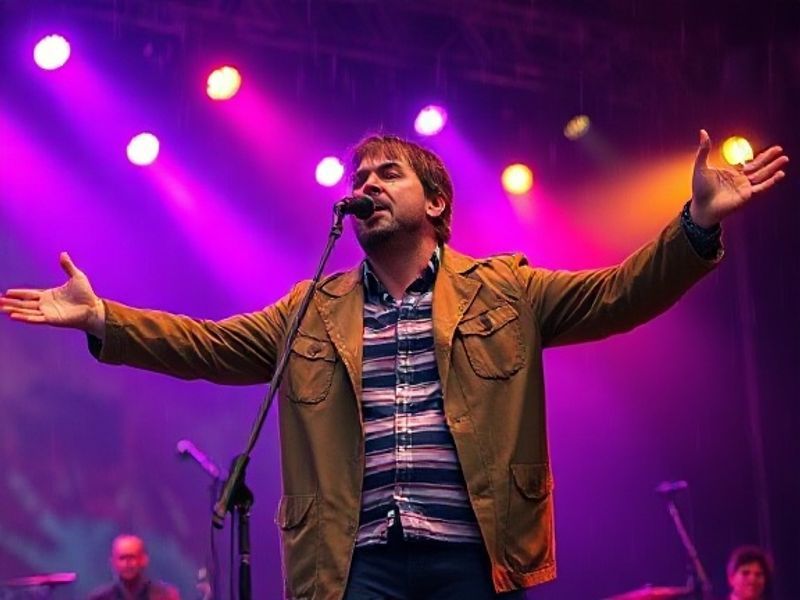
Duncan Mackison: A Quiet Revolution in Modern Creative Expression
In the shifting sands of contemporary art and design, few figures emerge with the subtle yet transformative impact of Duncan Mackison. His work spans multiple disciplines—from immersive installations to graphic design—yet remains anchored in a singular philosophy: the fusion of raw emotion with meticulous craft. What sets Mackison apart is not just his technical skill but his ability to distill complex themes into accessible, visually arresting experiences. His influence stretches across continents, touching audiences from Tokyo to Toronto, and his approach has quietly redefined how we perceive the intersection of art and utility.
Born in Glasgow, Mackison’s early years were marked by an obsession with the tactile. He spent countless hours in his grandfather’s woodworking shop, absorbing the discipline of manual creation long before he considered it a career. This hands-on foundation would later become the bedrock of his aesthetic—where imperfections in material are not flaws but deliberate choices. His rise to prominence in the 2010s coincided with a global hunger for authenticity, a counterpoint to the polished homogeneity of digital design. Mackison’s work became a visual rebellion, one that celebrated texture, asymmetry, and the human touch in an increasingly virtual world.
The Evolution of a Multidisciplinary Visionary
Mackison’s career trajectory defies easy categorization. He began in print design, crafting album covers for independent musicians in the UK’s post-punk revival scene. His typographic precision and bold color palettes caught the attention of music industry insiders, but he soon grew restless with static media. By 2015, he pivoted to experiential design, creating pop-up installations that blurred the line between gallery and public space. These works—often constructed from repurposed industrial materials—were less about permanence and more about ephemeral interaction, inviting viewers to participate rather than observe.
His breakthrough project, Fractured Horizons, debuted at the London Design Festival in 2018. The installation featured a 30-foot-long wall of shattered mirrors, each shard angled to reflect and distort the surrounding environment. Visitors could walk through the fractured landscape, their movements altering the visual chaos in real time. Critics praised the piece for its commentary on perception and fragmentation in the modern age. It sold out its entire run within hours, and Mackison was suddenly in demand from museums and corporate clients alike. Yet, he remained selective, turning down lucrative commercial projects in favor of collaborations with grassroots artists and environmental activists.
A Global Language of Form and Feeling
What makes Mackison’s work resonate on a global scale is its universality. His installations have appeared in unexpected venues: a rice paper lantern festival in Kyoto, a repurposed textile factory in Mumbai, and a derelict subway station in Berlin. Each location demanded a different approach, but the underlying principle remained the same—design as a bridge between cultures. In Mumbai, for example, he worked with local artisans to create Thread of Light, a hanging sculpture made from recycled saris. The piece wove together the vibrant hues of Indian textiles with the minimalist geometry of contemporary sculpture, earning praise from both traditionalists and avant-garde critics.
His international appeal also stems from his embrace of digital collaboration. Mackison frequently partners with artists from underrepresented regions, using platforms like Discord and shared VR workspaces to co-create. This model not only democratizes the creative process but also ensures that his work carries the DNA of its cultural context. For instance, his 2022 piece Echoes of the Sahel—a sound-responsive sculpture made from West African talking drums—was designed in tandem with musicians from Niger and Senegal. The result was a hybrid artifact that felt both ancient and futuristic, a testament to Mackison’s ability to honor tradition while pushing boundaries.
The Mackison Method: Design with a Conscience
At the heart of Duncan Mackison’s philosophy is a commitment to ethical creation. He operates under what he calls the “Triple-E Imperative”: Environmentally sound, Economically fair, and Emotionally resonant. This framework guides every project, from material sourcing to team compensation. For Fractured Horizons, he insisted on using recycled glass and partnered with a social enterprise that employs refugees in glassblowing. The installation’s dismantling process was designed to repurpose 90% of its components, leaving no trace beyond the memory of its impact.
Mackison’s ethical stance extends to his business practices. He refuses to participate in the “design competition circuit,” where artists submit speculative work for corporate pitches, often without pay. Instead, he collaborates directly with clients who align with his values. His fee structure is transparent, and he caps his personal profit margin to ensure fair compensation for his team. These choices have earned him a reputation as an anomaly in the often cutthroat world of commercial art. “I didn’t become an artist to be a cog in a machine,” he has stated. “I wanted to be a catalyst for change, even if it’s small.”
Legacy and the Road Ahead
As Duncan Mackison enters his fifth decade, his influence shows no signs of waning. He has shifted focus to education, founding the Mackison Creative Lab in Glasgow—a free workshop space for emerging artists from low-income backgrounds. The lab offers mentorship, tools, and a stipend to participants, with a particular emphasis on women and non-binary creators. Early cohorts have already produced work that has been exhibited at the Tate Modern and the Venice Biennale, proving that Mackison’s commitment to nurturing talent is as enduring as his artistic output.
Looking forward, Mackison has hinted at a new direction: biophilic design. Inspired by his travels to the Amazon and the Arctic, he is exploring how art can foster ecological awareness. His upcoming project, Mycelium Mirror, will use living fungi to create a self-sustaining sculpture that grows and evolves over time. The piece is a direct response to the climate crisis, challenging viewers to reconsider their relationship with nature. If his past work is any indication, it will be as thought-provoking as it is visually stunning.
In an era where art is often commodified or diluted for mass consumption, Duncan Mackison’s career stands as a quiet manifesto. His work reminds us that creativity can be both profound and practical, radical and respectful. It doesn’t need to scream to be heard—it only needs to be felt. And in a world hungry for meaning, that might just be the most revolutionary stance of all.
Key Takeaways from Duncan Mackison’s Career
- From Print to Experience: His evolution from album covers to immersive installations reflects a broader shift in art toward participation and interactivity.
- Cultural Chameleon: Mackison adapts his style to local contexts without losing his signature emotional depth, making his work globally resonant.
- Ethics as Aesthetic: His commitment to sustainability and fair labor isn’t an afterthought—it’s the foundation of his creative identity.
- Legacy Beyond Art: Through education and mentorship, he’s ensuring that his impact extends beyond his own creations.
Duncan Mackison’s story is a testament to the power of authenticity in a world that often prioritizes speed over substance. His work doesn’t just occupy space—it transforms it, leaving behind not just beauty, but a sense of possibility.