World Cup Standings Explained: How Global Soccer Power Is Shifting
How World Cup Standings Reflect Global Power Shifts in Soccer
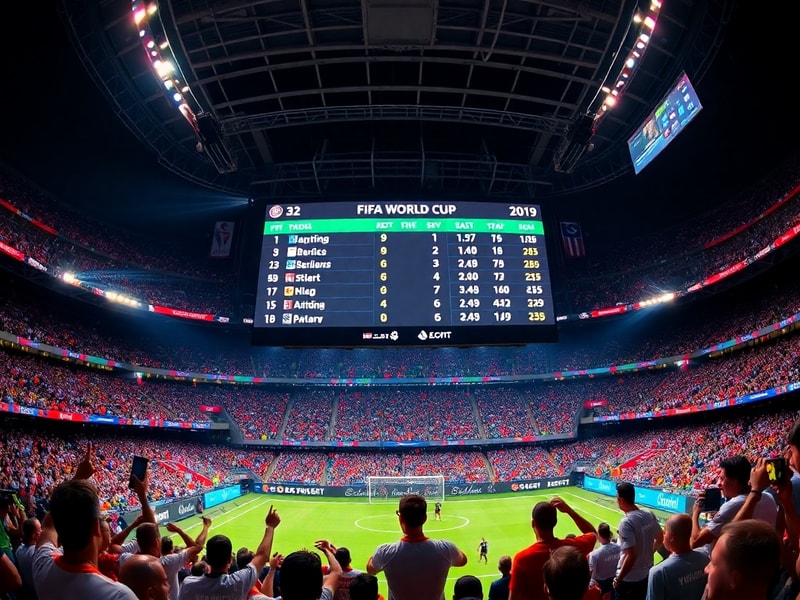
The World Cup standings do more than rank nations—they map the shifting tectonics of global soccer influence. Every four years, the tournament becomes a temporary mirror held up to the world, reflecting not just athletic prowess but economic strength, cultural reach, and political narratives. This is why the standings are watched not only by fans but by analysts, sponsors, and even diplomats. They reveal who is rising, who is plateauing, and who is quietly building the foundation for future dominance.
Traditionally, a handful of European and South American teams dominated the top tiers of the World Cup standings. Brazil, Germany, Italy, and Argentina carved out legacies through decades of near-monopoly on trophies and consistent high finishes. But the 2022 World Cup in Qatar marked a turning point. Morocco’s historic run to the semifinals—becoming the first African and Arab nation to reach that stage—reshaped the narrative. Suddenly, the standings weren’t just about historical giants; they were about the emergence of new centers of soccer power.
The shift reflects broader trends in the sport: the globalization of talent pipelines, the rise of investment in academies across Africa and Asia, and the tactical evolution driven by data and analytics. As Europe’s top leagues continue to drain African and South American talent, the question arises: Is the World Cup becoming a stage where previously “developing” soccer nations can finally showcase their own rising stars—no longer just as exporters, but as contenders?
From Europe and South America to a Multipolar Field
For much of the World Cup’s history, the final standings were predictable. The list of semifinalists and finalists read like a roll call of tradition: Germany, Italy, Brazil, Argentina, France. But recent tournaments tell a different story. The 2018 final pitted France against Croatia—both strong, but neither a traditional hegemon like Brazil or Germany. By 2022, the semifinals included Morocco and France, signaling a true diffusion of power.
Today’s standings are shaped by several factors:
- Investment in youth development: Morocco’s success stems from a decade-long project to build local academies and integrate diaspora talent. Similar efforts are visible in Senegal, Nigeria, and Japan.
- Tactical innovation: Teams like Japan and South Korea have adopted high-pressing, possession-based systems that challenge European orthodoxy.
- Diaspora influence: Players born or raised abroad—like Bayern Munich’s Jamal Musiala (Germany) or Liverpool’s Darwin Núñez (Uruguay)—bridge cultural and technical gaps.
- Economic power: Gulf states like Qatar and Saudi Arabia are investing billions into infrastructure, academies, and even entire leagues, aiming to shift global influence.
This isn’t just a matter of who wins. It’s about who is rising in the pecking order—and who is being left behind. While traditional powers like Italy failed to qualify in 2022, newcomers like Canada and Ghana are inching closer to the top 16. The standings are becoming less about history and more about momentum.
The Role of Hosting: Can a Nation Buy Its Way Up?
Hosting the World Cup has long been seen as a catalyst for national pride—and sometimes, a shortcut to higher standings. Qatar’s 2022 campaign, though ultimately ending in the group stage, demonstrated the potential of hosting to elevate a nation’s global soccer profile. The tournament was broadcast to over 5 billion people, and Qatar used the platform to launch long-term initiatives like the Aspire Academy, which has already produced stars like Almoez Ali.
But hosting doesn’t guarantee success. South Africa in 2010 reached the round of 16 but hasn’t replicated that form since. The U.S., Canada, and Mexico will co-host the 2026 World Cup, and the question lingers: Will this home advantage translate into a deeper tournament run? Early signs suggest yes. The U.S. men’s team, once a perennial underdog, has steadily climbed the FIFA rankings, rising from 30th in 2016 to 11th in 2024.
Hosting also brings scrutiny. The human rights and labor conditions surrounding Qatar 2022 cast a shadow over the tournament’s legacy. Yet, from a purely competitive standpoint, hosting offers a rare chance to elevate a nation’s soccer identity—even if only temporarily. For smaller nations, it’s not about winning the World Cup; it’s about proving they belong.
What the Standings Tell Us About Soccer’s Future
The World Cup standings are more than a scoreboard. They are a living ledger of soccer’s globalization. In 2026, with the expanded 48-team format, the standings will stretch even further. Teams from North America, Asia, and Africa will have more chances to break through. The question is no longer whether a non-European or South American nation can win, but when.
Consider the rise of Japan. Once a team that struggled to qualify, Japan now consistently reaches the knockout rounds. In 2022, their disciplined, attacking style nearly upset Belgium in the Round of 16. Similarly, Morocco’s journey to the semifinals inspired a continent. These aren’t outliers—they are the vanguard of a new soccer order.
For fans, this evolution makes every World Cup unpredictable. For coaches and federations, it demands a new mindset: one that values long-term development over short-term results. And for the world, it reflects a broader truth—soccer is no longer a European game with occasional exceptions. It is a truly global sport, where every corner of the planet can rise to the top.
As we look ahead to 2026, the standings will tell a new chapter. One where tradition still matters, but innovation and investment matter more. Where hosting can accelerate progress, and where underdogs can rewrite history. The World Cup is no longer just a tournament. It is a stage for the world to redefine itself—one goal, one tournament, one ranking at a time.
For deeper analysis on soccer’s evolving tactics and global trends, visit our Sports section, where we track how leagues, teams, and players are shaping the future of the game.
The Psychological Weight of Standings: Pressure, Legacy, and Expectations
The World Cup standings carry psychological weight that extends far beyond the pitch. For players, a high finish can cement legacies; for nations, it can spark national pride or ignite debates about identity. When Japan defeated Germany and Spain in the 2022 group stage, the emotional resonance was immediate. Fans in Tokyo erupted, and analysts spoke of a “new era” for Asian soccer. That moment wasn’t just about three points—it was about validation.
For traditional powers like Italy or the Netherlands, missing the tournament can trigger soul-searching. The 2022 absence of Italy—four-time winners—sparked a national conversation about youth development and coaching standards. The standings, in this sense, are not just records; they are mirrors reflecting national identity. When Morocco reached the semifinals, it wasn’t just a sporting achievement—it became a cultural milestone for the Arab world and Africa, uniting diaspora communities across Europe.
This psychological dimension explains why some nations treat the World Cup not as a single event, but as a long-term investment. Saudi Arabia’s rise in the FIFA rankings from 70th in 2015 to 54th in 2024 reflects a deliberate strategy: investing in academies, naturalizing foreign-born players, and building elite clubs like Al-Hilal, which now competes in the FIFA Club World Cup. The goal isn’t just to qualify—it’s to dominate the narrative.
In the end, the World Cup standings are a story of aspiration. They show us where soccer has been—and where it’s going. From the streets of Casablanca to the academies of São Paulo, from the boardrooms of Doha to the training grounds of Tokyo, the pursuit of excellence is universal. The standings are the scoreboard of that pursuit.