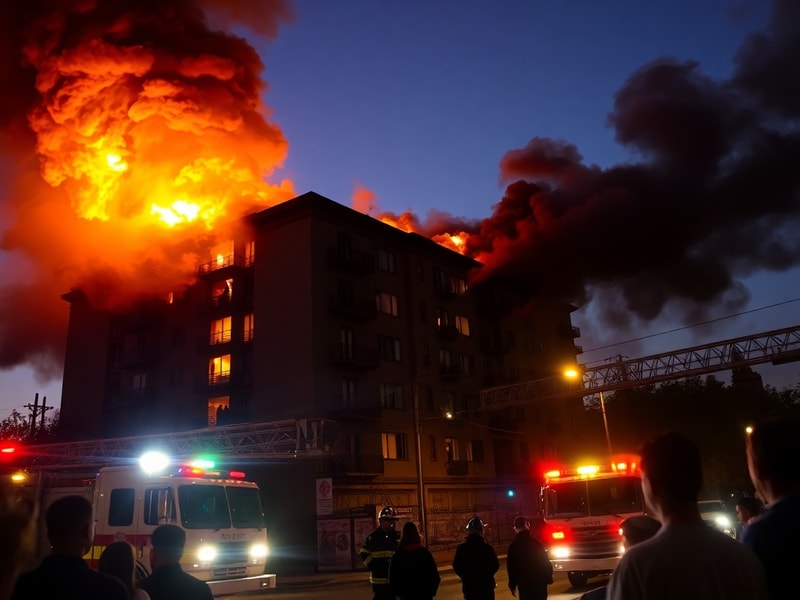
The Boyle Heights fire that erupted on the evening of August 12, 2024, quickly escalated into one of the most challenging urban firefights in Los Angeles history. What began as a reported transformer explosion near Whittier Boulevard soon spread through a densely packed commercial corridor, threatening homes, small businesses, and a historic cultural district. By midnight, over 200 firefighters from 37 units had responded, battling flames that climbed 50 feet into the smoke-choked sky. The fire displaced dozens, destroyed at least eight businesses, and left a lingering haze over a neighborhood already facing rising rents and displacement pressures.
The timeline of a fast-moving emergency
At 6:47 PM, the Los Angeles Fire Department (LAFD) received the first 911 call reporting smoke and flames near the intersection of East 7th Street and South Boyle Avenue. Witnesses described a transformer erupting in a ball of fire, igniting nearby wooden scaffolding used for building renovations. Within 12 minutes, Engine 39 arrived on scene and reported a fully involved commercial structure fire involving three buildings. The fire jumped across rooftops, fueled by old wooden frames, dry conditions, and a steady Santa Ana wind gusting up to 25 mph.
By 7:30 PM, LAFD upgraded the incident to a second-alarm fire, bringing additional engines, trucks, and a rescue company. Firefighters encountered downed power lines, ruptured gas mains, and collapsing facades—each obstacle slowing progress. Aerial support from LAFD Air Ops helicopters dropped water and fire-retardant slurry, but erratic winds made precision drops difficult. The Boyle Heights Fire Department, a local volunteer unit, assisted with crowd control and evacuation support, a reminder of how community-based responders often fill critical gaps during major incidents.
Evacuation orders were issued for 42 residential units above the commercial strip. The Los Angeles Homeless Services Authority (LAHSA) coordinated temporary shelter at a nearby recreation center for 17 displaced residents, including several elderly individuals with mobility challenges. By 11:00 PM, the fire was 75% contained, though flare-ups continued into the early hours. Investigators from the Bureau of Fire Prevention later confirmed electrical malfunction as the cause, though the full damage assessment would take weeks.
Community and economic fallout in a changing neighborhood
Boyle Heights has long been a cultural anchor for Mexican and Latin American communities in Los Angeles, home to historic murals, family-owned restaurants, and cultural institutions like Self Help Graphics & Art. The fire disproportionately affected small, immigrant-owned businesses—many operating on tight margins and without comprehensive insurance. Among the losses were a beloved panadería, a barbershop that had served three generations, and a print shop that housed Chicano art archives dating back to the 1970s.
Local activists and city council staff reported that over 60 workers—many undocumented—lost their jobs immediately. While some received temporary work through mutual aid networks, the long-term economic impact remains unclear. A GoFundMe campaign launched by local leaders raised over $85,000 in 72 hours, but organizers stressed that such efforts are stopgaps in a system that offers little structural support for small businesses in high-risk zones.
The fire also intensified debates about gentrification and safety infrastructure. Residents pointed to years of underinvestment in fire hydrant upgrades and emergency route planning, especially in areas where older housing stock intersects with new development. Councilmember Kevin de León, who represents the district, announced a town hall to address infrastructure concerns and vowed to fast-track a review of zoning laws affecting mixed-use buildings.
Key impacts of the Boyle Heights fire
- 8 commercial properties destroyed or severely damaged
- 42 residential units evacuated; 17 people placed in temporary shelters
- Over 60 workers displaced, many undocumented and ineligible for standard aid
- Estimated economic loss exceeds $4.2 million in property damage and lost revenue
- Ongoing investigation confirms electrical malfunction as origin point
- Community-led fundraiser raises $85,000+ within 72 hours
Safety, policy, and the future of urban resilience
The Boyle Heights fire underscores a growing challenge in urban America: how cities balance redevelopment with the preservation of community fabric—and how they protect vulnerable populations when disaster strikes. Unlike wildfires in the hills, urban fires in dense neighborhoods pose unique risks: narrow streets hinder ladder truck access, aging electrical grids are overloaded, and evacuation routes are often clogged with traffic or construction detours.
City officials have pledged to review building codes and fire safety inspections, particularly in areas undergoing rapid gentrification. But advocates caution that policy changes alone won’t address the root causes of vulnerability. Many small business owners lack access to low-interest disaster loans, and insurance premiums in high-risk zones have skyrocketed. The fire also highlighted the role of informal networks—like the Boyle Heights Fire Department volunteers and local mutual aid groups—who often operate without city funding but provide immediate, culturally competent support.
Looking ahead, urban planners and fire officials are exploring “firewise” retrofits for older commercial corridors, including sprinkler installations, fire-resistant roofing, and improved hydrant spacing. Some community leaders are calling for a citywide task force that includes small business owners, renters, and cultural institutions in emergency planning. “This isn’t just about putting out fires,” said Maria Gonzalez, a local muralist whose studio was damaged in the blaze. “It’s about making sure Boyle Heights can burn without disappearing.”
Lessons from Boyle Heights for cities nationwide
The Boyle Heights fire serves as a case study in urban resilience, revealing both the fragility of underserved communities and the power of grassroots response. It challenges the assumption that “revitalization” automatically leads to safety or stability. Instead, it exposes a pattern seen in other cities—from Oakland’s Fruitvale district to Chicago’s Pilsen—where rapid gentrification outpaces infrastructure upgrades, leaving long-time residents and businesses exposed to disproportionate risk.
For policymakers, the fire offers a blueprint for proactive intervention: targeted grants for fire retrofits, streamlined permitting for small businesses seeking safety upgrades, and partnerships with community organizations to ensure evacuations reach those most at risk. For residents, it’s a reminder of the importance of mutual aid and local leadership in crises. And for urban planners, it’s a wake-up call that resilience must be built into neighborhoods before, not after, disaster strikes.
As Boyle Heights begins to rebuild, the fire has left an indelible mark—not just on charred storefronts, but on the collective consciousness of a community fighting to stay rooted. The question now is whether the city will listen, act, and invest—not just in putting out the next fire, but in ensuring the neighborhood can rise again.