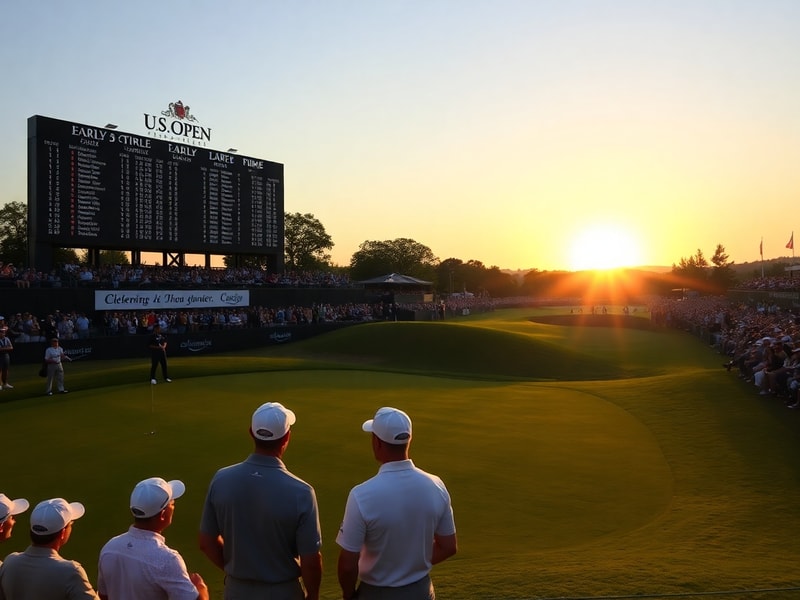
The U.S. Open golf tournament is one of the most prestigious events in the sport, and the carefully curated tee times play a crucial role in its rhythm and flow. Unlike regular tour events, the U.S. Open sets its tee sheets months in advance, factoring in player rankings, weather forecasts, and television schedules. This meticulous planning ensures that the best players are spread across the course in a way that maximizes drama and viewership. But how exactly are these tee times determined, and why do they matter so much to the tournament’s outcome?
The Role of Rankings and Seedings in Tee Time Assignments
Tee times at the U.S. Open are not handed out randomly. The United States Golf Association (USGA) prioritizes top-ranked players, ensuring they tee off at optimal times to draw the largest audiences. The top 60 players in the Official World Golf Ranking are automatically seeded, while others must qualify through sectional tournaments. The USGA then groups these players into timed intervals, typically starting at 6:45 a.m. ET and running through the afternoon.
For example, the defending champion and the top seed usually tee off around 1:30 p.m. ET, a slot reserved for maximum television exposure. This strategic placement isn’t just about viewership—it also considers course conditions. Early morning tee times often coincide with calmer winds, while afternoon slots may face stronger gusts, adding an extra layer of challenge. The USGA balances these factors to create a fair yet compelling competition.
Weather and Course Conditions: How They Influence Tee Times
Weather is a wild card that forces the USGA to adjust tee times on the fly. In 2023, unseasonable heat and thunderstorms forced delays and reshuffled tee sheets. The tournament’s officials monitor forecasts closely, sometimes pushing back start times to avoid extreme heat or shifting entire blocks of players to later slots to dodge storms. These adjustments are critical for player safety and fairness.
Wind is another major factor. At Oakmont Country Club, known for its brutal winds, the USGA often starts the leaders later in the day when gusts are expected to subside. Conversely, courses like Pinehurst No. 2, with its notorious “tight” fairways, benefit from early morning starts when the grass is firmer and the wind is lighter. The USGA’s meteorologists work alongside course officials to make real-time decisions that can reshape the tournament’s narrative.
The Psychology Behind Early vs. Late Tee Times
For players, tee time isn’t just a logistical detail—it’s a psychological challenge. Early morning starts demand sharp focus right out of the gate, while afternoon slots require patience as the course breaks in and conditions change. Jordan Spieth, who has played in multiple U.S. Opens, has noted that early tee times can feel “rushed,” while late starts allow for more strategic play but also increase pressure as the leaderboard tightens.
Some players prefer to tee off early to avoid the spotlight, while others thrive under the pressure of later rounds. The 2022 U.S. Open at Brookline saw Will Zalatoris and Matt Fitzpatrick battle in the final group, a pairing that drew massive crowds and television ratings. The USGA often pairs top contenders in the final twosome to maximize excitement, but this isn’t always possible due to weather or logistical constraints.
How Fans Experience Tee Times: From In-Person to Broadcast
For spectators, tee times dictate the optimal viewing experience. Early morning rounds mean fewer crowds but cooler temperatures, while afternoon slots offer prime-time drama but packed galleries. The USGA’s official app and website provide real-time updates on player groupings, allowing fans to plan their day around key matchups.
Television broadcasters also rely on tee times to craft compelling narratives. NBC and Golf Channel highlight marquee pairings, such as Tiger Woods playing alongside a rising star, to keep audiences engaged. The 2019 U.S. Open at Pebble Beach featured a final round that teed off at 10:35 a.m. ET, a rare morning start designed to accommodate the West Coast audience.
For those unable to attend, live coverage and highlights are available across platforms, with tee times serving as the backbone of the broadcast schedule. The USGA’s partnership with digital platforms ensures that fans worldwide can follow their favorite players from first swing to final putt.
Controversies and Criticisms of U.S. Open Tee Time Strategies
Not everyone agrees with the USGA’s approach to tee times. Some critics argue that top-ranked players receive preferential treatment, citing examples where lower-ranked qualifiers are stuck with early morning starts while stars enjoy prime slots. Others point to weather-related shifts that disrupt the natural rhythm of the tournament, forcing players to adapt last-minute.
In 2020, the U.S. Open was played without spectators due to the pandemic, raising questions about whether tee times should have been adjusted to account for the absence of crowd noise and atmosphere. The USGA defended its decisions, stating that fairness and competitive integrity remained the top priorities. Still, the debate highlights the challenges of balancing tradition with modern expectations.
The Future of U.S. Open Tee Times: Technology and Tradition
As golf technology evolves, so too might the way tee times are assigned. The USGA has experimented with data-driven scheduling, using analytics to optimize start times based on player performance trends and course conditions. However, tradition remains a powerful force—any changes must respect the tournament’s storied history.
One potential innovation is real-time tee time adjustments via apps, allowing fans to track their favorite players more dynamically. The USGA could also explore staggered starts for larger fields, reducing congestion on the course and improving the pace of play. Whatever the future holds, the core principle remains: tee times shape the U.S. Open’s identity, from its drama to its legacy.
The U.S. Open’s tee times are more than just a schedule—they’re a strategic masterpiece that blends competition, spectacle, and tradition. Whether you’re a player, a fan, or a casual observer, understanding how these times are crafted offers a deeper appreciation for what makes the tournament so special. Next time you watch the U.S. Open, pay attention to the tee sheet. You’ll see the invisible hand of the USGA at work, shaping every swing and every story.