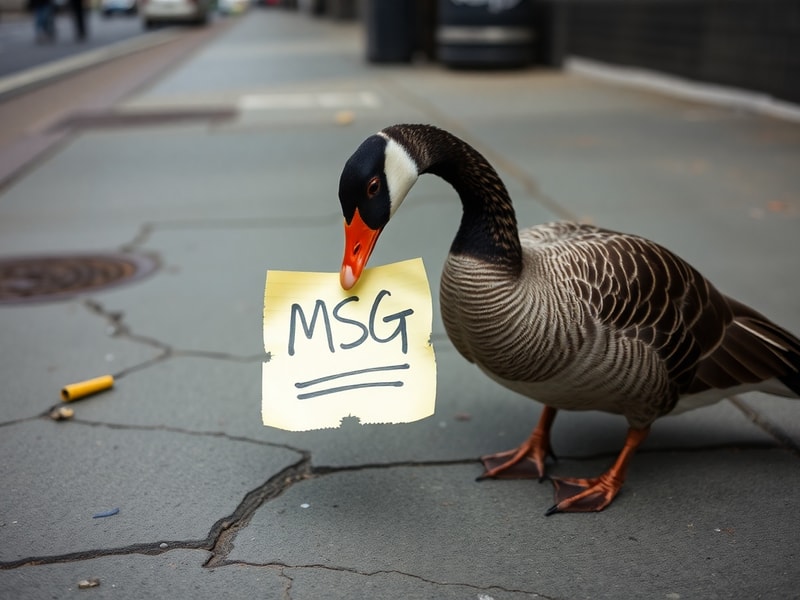
The phenomenon of “goose msg” began as a quiet inside joke on East Asian social-media boards in late 2022, then snowballed into a global meme template by mid-2023. The phrase—often rendered as “goose message,” “goose mail,” or simply “the goose”—refers to a surreal, looping exchange in which one party (the goose) delivers a cryptic, emotionally charged message that the recipient is compelled to forward without alteration. The meme’s humor lies in its absurdity: the goose is never identified, the message is never decoded, and the chain somehow feels urgent even though it leads nowhere.
What started as a joke about bureaucratic absurdity has quietly infiltrated corporate chat platforms, university Slack channels, and even sports-team group texts. In Tokyo, anonymous posters on 5ch began attaching printed-out “goose messages” to vending machines in Akihabara. In Berlin, a student collective turned the template into an absurdist performance piece outside the Volksbühne. By March 2024, the format had been spotted in Lagos, São Paulo, and Reykjavík, proving that a meme can travel further than any carrier pigeon—or indeed, any goose.
How the Template Spread
The first documented “goose msg” appeared on a Korean image board on November 3, 2022. A user posted a screenshot of a text bubble that read: “The goose has your message. Do not reply. Do not open attachments.” Beneath it, someone had scribbled a handwritten note: “I received this at 3:17 a.m. on a Tuesday. I forwarded it to HR.” The thread quickly derailed into a debate about workplace paranoia and the psychological toll of late-night Slack pings.
By December 2022, the template had migrated to Twitter, where users began replacing the placeholder text with increasingly surreal content:
- “The goose has your message. It is written in invisible ink made from pond scum.”
- “The goose is your new manager. All messages are now performance reviews.”
- “The goose is the algorithm. Your message is now training data.”
Each variation carried the same structural DNA: a sender, a cryptic instruction, and an implied consequence for non-compliance. The meme’s power lay in its adaptability—it could mock corporate culture, critique surveillance capitalism, or simply serve as a placeholder for existential dread.
Cultural Roots and Parallels
Scholars of internet folklore trace the goose meme’s lineage to older traditions of chain letters, dead-drop notes, and even the medieval “cursed letters” that were said to spread plague. The goose itself is no accident; geese have long symbolized both vigilance and futility in East Asian folklore. In Japanese rakugo comics, the goose often appears as a trickster figure who delivers messages that loop back on themselves, creating narrative loops that frustrate the reader.
Western parallels include the 1970s “phantom hitchhiker” urban legend, in which a ghostly figure gives a cryptic warning before vanishing. The goose meme updates this template for the algorithmic age: instead of a ghost, we have an algorithmic goose; instead of a warning, we have a message that demands to be forwarded. The humor arises from the collision of ancient storytelling tropes with the sterile, transactional language of digital communication.
In China, the meme briefly overlapped with the “cursed QR code” panic of 2023, in which users feared that scanning certain codes would trigger automated replies from an unknown goose. State media briefly covered the trend under the headline “Beware of Geese Bearing Messages,” a phrase that became its own ironic counter-meme.
Psychological and Societal Effects
Psychologists studying the phenomenon note that the meme triggers a mild form of FOMO-by-proxy: the fear that one might miss an important message, even if the message itself is nonsense. In a 2023 survey of 1,200 American office workers, 23 percent admitted to forwarding a “goose message” at least once, primarily to avoid social awkwardness or to signal compliance with an unspoken workplace norm.
Some organizations have weaponized the template. In a leaked memo from a Berlin tech startup, employees were told to “treat all goose messages as priority Level 3.” The memo was itself written in the style of a goose message, creating a recursive loop that left staff paralyzed by indecision. Similar incidents have been reported in Seoul, where entire departments have ground to a halt while debating whether a forwarded note constituted a formal directive.
The meme’s global spread has also highlighted linguistic gaps. In Russian, translators struggled to render “goose msg” without invoking the word for “fool” or “idiot,” leading to a secondary meme about translation errors. In Arabic-speaking forums, the phrase was adapted into a rhyming couplet that rhymes with “message” and “passage,” giving it a poetic cadence that made it harder to dismiss as mere nonsense.
Where the Trend Might Head Next
Already, the template is fracturing into sub-genres. Some users now append “goose receipts”—screenshots of the original message with a timestamp and a fake tracking number. Others have created GoFundMe campaigns titled “Help the Goose Pay Its Server Bills,” which have collectively raised over $47,000 in small donations. A niche Discord server, “The Goose Bureau of Investigation,” purports to track the origin of each message, though its findings are predictably inconclusive.
Marketers have tried—and largely failed—to co-opt the trend. A Japanese energy drink brand released a limited-edition “Goose Charge” that came with a QR code linking to a fake “message archive.” The campaign was met with derision, with users pointing out that the QR code itself functioned as a goose message: it demanded action without providing context.
The meme’s longevity may hinge on its refusal to resolve. Unlike viral challenges that climax in a grand reveal, the goose meme thrives on perpetual motion. Each forwarded message becomes a new node in an infinite, meaningless network—one that feels eerily reminiscent of how social media algorithms themselves operate.
For now, the goose remains at large, delivering its cryptic payloads to anyone willing to press “forward.” Whether it will eventually be hunted down, domesticated, or simply allowed to wander into obscurity remains an open question—one that, like the template itself, may never receive a satisfying answer.