How Soccer World Rankings Work and Why They Matter
The Numbers Game: How Soccer World Rankings Shape the Beautiful Game’s Global Order
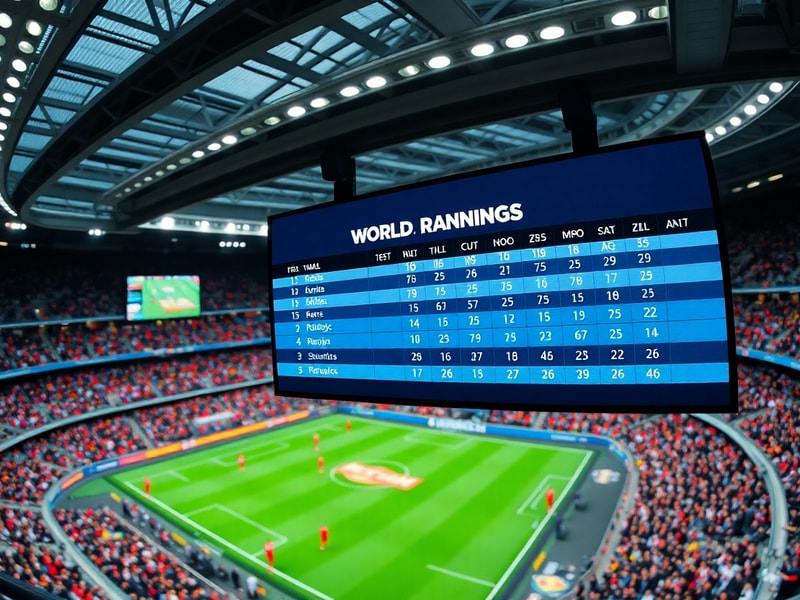
Every four years, the FIFA World Cup delivers a spectacle watched by billions. But long before the first whistle blows in Qatar or Canada, soccer’s hierarchy is already etched in stone—or rather, in spreadsheets. FIFA’s world rankings, updated monthly, determine which nations sit atop the global pecking order. These rankings are more than just bragging rights; they influence seeding, hosting rights, and even the financial health of federations. Yet their methodology remains a subject of debate among coaches, players, and analysts alike.
Introduced in 1992 and overhauled in 2018, the current ranking system uses a points-based formula. Teams earn points by winning matches, with bonuses for victories against higher-ranked opponents. Friendly games still count, though less than competitive fixtures in World Cup qualifiers or continental championships. The system’s complexity lies in its attempt to balance consistency with performance. A team like Brazil, with decades of dominance, can afford to drop a few places without panic. Meanwhile, nations like Japan or Morocco ride momentum from surprise victories to climb the ladder.
Critics argue the rankings lack nuance. A heavy defeat to a top team can erase months of progress, while a small nation beating a giant might not reflect in the standings for weeks. The system’s weighting also favors European and South American teams, whose frequent high-stakes matches keep their points ticking over. Africa and Asia, despite producing thrilling underdog stories, often struggle to gain ground. This imbalance underscores a deeper truth: soccer’s world rankings are less a pure meritocracy and more a reflection of historical power structures.
From Humble Beginnings to Global Dominance: The Evolution of Rankings
The idea of ranking national teams predates FIFA’s official system. Early attempts in the 1980s relied on subjective assessments or limited match data. The breakthrough came in 1992 when FIFA introduced a points system based on wins, draws, and goal margins. This was revolutionary for its time, offering a transparent way to compare teams across continents. Yet it also faced immediate criticism for overemphasizing goal difference, which could distort perceptions of true strength.
The first major overhaul arrived in 2006, with FIFA adopting a more sophisticated model that considered the strength of opponents. This change aimed to reward teams for beating quality opposition, not just piling up wins against weaker sides. However, the system still struggled to account for the varying difficulty of continental tournaments. A win in Europe’s competitive qualifiers, for example, carried more weight than a similar result in Africa’s less dense schedule.
In 2018, FIFA rolled out its most ambitious revision yet. The new model eliminated goal difference as a direct factor, instead focusing on match outcomes and opponent strength. It also introduced a time-weighted decay, meaning older results gradually lose significance. This shift was designed to reward recent form over historical prestige. Yet even this modern approach isn’t foolproof. The rankings can still be gamed—teams might prioritize friendly matches against lower-ranked opponents to boost points, or coaches could field weakened squads in less critical games to preserve their star players for bigger fixtures.
The Rankings’ Hidden Influence: Money, Politics, and Prestige
The stakes of the world rankings extend far beyond the pitch. FIFA uses them to determine seeding for World Cup draws, ensuring top teams avoid early upsets. This has tangible consequences: a higher seed can mean easier group-stage opponents, shorter travel distances, and even home advantage in knockout rounds. For nations like the United States, which hosted the 2026 World Cup alongside Canada and Mexico, climbing the rankings could mean avoiding powerhouses like Brazil or France until later stages.
Politics also plays a role. The rankings influence voting for FIFA’s executive committee, where nations jockey for influence over global soccer governance. A high ranking can translate into soft power, helping countries secure hosting rights or lucrative sponsorship deals. Qatar’s rise in the rankings ahead of its 2022 World Cup bid is a case in point—its sudden ascent coincided with its successful campaign to host the tournament, sparking allegations of manipulation. While FIFA denies any direct link between rankings and bid evaluations, the perception of impropriety lingers.
Financially, the rankings are a lifeline for smaller federations. Higher-ranked teams attract bigger sponsorships, better broadcast deals, and more investment in grassroots development. The contrast is stark: England, ranked in the top 10, can command premium rates for friendlies against top opponents. Meanwhile, nations like El Salvador or New Zealand rely on occasional upsets to stay relevant and attract funding. This disparity reinforces soccer’s economic divide, where wealth begets wealth and obscures the true potential of emerging footballing nations.
Cultural Pride and the Intangible Weight of Rankings
For fans, the rankings are a source of national pride—or frustration. In Argentina, a top-five ranking is a point of obsession, reflecting the country’s storied history and Lionel Messi’s legacy. In Nigeria, climbing into the top 30 is a badge of honor, symbolizing the Super Eagles’ resilience against colonial-era stereotypes. Even in Europe, where club soccer dominates, national team rankings shape identity. Italy’s drop to 20th place in 2022, after failing to qualify for the World Cup, sparked soul-searching about the state of Italian football.
The rankings also serve as a barometer for soccer’s global expansion. Nations like the Philippines or India, once perennial also-rans, have made steady progress by investing in youth academies and foreign coaches. Their ascent isn’t just about points—it’s about challenging the old guard. Yet the system’s Eurocentric bias means progress is incremental. A team from Oceania, for instance, must win by larger margins to gain the same points as a European side, simply because the competition is less intense.
Culturally, the rankings reflect soccer’s role as a unifier and divider. They can inspire collective hope, as when Iceland’s tiny population defied odds to reach Euro 2016. Or they can deepen resentment, as when African nations accuse FIFA of underrepresenting their teams in World Cup spots. The rankings, in their cold numerical form, capture soccer’s contradictions: a global game built on local passions, where the smallest nations dream of dethroning giants.
Beyond the Numbers: What the Rankings Miss
No system is perfect, and soccer’s world rankings are no exception. They ignore the intangibles: team chemistry, tactical innovation, or the sheer unpredictability of the game. A single tournament can upend years of rankings—just ask Saudi Arabia, whose shock win over Argentina at the 2022 World Cup sent its ranking soaring overnight. The rankings also struggle to account for the rise of women’s soccer, where FIFA’s separate system has its own flaws and biases.
Perhaps the rankings’ greatest flaw is their inability to measure joy. Soccer’s magic lies in its capacity to create moments that transcend statistics—a last-minute winner, a goalkeeper’s heroic save, or a nation’s collective roar. The rankings reduce these ephemeras to data points, stripping away the emotion that makes the game universal. Yet for all their limitations, they remain indispensable. In a sport where history is written in goals and trophies, the rankings offer a fleeting glimpse into the future.
For coaches, players, and fans, the rankings are a starting point—not an endpoint. They provide context, but they don’t tell the whole story. The true measure of a nation’s soccer strength lies in its ability to captivate, inspire, and occasionally defy the odds. And that, as any fan knows, is something no spreadsheet can capture.