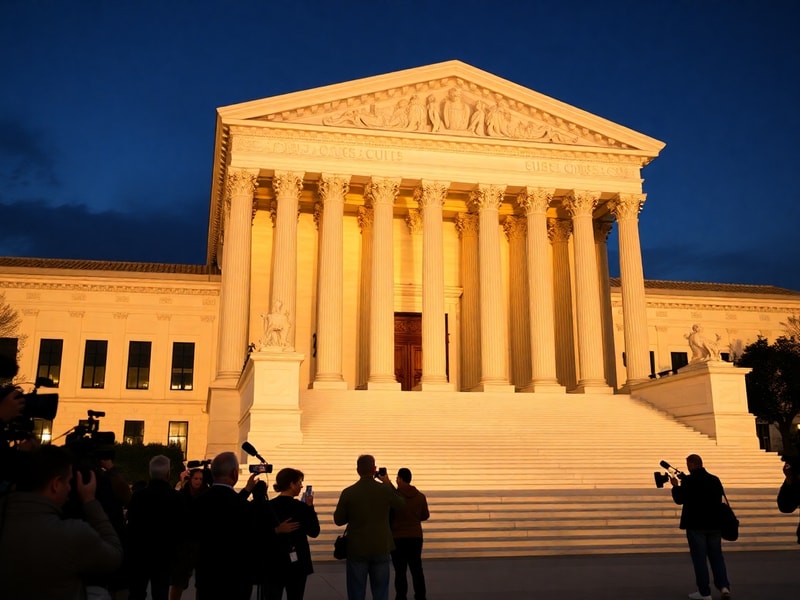
Supreme Court Shakes Up Legal Landscape with Landmark Ruling
The U.S. Supreme Court delivered a seismic shift this week with its 6-3 decision in Johnson v. United States, rewriting the rules for federal sentencing guidelines. The ruling dismantles decades of precedent by declaring that judges cannot impose harsher penalties based solely on facts not proven to a jury beyond a reasonable doubt. Legal scholars immediately recognized the implications, calling it the most significant criminal justice reform since Apprendi v. New Jersey in 2000. The decision affects thousands of pending cases and could force Congress to revisit sentencing statutes that have governed federal courts since the 1980s.
Writing for the majority, Justice Elena Kagan emphasized the constitutional imperative: “The Sixth Amendment requires that each fact necessary to justify a sentence be found by a jury, not a judge.” The dissent, penned by Justice Samuel Alito, warned of “dangerous consequences” for public safety, arguing that the ruling would tie judges’ hands in cases involving violent crimes. The sharp divide reflects broader tensions within the Court over the balance between individual rights and state authority—a debate that shows no signs of resolution.
The Case That Started It All
Johnson v. United States centered on Brandon Johnson, a nonviolent offender convicted of distributing methamphetamine. During sentencing, the trial judge enhanced Johnson’s penalty under the Armed Career Criminal Act (ACCA), citing prior state convictions that had never been presented to a jury. Johnson’s legal team argued that this violated his constitutional right to a jury trial—a claim the Supreme Court ultimately upheld. The decision doesn’t just affect drug cases; it casts doubt on the legality of sentencing enhancements in everything from white-collar fraud to firearms violations.
Legal analysts note that the ruling could invalidate portions of the U.S. Sentencing Guidelines, which rely heavily on judicial fact-finding. According to data from the U.S. Sentencing Commission, over 70% of federal sentences include enhancements based on judge-determined facts. This means thousands of inmates currently serving sentences could petition for resentencing, clogging already overburdened courts. The Department of Justice has not yet announced how it will respond, but insiders suggest a legislative fix may be in the works.
What This Means for Federal Sentencing
The Supreme Court’s decision creates immediate uncertainty for prosecutors and defendants alike. Here are the key takeaways:
- Retroactive relief: Inmates serving sentences enhanced by judicial fact-finding may now qualify for resentencing hearings.
- Prosecutorial strategy: Federal attorneys may shift toward charging defendants with offenses that carry mandatory minimums, bypassing judicial discretion entirely.
- Judicial constraints: Trial judges will face stricter limits on imposing upward departures from sentencing guidelines.
- Congressional action: Lawmakers may introduce new legislation clarifying which facts must be proven to a jury, though gridlock on Capitol Hill makes swift reform unlikely.
Critics of the ruling argue it undermines the federal sentencing framework designed to ensure consistency across districts. Proponents counter that it restores a fundamental constitutional protection—one that has eroded since the Supreme Court first allowed judicial fact-finding in sentencing in McMillan v. Pennsylvania (1986). The tension between these perspectives will shape criminal justice policy for years to come.
Broader Implications for the Justice System
Beyond sentencing, the Court’s decision touches on deeper questions about the role of discretion in the legal system. Federal judges have long wielded significant power to tailor punishments to individual circumstances, a practice that supporters argue promotes fairness. Yet opponents contend that unchecked judicial discretion leads to disparities—particularly along racial and socioeconomic lines. Studies show that Black defendants receive sentences nearly 20% longer than white defendants for similar crimes, a gap that could widen if judges lose the ability to adjust penalties based on mitigating factors.
The ruling also intersects with ongoing debates about mass incarceration. Since 1980, the federal prison population has grown by over 800%, driven in part by mandatory minimums and sentencing enhancements. If inmates successfully challenge their sentences under Johnson, the Bureau of Prisons could face a wave of early releases, straining reentry programs already struggling to meet demand. Advocacy groups like the American Civil Liberties Union have hailed the decision as a step toward reform, while law enforcement organizations warn of unintended consequences for public safety.
Legal historians point out that the Court has been gradually chipping away at judicial discretion since the 2005 decision in United States v. Booker, which made the sentencing guidelines advisory rather than mandatory. The Johnson ruling accelerates this trend, signaling a potential return to a jury-centric model of justice. Whether this shift will reduce disparities or create new challenges remains an open question—one that will likely dominate legal scholarship for decades.
What Comes Next?
The Supreme Court’s decision leaves several critical questions unanswered. First and foremost: How will lower courts interpret the ruling? Some judges may adopt a narrow reading, limiting its impact to cases involving sentencing enhancements. Others could apply it broadly, calling into question the validity of any sentence influenced by judicial fact-finding. The Court may need to clarify its position in future cases, adding to an already crowded docket.
Congress also faces pressure to act. While legislation to address the ruling’s fallout is unlikely in the current political climate, the issue could resurface during the next session. Possible reforms include:
- Codifying specific facts that must be proven to a jury in sentencing hearings.
- Expanding the use of mandatory minimums to ensure uniformity in punishment.
- Creating a “safety valve” provision allowing judges limited discretion in extraordinary cases.
For now, the legal community is left to grapple with the decision’s immediate effects. Defense attorneys are already filing motions to vacate sentences, while prosecutors are scrambling to adjust their trial strategies. One thing is clear: The Supreme Court has once again reshaped the legal landscape, and the repercussions will be felt far beyond the courthouse.
The latest Supreme Court news and legal analysis are available on Dave’s Locker, where we continue to track the evolving impact of this landmark decision.