World Cup Standings: Power, Surprises and Global Football Trends
The FIFA World Cup stands as the most prestigious tournament in global football, drawing billions of viewers and uniting nations in a celebration of sport, culture, and competition. Beyond the glory of lifting the trophy, the World Cup standings tell a story of ambition, strategy, and the ever-shifting balance of power in international football. Every four years, the tournament reshapes the perception of which nations truly belong among the elite, while others emerge from relative obscurity to challenge the status quo.
How World Cup Standings Shape Football’s Global Hierarchy
The World Cup standings are more than just a scoreboard—they reflect the evolution of football tactics, investment, and identity. Nations that consistently finish in the top positions, such as Brazil, Germany, and Argentina, have built reputations as footballing powerhouses. Their success is often attributed to decades of infrastructure development, youth academies, and cultural passion for the game. Yet the standings also reveal surprises: teams like Croatia in 2018 and Morocco in 2022 defied expectations, proving that grit, tactical discipline, and collective belief can elevate a nation far beyond its historical standing.
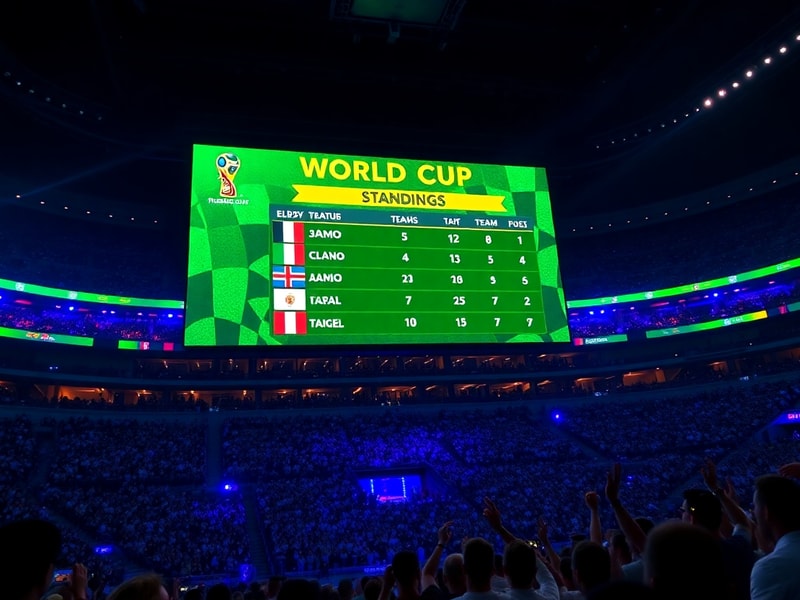
Standings are calculated based on a points system: three points for a win, one for a draw, and none for a loss. In the group stage, teams are ranked by points, goal difference, goals scored, and head-to-head results. This structure ensures that even brief moments of brilliance or defensive resilience can dramatically alter a nation’s trajectory. For example, Japan’s stunning 2-1 victory over Germany in 2022 sent shockwaves through the football world, not just because of the result, but because it demonstrated how underdogs could disrupt the established order.
From Underdogs to Champions: The Stories Behind the Numbers
The beauty of World Cup standings lies in their unpredictability. History is filled with teams that entered tournaments as long shots, only to climb the ladder through sheer determination. In 1990, Cameroon became the first African team to reach the quarterfinals, defeating Argentina in the opening match. Their journey inspired generations of African footballers and showed the world that geography does not dictate destiny.
Similarly, South Korea’s run to the semifinals in 2002, co-hosted with Japan, remains one of the most unlikely feats in World Cup history. The Red Devils, as they were affectionately known, rode a wave of home support and tactical innovation to stun Spain and Italy on their way to a historic fourth-place finish. These stories are etched into the collective memory of football fans, proving that the standings are not just cold statistics—they are narratives of hope, resilience, and transformation.
Even in defeat, some teams leave indelible marks. The United States’ 1-0 victory over England in 1950 stunned the football world, while Senegal’s opening-day win over France in 2002 announced Africa’s arrival on the global stage. These moments remind us that the World Cup is not just about the final table; it’s about the stories that unfold along the way.
The Role of Host Nations: Can They Rise to the Occasion?
Host nations often face immense pressure to perform well, and their progress in the standings can become a matter of national pride. When South Africa hosted the 2010 World Cup, Bafana Bafana’s early exit was a disappointment, but their vibrant atmosphere and colorful vuvuzelas turned the tournament into a cultural festival. In contrast, Russia’s 2018 campaign saw them reach the quarterfinals, fueled by passionate home support and a tactical resurgence under Stanislav Cherchesov.
The host nation’s performance often hinges on a combination of factors: familiarity with conditions, tactical adaptability, and the ability to handle the weight of expectations. Japan’s 2002 and 2022 campaigns, both as co-hosts, showcased how a nation could channel the energy of its supporters into a cohesive, competitive force. Meanwhile, Qatar’s 2022 debut as the first Middle Eastern host was marked by resilience despite early setbacks, highlighting the tournament’s growing global footprint.
For host nations, the World Cup is more than a sporting event—it’s a chance to showcase identity, culture, and ambition on the world’s biggest stage. Their standings become a reflection of national pride, and their performances can leave a legacy that extends far beyond the pitch.
What the Standings Reveal About Modern Football
The evolution of World Cup standings mirrors broader trends in global football. In recent decades, traditional powerhouses have faced increasing competition from nations investing heavily in development. Clubs like Manchester City and Paris Saint-Germain, backed by wealthy owners, have driven up the cost of talent, but national teams have benefited from this wealth in different ways.
For example, Belgium’s golden generation of the 2010s, featuring stars like Kevin De Bruyne and Eden Hazard, propelled the Red Devils to a third-place finish in 2018. Their success was built on a generation of players developed through Belgium’s renewed focus on youth development and tactical innovation. Similarly, Portugal’s rise in the 2010s, powered by Cristiano Ronaldo and a deep pool of talent, underscored how a nation could leverage individual brilliance into collective success.
Yet the standings also highlight disparities. Some nations struggle with political instability, limited resources, or lack of infrastructure, which constrains their ability to compete. The gap between the top-ranked teams and those at the bottom remains a persistent challenge, raising questions about how to create a more level playing field in international football.
One promising trend is the growing influence of women’s football. The FIFA Women’s World Cup standings are beginning to rival the men’s tournament in visibility and fan engagement. Nations like the United States, Germany, and England have invested in their women’s teams, resulting in more competitive and entertaining tournaments. As the women’s game continues to grow, it may reshape the global football landscape in ways we are only beginning to understand.
The Psychological Edge: How Standings Influence Team Mentality
Beyond tactics and talent, the World Cup standings carry a psychological weight that can define a team’s journey. Teams that start strong often carry momentum into later stages, while those that stumble early face immense pressure to recover. For instance, France’s 2018 campaign was built on a core of young talent like Kylian Mbappé, who thrived under the weight of expectations. Their ability to handle pressure in high-stakes matches—culminating in a 4-2 victory over Croatia in the final—demonstrated how mental resilience can shape a nation’s standing.
In contrast, teams like the Netherlands in 2014, who finished third after a heartbreaking semifinal loss to Argentina, showed how near-misses can fuel future success. The Dutch rebuilt their squad with a blend of experienced players and emerging talent, returning to the semifinals in 2022. These cycles of setback and redemption highlight the intangible factors that influence the standings: confidence, cohesion, and the ability to perform under pressure.
Coaches play a crucial role in shaping a team’s mentality. Jürgen Klinsmann’s innovative approach with the United States in 2014, which emphasized physicality and pressing, helped the team reach the round of 16. Similarly, Gareth Southgate’s calm leadership transformed England from a team plagued by penalty shootout failures to one that reached the semifinals in 2018 and the final in 2022. The psychological dimension of the World Cup standings underscores that football is as much a mental game as it is a physical one.
The Future of World Cup Standings: What’s Next?
The World Cup landscape is evolving, with expansion to 48 teams in 2026 set to redefine the standings. More nations will have the opportunity to compete, but the challenge of maintaining competitive balance will grow. Will traditional powerhouses continue to dominate, or will new contenders emerge from regions like Africa and Asia? The expansion could democratize the tournament, but it also risks diluting the prestige of the top positions.
Another factor to watch is the increasing influence of data analytics. Teams are now using advanced metrics to scout opponents, optimize training, and make tactical decisions. Nations that embrace these innovations could gain a competitive edge in the standings. For example, Morocco’s impressive 2022 campaign was fueled by a deep understanding of their opponents’ weaknesses and a disciplined, collective approach to play.
The rise of global football leagues, such as the Saudi Pro League and the MLS, also presents new challenges and opportunities. Will players from these leagues be able to replicate their club success at the international level? How will the growing influence of money in football reshape the balance of power in the World Cup standings? These questions will define the next chapter of the tournament’s history.
The World Cup standings are a mirror to the ever-changing world of football. They capture the triumphs of underdogs, the dominance of powerhouses, and the unpredictable nature of sport. As the tournament continues to evolve, so too will the stories etched into the standings—stories of glory, heartbreak, and the unyielding pursuit of greatness.