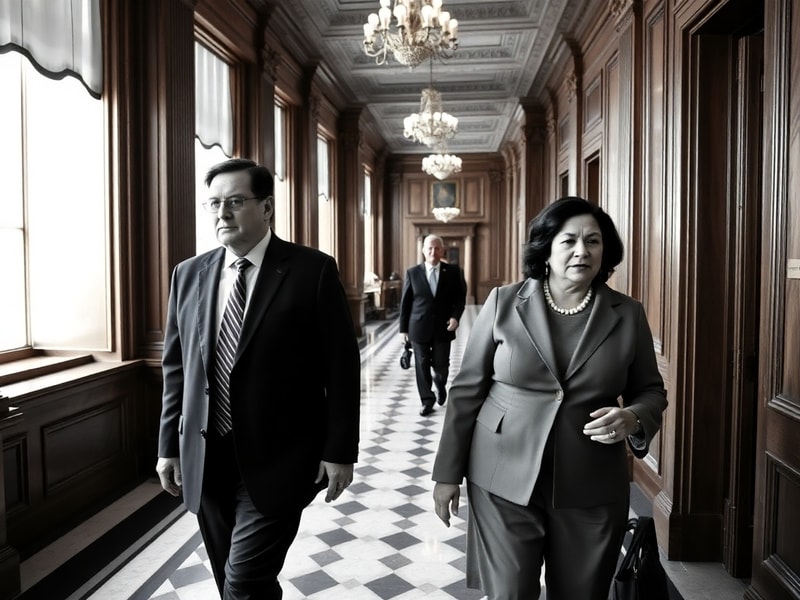
In a legal landscape often defined by sharp ideological divides, two Supreme Court justices stand out for their unyielding commitment to their principles: Samuel Alito and Sonia Sotomayor. Their careers, spanning decades of jurisprudence, reveal contrasting philosophies that shape the highest court in the land. While Alito is frequently the anchor of the Court’s conservative bloc, Sotomayor has emerged as a leading voice for progressive values and institutional integrity. Their interactions—sometimes sharp, sometimes respectful—reflect the broader tensions within American law and society.
Their professional trajectories tell a story of ambition, resilience, and unshakable belief in their respective visions of justice. Alito, appointed in 2006, brought a disciplined textualist approach to constitutional interpretation. Sotomayor, confirmed in 2009, carried with her a deep sense of empathy forged in the Bronx and a commitment to equality under law. Together, they represent not just two legal minds, but two visions of what it means to interpret the Constitution in the 21st century.
Early Lives and Paths to the Bench
Samuel Alito was born on April 1, 1950, in Trenton, New Jersey, into a family with deep roots in law enforcement and public service. His father was a high school teacher and later a state legislator, while his mother worked as a school principal. Alito attended Princeton University, where he earned his bachelor’s degree in 1972. His time at Princeton was marked by involvement in conservative student groups and a growing skepticism of affirmative action policies—a theme that would resurface decades later in his judicial opinions.
After graduating from Yale Law School, Alito clerked for Judge Leonard Garth on the Third Circuit and later served as an assistant U.S. attorney in New Jersey. His early career also included time in the Justice Department during the Reagan administration, where he played a role in shaping legal policy. These formative years solidified his reputation as a staunch conservative committed to originalism and judicial restraint—principles he would champion from the bench.
Sonia Sotomayor’s journey to the Supreme Court is one of triumph over adversity. Born on June 25, 1954, in the Bronx to Puerto Rican parents, she was diagnosed with juvenile diabetes at age seven and raised in public housing. Despite these challenges, she excelled academically, graduating summa cum laude from Princeton in 1976 and earning her law degree from Yale in 1979. Sotomayor’s life story became central to her judicial philosophy, which emphasized the role of personal experience in legal reasoning—a perspective she articulated in a 2001 lecture that later drew both praise and criticism.
After working as an assistant district attorney in New York, Sotomayor was nominated to the U.S. District Court by President George H.W. Bush in 1991—a rare bipartisan appointment. Her sharp intellect and no-nonsense demeanor quickly made her a respected figure in the legal community, paving the way for her elevation to the Second Circuit Court of Appeals in 1998 under President Bill Clinton.
Judicial Philosophies in Conflict
The contrast between Alito and Sotomayor’s judicial philosophies could not be more stark. Alito is widely regarded as one of the Court’s most consistent conservative votes, often siding with outcomes that limit federal regulatory power, uphold religious liberty claims, and restrict abortion access. His opinions frequently emphasize textualism—the idea that the Constitution and laws should be interpreted based on their plain meaning—while resisting expansive readings of individual rights.
One of Alito’s most consequential opinions came in Dobbs v. Jackson Women’s Health Organization (2022), where he authored the majority decision overturning Roe v. Wade and Planned Parenthood v. Casey. In his ruling, Alito argued that the Constitution does not confer a right to abortion and that such decisions should be returned to the states. The decision sparked nationwide debate and marked a seismic shift in American reproductive rights law.
In contrast, Sotomayor has become a leading defender of civil rights, voting rights, and criminal justice reform. Her dissenting opinions often reflect a deep skepticism of government overreach, particularly in cases involving racial discrimination or punitive policing. In Shelby County v. Holder (2013), she joined the dissent in a 5–4 decision that struck down a key provision of the Voting Rights Act, warning that the majority’s ruling “eviscerates a statute that stands as one of the most important achievements of the Civil Rights Movement.”
Sotomayor’s dissent in Utah v. Strieff (2016), a case involving police stops and the exclusionary rule, is among her most cited. She wrote that the decision “implies that you are not a citizen of a democracy but the subject of a carceral state, just waiting to be cataloged.” Her powerful prose and moral clarity have made her a favorite among progressives and a frequent target of conservative critics.
Clashes and Collaboration on the Court
Alito and Sotomayor’s relationship on the Court has been marked by both tension and mutual respect. While they rarely agree on outcomes, their exchanges in oral arguments and written opinions reveal a shared commitment to rigorous legal analysis—even when their conclusions diverge sharply.
One notable example came in Bostock v. Clayton County (2020), a landmark case that extended workplace anti-discrimination protections to LGBTQ+ employees. Sotomayor joined the majority opinion written by Justice Neil Gorsuch, which held that discrimination based on sexual orientation or gender identity is a form of sex discrimination under Title VII. Alito, in dissent, argued that the majority had rewritten the law rather than interpreting it, warning of “legislation through litigation.”
Another flashpoint emerged in Students for Fair Admissions v. Harvard (2023), where the Court struck down affirmative action in college admissions. Sotomayor dissented vociferously, writing that the decision “rolls back decades of precedent and momentous progress.” Alito, in contrast, joined the majority, reaffirming his long-standing opposition to race-conscious admissions policies—a stance he first articulated in his Princeton thesis.
Despite these disagreements, both justices have demonstrated a willingness to cross ideological lines when principles of institutional integrity are at stake. Sotomayor joined a unanimous Court in upholding the Affordable Care Act in California v. Texas (2021), while Alito has occasionally sided with criminal defendants in cases involving procedural due process.
Yet, their fundamental differences remain impossible to ignore. Where Sotomayor sees a role for empathy and lived experience in judicial decision-making, Alito insists on a rigid separation between personal values and legal interpretation. These competing visions continue to shape the Court’s direction and the nation’s legal discourse.
Their Legacies and the Future of the Court
The legacies of Alito and Sotomayor will be defined not only by their votes and opinions but by the institutions they leave behind. Alito, now the senior associate justice in the conservative bloc, wields significant influence in shaping the Court’s agenda. His opinions in cases involving religious liberty—such as Burwell v. Hobby Lobby (2014) and Kennedy v. Bremerton School District (2022)—have expanded protections for faith-based institutions and individuals, often at the expense of secular government neutrality.
Sotomayor, meanwhile, has become a cultural and intellectual icon for many Americans, particularly those from marginalized communities. Her memoir, My Beloved World, and her public speeches have inspired generations of young lawyers and activists. Her dissenting opinions, often cited in law review articles and media commentary, have elevated the role of narrative and moral reasoning in legal analysis.
As the Court grapples with issues like gun rights, election integrity, and digital privacy, the influence of Alito and Sotomayor will likely endure. Their jurisprudence offers a roadmap for future justices navigating an increasingly polarized legal landscape.
For those interested in the broader implications of their rulings, the News section of Dave’s Locker provides ongoing coverage of Supreme Court decisions and their impact on American society. Meanwhile, the Analysis section offers deeper dives into legal trends and judicial philosophies shaping the nation.
Looking ahead, the question is not whether Alito and Sotomayor will continue to disagree, but how their disagreements will shape the future of American law. One thing is certain: their careers have already left an indelible mark on the Court—and on the nation they serve.