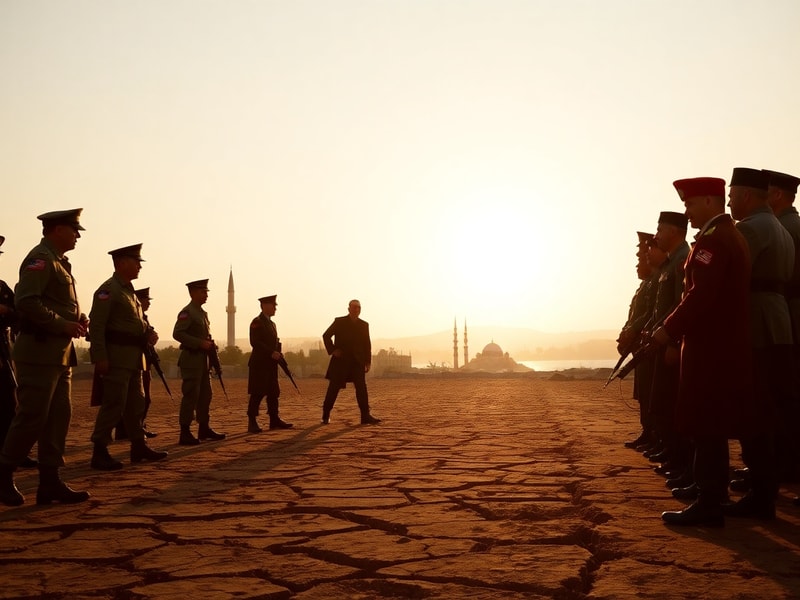
Geopolitical Rivalries in the 21st Century: USA vs Turkey
The relationship between the United States and Turkey has shifted from alliance to strategic friction over the past two decades. Once NATO allies during the Cold War, the two nations now find themselves at odds on issues ranging from regional security to economic policy. This evolution reflects deeper structural changes in global power dynamics, where historical partnerships are increasingly strained by competing national interests.
Turkey’s strategic location bridging Europe and Asia has made it a critical player in NATO’s southern flank. Yet its independent foreign policy under Recep Tayyip Erdoğan has diverged sharply from Washington’s priorities. The U.S. views Turkey as an unreliable partner due to its warming ties with Russia, its military operations in Syria, and its purchase of the S-400 missile system. Meanwhile, Ankara accuses the U.S. of supporting Kurdish militants linked to the PKK and undermining Turkish sovereignty through sanctions and political pressure.
These tensions are not isolated incidents but part of a broader realignment in international relations. As the U.S. pivots toward Asia and Europe strengthens its defense autonomy, Turkey seeks to reposition itself as a regional power broker. The result is a complex web of cooperation and conflict that challenges traditional alliance structures.
Key Areas of Conflict Between Washington and Ankara
The U.S.-Turkey relationship is defined by both strategic cooperation and deep-seated disagreements. Below are the primary areas where the two nations clash:
- Military and Defense: The U.S. has repeatedly criticized Turkey’s acquisition of Russian S-400 missile systems, which Washington argues compromises NATO’s integrated air defense. The U.S. responded by suspending Turkey’s participation in the F-35 fighter jet program, a move that cost Ankara billions in potential revenue.
- Kurdish Issue: The U.S. has long supported the Syrian Democratic Forces (SDF), a Kurdish-led militia in Syria, as a key ally against ISIS. Turkey, however, views the SDF as an extension of the Kurdistan Workers’ Party (PKK), a designated terrorist organization. This fundamental disagreement has led to direct military confrontations and diplomatic standoffs.
- Economic Sanctions: The U.S. has imposed targeted sanctions on Turkish officials and entities, particularly over human rights concerns and the detention of American citizens. These measures have weakened the Turkish lira and fueled inflation, exacerbating economic instability in the country.
- Regional Influence: Both nations vie for influence in the Eastern Mediterranean, the Balkans, and the Caucasus. Turkey’s support for Azerbaijan in the Nagorno-Karabakh conflict and its maritime boundary disputes with Greece have drawn sharp rebukes from Washington, which seeks to maintain stability in the region.
These conflicts are not merely diplomatic disagreements but represent fundamental differences in how each country perceives its security needs and global role. The U.S. prioritizes a rules-based international order, while Turkey increasingly pursues an assertive, sovereignty-first foreign policy.
Why This Rivalry Matters Beyond Bilateral Tensions
The U.S.-Turkey divide has far-reaching implications for global security and economic stability. NATO’s cohesion, already fragile due to internal divisions, faces further strain as Turkey deepens its ties with non-Western powers. The alliance’s effectiveness in countering Russian aggression in Ukraine and managing migration flows from the Middle East depends heavily on Ankara’s cooperation.
Economically, the conflict has disrupted supply chains, particularly in the defense and energy sectors. Turkey’s role as a transit hub for natural gas pipelines from the Caspian Sea to Europe has complicated U.S. efforts to reduce European dependence on Russian energy. Meanwhile, American defense contractors have lost lucrative contracts due to Turkey’s pivot toward Russian and Chinese military suppliers.
For the broader Middle East, the U.S.-Turkey rivalry has reshaped alliances and conflict dynamics. Turkey’s military interventions in Syria and Libya have altered the balance of power, while U.S. sanctions on Iran have forced Turkey to navigate a delicate balancing act between Washington and Tehran. The result is a fragmented regional order where traditional alliances no longer guarantee predictable outcomes.
Culturally and socially, the tensions have also affected diaspora communities in both countries. Turkish-American relations have soured, with visa restrictions and political rhetoric fueling mutual distrust. In Turkey, anti-American sentiment has risen, fueled by perceived interference in domestic politics and support for opposition groups.
Can the U.S. and Turkey Rebuild a Functional Relationship?
Despite the deepening rift, there are still avenues for cooperation. Both nations share an interest in preventing the resurgence of ISIS in Syria and Iraq, and Turkey remains a critical partner in managing refugee flows into Europe. Additionally, the U.S. has sought to balance its criticism of Ankara with efforts to stabilize the Turkish economy, recognizing that economic collapse could lead to further regional instability.
However, rebuilding trust will require substantial concessions from both sides. Turkey would need to reconsider its military alignment with Russia and reduce its support for non-state actors in Syria. The U.S., in turn, would have to address Ankara’s security concerns regarding Kurdish groups and refrain from imposing unilateral sanctions that exacerbate economic hardship.
Diplomatic engagement remains the most viable path forward. High-level talks, such as the recent meetings between U.S. Secretary of State Antony Blinken and Turkish Foreign Minister Mevlüt Çavuşoğlu, suggest that both sides recognize the need to prevent further deterioration. Yet the road to reconciliation is fraught with obstacles, including domestic political pressures in both countries.
For now, the U.S.-Turkey relationship remains in a state of managed competition rather than outright hostility. The question is whether this delicate balance can endure or if the two nations will drift further apart, reshaping the geopolitical landscape in the process.