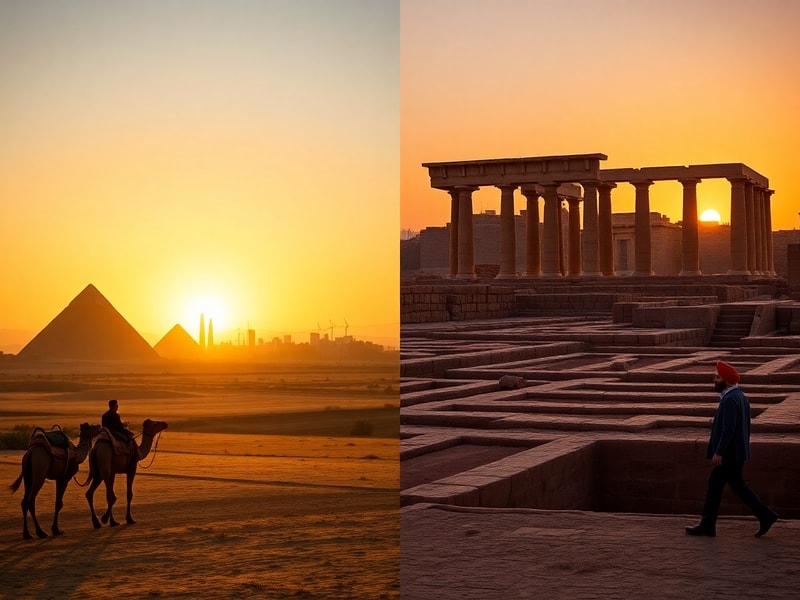
Egypt vs Iran: Ancient Rivalry Shapes Modern Geopolitics
Ancient Rivalries and Modern Rivalries: Egypt and Iran’s Complex Legacy
The relationship between Egypt and Iran stretches back thousands of years, woven through the sands of time as two of the ancient world’s most influential civilizations. Today, their rivalry continues to shape geopolitics across the Middle East, North Africa, and beyond. While both nations boast rich histories—Egypt with its pyramids and pharaonic dynasties, Iran with its Persian empires and cultural depth—their modern interactions are often defined by competition rather than cooperation. From the Cold War era to the Arab Spring and the ongoing tensions in the Persian Gulf, the dynamics between Cairo and Tehran reveal a story of ideological divides, strategic maneuvering, and shifting alliances.
Geography and religion provide the first layers of this complex relationship. Egypt, predominantly Sunni Muslim with a Christian minority, sits at the crossroads of Africa and the Middle East. Iran, a majority Shia Muslim nation with deep historical roots in the Persian tradition, lies at the heart of the Gulf region. This religious divide has often been exploited in political narratives, especially after Iran’s 1979 Islamic Revolution, which promoted a revolutionary Shia ideology that unsettled many Sunni-led regimes—Egypt included.
Centuries of Influence: Historical Foundations of a Rivalry
Egypt and Iran first clashed during the height of Persian expansion in the 6th century BCE, when Cambyses II of Persia invaded Egypt, marking the beginning of centuries of domination. The Achaemenid Empire ruled Egypt for over two centuries, integrating it into a vast administrative system that spanned from the Indus River to the Mediterranean.
Later, the rise of Islam brought both regions under the same religious banner, yet their political paths diverged. The Fatimid Caliphate, which originated in North Africa, established Cairo as its capital in 969 CE, while Persia remained under Seljuk, Mongol, and Timurid rule before the emergence of the Safavid Dynasty in the 16th century. The Safavids’ conversion to Shia Islam in 1501 created a religious identity that would later become a defining feature of modern Iran.
By the 19th and 20th centuries, both nations found themselves under colonial pressure—Egypt under British rule, Iran under British and Russian spheres of influence. Their shared experience of foreign domination led to nationalist movements. In Egypt, the 1952 revolution overthrew the monarchy and brought Gamal Abdel Nasser to power, championing pan-Arabism and non-alignment. In Iran, the 1953 coup orchestrated by Western powers reinstated the monarchy but set the stage for the 1979 Islamic Revolution, which overthrew the Shah and established an Islamic republic under Ayatollah Khomeini.
These revolutions marked a turning point. Nasser’s Egypt sought to lead the Arab world, while Khomeini’s Iran promoted Islamic revolution globally. The two ideologies—Arab nationalism versus Islamic theocracy—clashed directly, and Egypt became a primary target of Iran’s revolutionary rhetoric.
Cold War Shadows: Ideology, Politics, and Proxy Battles
The Cold War era intensified the rivalry between Egypt and Iran. Egypt, under Nasser and later Anwar Sadat, aligned with the Soviet Union, adopting socialist policies and anti-Western rhetoric. Iran, meanwhile, was a key U.S. ally under the Shah, hosting Western military bases and serving as a pillar of American containment strategy against the Soviet Union.
After the 1979 revolution, Iran’s new leadership declared Egypt an enemy of Islam for recognizing Israel in the 1979 Camp David Accords. Iran severed diplomatic ties with Egypt, which remained in place for over three decades. During the Iran-Iraq War (1980–1988), Egypt supported Saddam Hussein’s Iraq with weapons and diplomatic backing, further antagonizing Iran.
This ideological conflict extended beyond borders through proxy wars. In Lebanon, Iran backed Hezbollah, a Shia militant group, while Egypt supported various Sunni factions and Arab nationalist movements. In the Gaza Strip, Iran provided funding and arms to Hamas, which Egypt often restricted from operating freely in the Sinai Peninsula. These proxy dynamics turned the Egypt-Iran rivalry into a regional proxy war, with each nation backing opposing sides in conflicts from Syria to Yemen.
The Arab Spring of 2011 briefly raised hopes for reconciliation. In Tunisia and Egypt, popular uprisings toppled long-standing dictators. Egypt’s Hosni Mubarak was removed, and a new government emerged. Iran saw an opportunity to expand its influence in the Arab world. However, the subsequent rise of Mohamed Morsi and the Muslim Brotherhood in Egypt—an organization with ideological ties to Iran’s revolutionary model—raised alarms in Riyadh and Washington but also opened a brief window for dialogue between Cairo and Tehran.
That window closed quickly. After the 2013 military coup in Egypt, which removed Morsi and brought Abdel Fattah el-Sisi to power, relations deteriorated once more. Sisi’s government cracked down on the Muslim Brotherhood, branding it a terrorist organization, and accused Iran of supporting Islamist militants in the Sinai. Iran, in turn, condemned Sisi’s crackdown and continued to support Hamas and other groups opposed to Egypt’s peace treaty with Israel.
Strategic Interests: Energy, Security, and Regional Power
Beyond ideology, Egypt and Iran compete for strategic influence in the Middle East and beyond. Both nations view themselves as leaders of their respective cultural and religious blocs—Egypt as the heart of Arab identity, Iran as the guardian of Shia Islam.
Energy resources are a key point of contention. Iran possesses vast oil and natural gas reserves and has long sought to export its energy to Europe and Asia via pipelines through Iraq and Syria. Egypt, while not as resource-rich, controls the Suez Canal, one of the world’s most vital maritime chokepoints. In 2015, Egypt signed a deal with Cyprus, Greece, Israel, Italy, and Jordan to build the EastMed pipeline, a project designed to bypass Turkey and potentially limit Iran’s energy influence in Europe.
Security concerns also divide the two nations. Egypt has repeatedly accused Iran of supporting militant groups in the Sinai, including through arms smuggling from Gaza. Iran, in turn, has accused Egypt of hosting American and Israeli intelligence operations aimed at destabilizing the Islamic Republic.
The conflict in Syria has been particularly illustrative. Iran, along with Russia, backed the Assad regime, while Egypt initially supported the Syrian opposition before shifting to a more neutral stance. Despite Egypt’s cautious approach, Iran viewed Cairo’s limited engagement in Syria as a strategic threat, fearing that Egypt could align with Gulf states like Saudi Arabia and the UAE in opposing Iranian expansion.
Egypt’s peace treaty with Israel—signed in 1979—remains a major point of contention with Iran, which rejects Israel’s existence. Iran’s leaders have repeatedly called for the destruction of Israel, while Egypt has positioned itself as a mediator in the Israeli-Palestinian conflict. This contrast in approach has made Egypt a target of Iranian criticism and a potential partner for Western and Israeli interests in the region.
Cultural and Soft Power: Competing Narratives
While hard power and geopolitics dominate headlines, the cultural rivalry between Egypt and Iran is equally significant. Both nations have long used media, cinema, and religious institutions to project influence.
Egypt’s film industry, centered in Cairo, has produced some of the Arab world’s most iconic films and soap operas. Egyptian actors, directors, and musicians are household names across the Arab world, shaping public opinion and cultural trends. Iranian cinema, meanwhile, has gained international acclaim, with directors like Abbas Kiarostami and Asghar Farhadi winning top awards at Cannes and other festivals. Iranian films often critique social and political issues, offering a counter-narrative to Western and Arab media.
Religion plays a central role in soft power. Egypt hosts Al-Azhar University, the preeminent center of Sunni Islamic learning, while Iran’s Qom Seminary is the heart of Shia scholarship. Both institutions train clerics who influence millions of believers across the Muslim world. Egypt has also promoted its Sufi traditions as a counter to what it views as Iranian extremism.
Language and literature are another battleground. Persian poetry, with figures like Rumi and Hafez, enjoys global prestige, while Egypt’s modern Arabic literature—from Naguib Mahfouz to Alaa al-Aswany—remains foundational to Arab intellectual life. These cultural exports reinforce national identities and shape regional perceptions.
Despite these rivalries, there have been moments of cultural exchange. Egyptian films were popular in Iran before the 1979 revolution, and Persian poetry remains widely read in Egypt. But political tensions have often overshadowed these connections, limiting collaboration in arts and education.
Looking Ahead: Can Dialogue Break the Stalemate?
The future of Egypt-Iran relations remains uncertain. While both nations face internal challenges—Egypt with economic instability and water scarcity, Iran with sanctions and domestic unrest—neither appears ready to make concessions on core issues like Israel, regional alliances, or ideological legitimacy.
Diplomatic re-engagement has been attempted several times. In 2020, Oman mediated indirect talks between Egypt and Iran, focusing on de-escalation in Libya and Yemen. In 2023, Iraq hosted another round of discussions. Yet no breakthrough has occurred. The fundamental issues—ideology, security, and regional influence—remain unresolved.
For dialogue to succeed, both sides would need to set aside decades of mistrust. Egypt would have to reconsider its stance on Iran’s regional role, while Iran may need to temper its revolutionary rhetoric to engage with Arab states on pragmatic terms.
Regional dynamics are shifting. With the Abraham Accords normalizing relations between Israel and several Arab states, Egypt finds itself in a delicate position—balancing its peace treaty with Israel, its leadership in the Arab world, and its historical rivalry with Iran. Meanwhile, Iran’s nuclear program and regional militias continue to draw international attention, complicating any potential rapprochement.
Looking further ahead, climate change and water scarcity could become unexpected points of cooperation. The Nile and the Tigris-Euphrates basins are critical to both nations’ survival. Shared environmental challenges may force a reconsideration of old rivalries in favor of collective action.
Until then, Egypt and Iran remain locked in a rivalry that transcends borders. It is less a clash of civilizations and more a contest of narratives—one rooted in ancient history, fueled by modern ideologies, and perpetuated by strategic interests. Whether this rivalry leads to further conflict or eventual reconciliation will depend not only on the leaders in Cairo and Tehran but on the shifting sands of global power itself.
For those interested in regional geopolitics, these dynamics are worth watching closely. The outcome will shape not only the Middle East but also the broader world order in the decades to come.