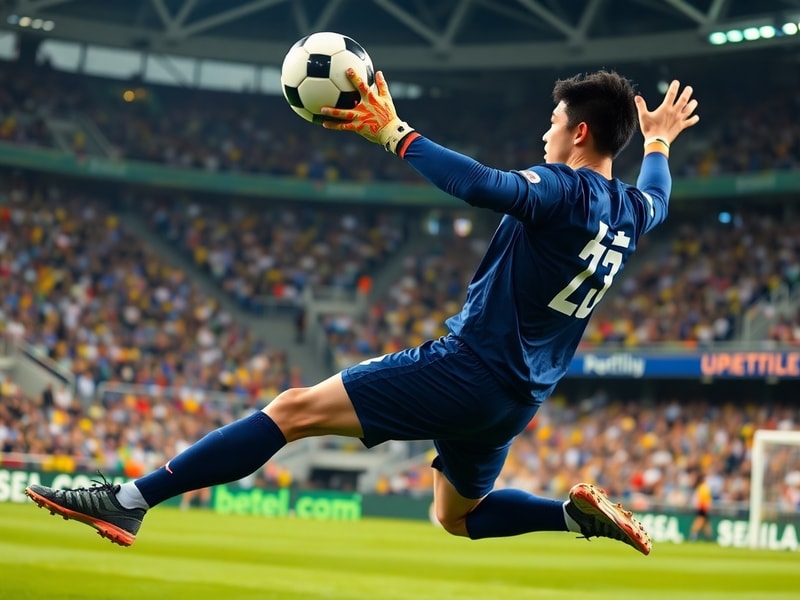
The role of a goalkeeper in Japanese football has evolved dramatically over the past two decades, shifting from a position of relative obscurity to one of immense tactical importance. While Japan’s national team and domestic league, J.League, have long been celebrated for their technical midfielders and creative forwards, the evolution of the goalkeeper has been just as critical to the country’s footballing progress. No longer seen as mere shot-stoppers, Japanese goalkeepers today are expected to command their penalty areas with authority, play out from the back with composure, and even contribute to buildup play. This transformation reflects broader trends in modern football, where the goalkeeper’s role extends far beyond traditional shot-stopping duties.
The Rise of the Japanese Goalkeeper in the J.League
Japan’s J.League has long been a proving ground for technical footballers, but the development of goalkeepers has been particularly notable in recent years. Clubs such as Kawasaki Frontale, Gamba Osaka, and Vissel Kobe have prioritized goalkeepers who can operate as the 11th outfield player, a philosophy deeply embedded in the club’s possession-based systems. This shift mirrors the influence of European football, where goalkeepers like Alisson and Ederson have redefined the position.
One of the most influential figures in this evolution is Yosuke Kashiwagi, former goalkeeper and current coach at Urawa Red Diamonds. Kashiwagi, who played under the legendary Osvaldo Ardiles, emphasizes the importance of a goalkeeper’s ability to read the game rather than just make saves. “A modern Japanese goalkeeper must have excellent footwork and spatial awareness,” Kashiwagi explained in a 2022 interview. “It’s not just about reflexes anymore—it’s about decision-making under pressure.”
This philosophy has led to the emergence of goalkeepers like Shota Arai, who made headlines in 2023 for his performances with FC Tokyo. Arai’s ability to play out from the back and initiate attacks has drawn comparisons to European counterparts like Marc-André ter Stegen. His composure under pressure and distribution skills have made him a key asset in FC Tokyo’s buildup play, demonstrating how the role of the goalkeeper in Japan is becoming indistinguishable from that of an outfield player.
Japan’s National Team and the Goalkeeper Dilemma
The Japanese national team’s reliance on a strong goalkeeper has been a recurring theme in recent tournaments. At the 2022 FIFA World Cup in Qatar, Japan’s run to the Round of 16 was largely built on the foundation of a resolute defensive line, anchored by goalkeeper Eiji Kawashima. At 40 years old, Kawashima became the oldest outfield player in World Cup history, a testament to his longevity and adaptability. His leadership and shot-stopping ability were instrumental in Japan’s victories over Germany and Spain, two of the tournament’s biggest upsets.
However, the national team faces a generational transition. Kawashima’s retirement in 2023 has left a void that the Japan Football Association (JFA) is still trying to fill. The current crop of goalkeepers vying for the number one spot includes Daniel Schmidt, who plays for Belgian club Sint-Truiden, and Makoto Hasebe, a veteran defender-turned-goalkeeper who briefly filled in during emergencies. Schmidt, who made his debut for Japan in 2019, has drawn praise for his reflexes and command of the penalty area, but questions remain about his consistency in high-pressure situations.
Japan’s coaching staff, led by Hajime Moriyasu, has emphasized the need for a goalkeeper who can excel in both shot-stopping and distribution. This dual requirement reflects Japan’s tactical evolution under Moriyasu, who has prioritized a high-pressing, possession-based style. A goalkeeper who can play out from the back is now a non-negotiable asset. “We need someone who can start attacks from the back,” Moriyasu told reporters in 2023. “It’s not just about saving goals—it’s about creating them.”
Key Attributes of a Modern Japanese Goalkeeper
To thrive in today’s football landscape, Japanese goalkeepers must possess a unique blend of skills. Here are the most critical attributes:
- Distribution: Ability to play short passes to defenders and launch counters with long balls.
- Footwork: Comfortable in tight spaces, able to dribble past pressing forwards.
- Positional Awareness: Anticipates danger before it materializes, reducing the need for last-ditch saves.
- Reflexes: Sharp reactions to close-range shots, a hallmark of traditional goalkeeping.
- Leadership: Vocal presence in organizing the defensive line and communicating with teammates.
The Broader Implications for Asian Football
Japan’s goalkeeper development is not an isolated phenomenon—it reflects a broader shift in Asian football. Countries like South Korea and Australia have also begun prioritizing the technical development of goalkeepers, recognizing that the position is now a critical component of modern football tactics. This evolution aligns with the growing influence of European coaching methods in Asia, where clubs and national teams are increasingly adopting possession-based systems.
However, challenges remain. Many young Japanese goalkeepers still face pressure to conform to traditional shot-stopping roles, particularly in lower-tier clubs or regional academies. The JFA has responded by implementing goalkeeper-specific training programs, such as the JFA Goalkeeper Academy, which focuses on technical development and tactical education. These initiatives aim to produce goalkeepers who can compete at the highest levels, whether in the J.League, European leagues, or the national team.
Another critical factor is the increasing presence of foreign goalkeepers in the J.League. Players like Mitchell Langerak, who joined Nagoya Grampus in 2023, bring a wealth of experience from European leagues. Their influence has raised the standard of goalkeeping in Japan, pushing local talents to improve their technical and tactical abilities. Langerak’s ability to command the box and distribute the ball has set a new benchmark for Japanese goalkeepers to aspire to.
The Future of Japanese Goalkeeping
The trajectory of Japanese goalkeeping is clear: the position will continue to evolve toward a more technical and tactical role. As Japan prepares for the 2026 FIFA World Cup, the JFA is likely to invest heavily in goalkeeper development, with a focus on producing players who can compete with the best in the world. The success of goalkeepers like Arai and Schmidt suggests that Japan is on the right path, but the ultimate test will come in major tournaments where mistakes are unforgiving.
For aspiring goalkeepers in Japan, the message is simple: adapt or be left behind. The days of goalkeepers being judged solely on their shot-stopping ability are over. Today, a goalkeeper must be a complete footballer—comfortable with the ball at their feet, capable of reading the game, and resilient under pressure. Those who embrace this evolution will not only shape the future of Japanese football but also redefine the role of the goalkeeper in Asian football as a whole.
As the J.League and the national team continue to push the boundaries of what is expected from goalkeepers, one thing is certain: the position is no longer an afterthought. It is a cornerstone of Japan’s footballing identity, and its evolution will be a defining factor in the country’s quest for international success.