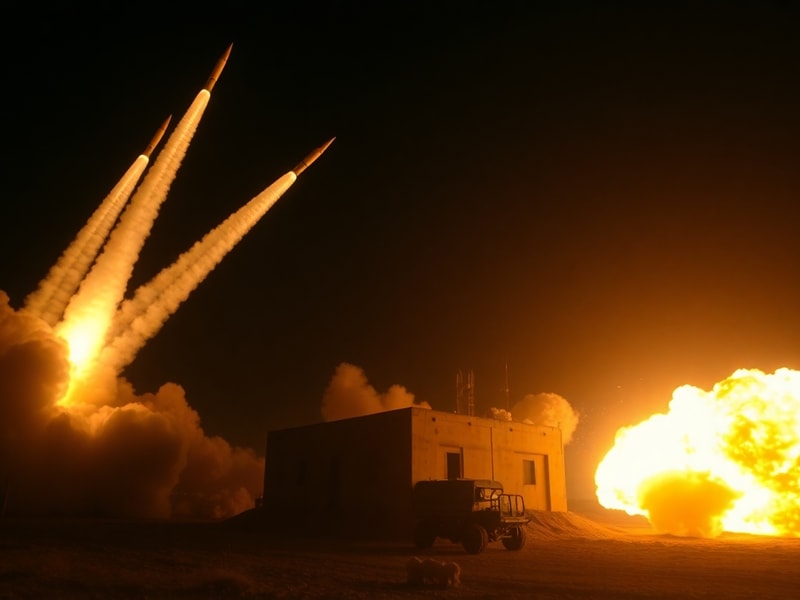
US Military Strikes Iranian-Backed Groups in Syria and Iraq
The Pentagon confirmed early Wednesday that US military forces conducted precision strikes against three Iranian-backed militia sites in Syria and Iraq. The operation targeted facilities used by groups affiliated with Iran’s Islamic Revolutionary Guard Corps (IRGC), according to a statement from US Central Command (CENTCOM). The move comes amid escalating regional tensions following a series of attacks on American personnel and allies in the Middle East.
CENTCOM reported that the strikes were in direct response to a drone attack on a US base in northeast Syria on March 23, which killed three American contractors and wounded six US service members. The Pentagon identified the militia responsible as part of the umbrella group known as the Islamic Resistance in Iraq, which has been linked to numerous hostile actions against coalition forces in recent months.
The operation marks the latest in a series of tit-for-tat engagements between Washington and Tehran’s proxy forces across the Middle East. Since October 7, regional tensions have surged, with over 150 attacks on US and allied targets in Iraq, Syria, and the Red Sea attributed to groups backed by Iran. These incidents have raised concerns about the potential for broader conflict, especially as the war in Gaza continues to strain diplomatic relations between Israel and its neighbors.
Regional Repercussions and Diplomatic Fallout
The strikes immediately drew condemnation from Tehran, with Iran’s Foreign Ministry spokesman Nasser Kanani calling the action a “violation of international law” and vowing retaliation. Iranian state media framed the US strikes as an act of aggression, while also emphasizing the country’s support for “resistance groups” across the region. Analysts note that Iran’s response is likely to be measured but calculated, possibly targeting US interests through proxies in Yemen, Lebanon, or Syria.
Across the Arab world, reactions have been mixed. While some governments in the Gulf have quietly supported US efforts to counter Iranian influence, others have expressed concern over the risk of further destabilization. Egypt and Jordan, both facing internal challenges, have urged restraint to prevent a wider regional conflict. Meanwhile, Iraq’s government condemned the strikes as a violation of its sovereignty, summoning the US ambassador in Baghdad to protest the operation.
The strikes also highlight the delicate balance the Biden administration must maintain. With elections looming, the White House faces pressure to demonstrate strength against Iranian aggression while avoiding a full-scale military confrontation. The US has repeatedly stated it does not seek war with Iran but will defend its personnel and interests. This strategy has so far included a mix of deterrence, diplomacy, and targeted military action.
Humanitarian Concerns in Syria and Iraq
Civilian impact remains a critical concern following the strikes. Local reports from Syria indicate that the targeted facilities were located near residential areas in eastern Deir ez-Zor province. While the Pentagon insists the operation was conducted with precision to minimize collateral damage, activists on the ground report at least two civilian casualties, including a child. The Syrian Observatory for Human Rights, a UK-based monitoring group, described the strikes as “indiscriminate,” though its claims have not been independently verified.
In Iraq, the strikes hit positions in the semi-autonomous Kurdistan region, where Iranian-backed militias have established a foothold in recent years. The Kurdistan Regional Government (KRG) condemned the operation, calling it a violation of Iraqi sovereignty. Local officials in Erbil reported power outages and disruptions to civilian infrastructure following the strikes, raising fears of broader destabilization in an already fragile region.
Humanitarian organizations have warned that further military escalation could exacerbate an already dire situation. Syria remains mired in a 13-year civil war, with millions displaced and dependent on international aid. Iraq, while more stable, still grapples with political instability and the lingering influence of armed groups. The US strikes risk compounding these challenges, particularly if they trigger retaliatory attacks on critical infrastructure such as oil fields or water treatment facilities.
International aid groups have called for de-escalation, emphasizing the need to protect civilians caught in the crossfire. “Any military action must adhere to international humanitarian law,” said a spokesperson for the International Committee of the Red Cross (ICRC). “The protection of civilians and civilian infrastructure is paramount, especially in conflict zones where populations are already vulnerable.”
What Comes Next? Assessing the Path Forward
The US strikes represent a calculated but risky move in an increasingly volatile region. Analysts suggest several potential scenarios for how events might unfold in the coming weeks. One possibility is a cycle of retaliatory attacks, with Iranian-backed groups targeting US forces or allies in Iraq, Syria, or the Persian Gulf. Another scenario involves Iran leveraging its diplomatic channels to rally support from regional partners, potentially isolating the US diplomatically.
There is also the question of Israel’s role in the unfolding crisis. While Israel has not directly commented on the US strikes, its ongoing military operations in Gaza and recent strikes in Lebanon have already heightened tensions with Hezbollah and other Iranian proxies. A broader conflict involving Israel, Iran, and their respective allies could draw in the US, further complicating regional stability.
For now, the Biden administration appears committed to a strategy of deterrence without escalation. The Pentagon has reiterated its willingness to defend US personnel but has also signaled openness to dialogue. “We remain committed to de-escalation and diplomatic solutions,” said a senior US defense official. “However, we will not hesitate to take action to protect our people and our interests.”
As the situation develops, the international community will be watching closely. The strikes in Syria and Iraq are not isolated incidents but part of a broader pattern of conflict in the Middle East. Whether this latest round of violence leads to further destabilization or serves as a deterrent remains to be seen. What is clear is that the stakes have never been higher for a region already on the brink.
For those interested in the broader geopolitical implications of this crisis, our Politics section offers deeper analysis on the shifting alliances in the Middle East. Meanwhile, our News page provides real-time updates on the evolving situation.