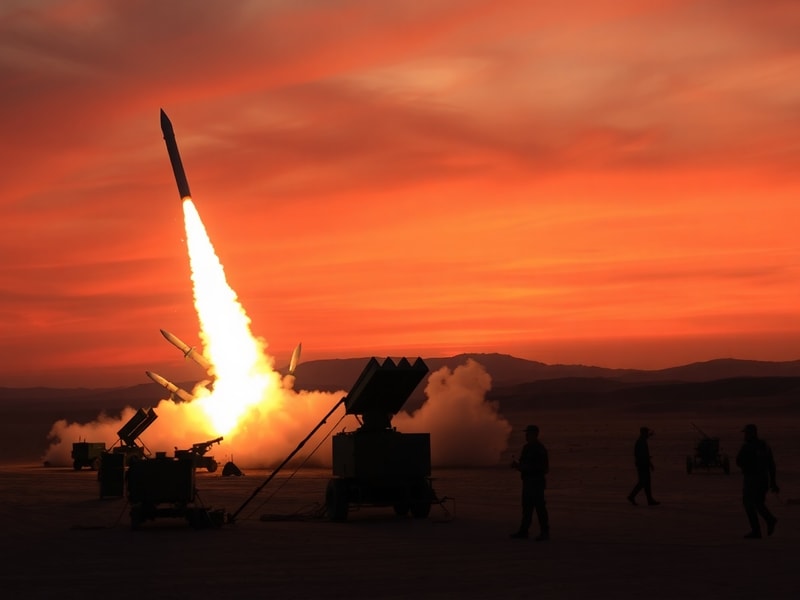
Iran’s recent military actions have reignited tensions across the Middle East, drawing sharp reactions from global powers and regional allies alike. The strikes, which targeted Israeli military sites and facilities linked to Iran-backed militant groups, underscore the escalating shadow war between the two nations. Analysts warn that these attacks could push the region closer to a broader conflict, with ripple effects felt from Lebanon to Yemen.
Israel’s response, characterized by precision airstrikes and coordinated operations with regional partners, suggests a carefully calculated strategy to degrade Iran’s military capabilities without triggering a full-scale war. The operation reportedly destroyed key radar installations and missile depots in central and western Iran, demonstrating Israel’s ability to project power deep into Iranian territory. Yet, the tactical success does little to address the underlying geopolitical tensions fueling the cycle of retaliation.
Roots of the Escalation: A Decade of Hostilities
The current confrontation is the latest chapter in a decades-long struggle between Israel and Iran, rooted in ideological opposition, nuclear ambitions, and proxy conflicts. Tensions surged in April 2024 when Israel launched a preemptive strike on an Iranian consulate in Damascus, killing several high-ranking military officials. Iran retaliated with a direct missile and drone attack on Israeli soil, marking the first time it had launched such an assault from its own territory.
This exchange set the stage for the most recent strikes. Iran’s Islamic Revolutionary Guard Corps (IRGC) has long provided funding, weapons, and training to groups like Hezbollah in Lebanon and Hamas in Gaza, enabling them to challenge Israeli military dominance. Israel, in turn, has targeted these proxy forces with covert operations and overt strikes, including assassinations of key figures and sabotage of nuclear facilities. The cycle of violence shows no signs of abating, as each side views deterrence as its top priority.
Analysts point to Iran’s nuclear program as a central flashpoint. Despite international agreements like the JCPOA, which aimed to curb Iran’s uranium enrichment, Tehran has steadily expanded its nuclear capabilities in recent years. The International Atomic Energy Agency (IAEA) has documented increased enrichment levels and restricted access to inspection sites, raising concerns about Iran’s long-term intentions. Israel, which has repeatedly stated it will not allow Iran to acquire nuclear weapons, has hinted at further military action if diplomatic efforts fail.
The Regional Fallout: Who Bears the Cost?
The immediate victims of the latest strikes are not just Iran and Israel, but the broader Middle East, where proxy wars have already destabilized entire nations. Lebanon, already grappling with economic collapse and political paralysis, faces renewed threats from Hezbollah, which has vowed retaliation against Israel. The group’s arsenal of rockets and missiles, many of which are precision-guided, could overwhelm Israeli defenses and trigger a devastating war in the north.
In Yemen, the Iran-backed Houthi rebels have also stepped up attacks on Red Sea shipping lanes, disrupting global trade and drawing retaliatory strikes from a U.S.-led coalition. These actions, while not directly tied to the Iran-Israel conflict, illustrate how regional tensions can spiral into broader crises. The Houthi movement’s slogan—“Death to America, Death to Israel”—reflects its alignment with Iran’s anti-Western stance, further entrenching the proxy dynamic.
- Lebanon: Hezbollah’s arsenal and proximity to Israel make it a critical player in any escalation, with potential consequences for civilians on both sides of the border.
- Gaza: Hamas, another Iranian proxy, remains a volatile actor, especially amid stalled ceasefire negotiations and ongoing humanitarian crises.
- Syria: The Assad regime, backed by Iran and Russia, has become a battleground for covert operations, with Israel frequently targeting Iranian military installations.
- Yemen: The Houthis’ attacks on shipping lanes have global implications, highlighting how regional conflicts can disrupt international commerce.
Beyond the immediate military impacts, the economic toll of prolonged conflict is staggering. Oil prices have surged in response to the strikes, reflecting fears of supply disruptions in a region that accounts for nearly a third of global oil production. Countries like Saudi Arabia and the United Arab Emirates, which have sought to balance relations with both Iran and Israel, now face pressure to mediate or risk further instability.
Global Powers Weigh In: Diplomacy or Escalation?
The international community’s response to the Iran-Israel conflict has been fragmented, with major powers divided over how to de-escalate tensions. The United States, Israel’s strongest ally, has reiterated its commitment to Israel’s security while urging restraint. President Biden’s administration has dispatched senior officials to the region, including CIA Director William Burns, to explore diplomatic avenues. However, the U.S. has also signaled its support for Israel’s right to self-defense, complicating efforts to broker a ceasefire.
Russia and China, both of which maintain close ties with Iran, have called for restraint but stopped short of condemning Iran’s actions. Moscow, which has leveraged its relationship with Tehran to expand its influence in the Middle East, may seek to position itself as a mediator. Beijing, meanwhile, has emphasized the importance of dialogue but has not taken a firm stance against Iran’s military actions. Their reluctance to criticize Iran reflects broader geopolitical alignments, with both countries viewing the U.S. as a rival.
Europe’s response has been more cautious, with leaders like French President Emmanuel Macron urging both sides to avoid further escalation. The European Union has imposed sanctions on Iranian entities linked to the IRGC, targeting their financial networks and military supply chains. However, these measures have done little to curb Iran’s aggressive posture, as the IRGC operates with significant autonomy from civilian oversight.
For its part, the United Nations has struggled to pass meaningful resolutions due to veto threats from the U.S. and Russia. Secretary-General António Guterres has warned that the region is “on the brink of a wider conflagration,” but the UN’s limited leverage underscores the challenges of multilateral diplomacy in a polarized geopolitical landscape.
What’s Next? Scenarios for the Path Forward
The coming weeks will be critical in determining whether the current cycle of violence escalates into a full-blown war or de-escalates into a tense stalemate. Several scenarios could unfold, each with distinct implications for the region and beyond.
- Limited Retaliation: Iran may opt for symbolic strikes or cyberattacks to save face without provoking a devastating Israeli response. Such actions could allow both sides to declare victory and return to a state of uneasy calm.
- Proxy Escalation: Iran-backed militias in Lebanon, Syria, or Yemen could launch large-scale attacks on Israel, forcing the IDF to expand its operations. This scenario risks drawing Hezbollah and Hamas into direct conflict with Israel, with catastrophic consequences for civilians.
- Diplomatic Off-ramp: International pressure, particularly from European and Gulf states, could push Iran to engage in indirect talks with Israel via intermediaries. However, the trust deficit between the two nations makes meaningful negotiations unlikely without significant concessions.
- Regional War: A miscalculation or intentional escalation could trigger a broader conflict involving multiple state and non-state actors. Such a scenario could draw in the U.S., Russia, and other global powers, with unpredictable consequences.
The most plausible outcome, according to many analysts, is a continuation of the current pattern: sporadic strikes, covert operations, and proxy conflicts that maintain a state of perpetual tension. This “gray zone” warfare allows both Israel and Iran to avoid all-out war while advancing their strategic objectives. However, the risk of miscalculation remains high, as evidenced by the 2020 U.S. strike that killed Iranian General Qasem Soleimani, which nearly pushed the two nations to the brink of war.
For now, the focus remains on preventing further escalation. Israel has signaled its willingness to accept a measured response from Iran, provided it does not cross certain red lines. Meanwhile, Iran’s leadership, facing domestic pressure over economic woes and political unrest, may seek to balance its aggressive posture with domestic concerns.
The path forward will depend on the actions of key players in the coming days. Diplomats will scramble to find a solution, while military planners on both sides prepare for the worst. One thing is clear: the Middle East’s fragile balance of power is once again at risk, and the consequences of failure could be dire.
For deeper insights into the region’s shifting alliances, explore our Analysis section, where experts dissect the geopolitical implications of these events. To track the humanitarian impact of the conflict, visit our News category for real-time updates.