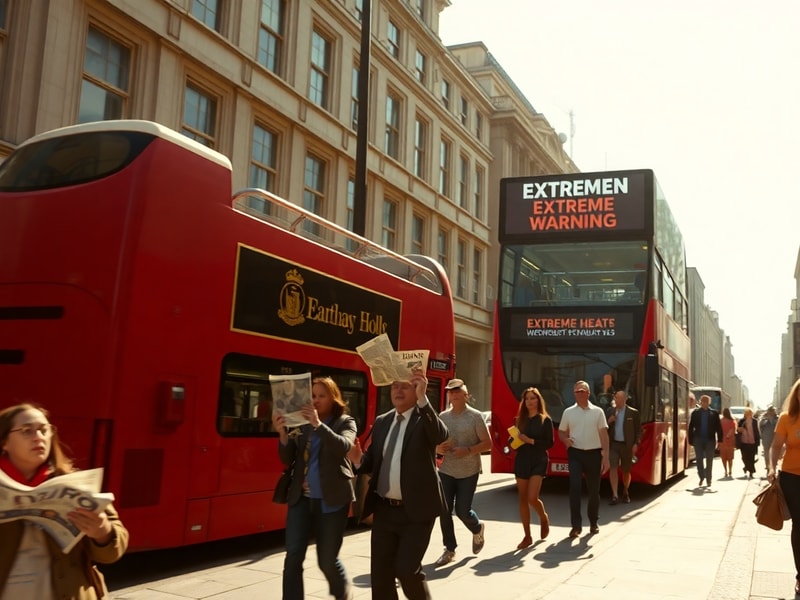
The Met Office’s amber extreme heat weather warning for London and southeast England isn’t just another seasonal alert. It arrived on the heels of Europe’s relentless June heatwaves—Madrid touched 40°C while Rome neared 42°C—making London’s projected peak of 33°C feel almost mild by comparison. Yet the city’s infrastructure, designed for a temperate maritime climate, now strains under the weight of rapid urbanisation and climate change. London’s built environment, from the Victorian terraces of Islington to the glass towers of Canary Wharf, absorbs and retains heat, creating urban heat islands that can be 10°C warmer than surrounding rural areas.
This isn’t merely a meteorological event. It’s a cultural and economic stress test. Tourism slows as outdoor attractions like the South Bank and Hyde Park’s Serpentine Lido see reduced footfall. Meanwhile, the Tube’s Central Line, notorious for its heat-trapping tunnels, becomes a symbol of systemic vulnerability. The warning isn’t just about health risks—though those are severe—but about the city’s ability to function when the basics of urban life falter under extreme conditions.
Why London’s heat warnings are becoming routine
London’s first extreme heat warning arrived in July 2022. Since then, the Met Office has issued five such alerts in just three years. The pattern mirrors global trends: 2023 was the hottest year on record, and 2024 is on track to surpass it. While the UK has historically avoided the kind of prolonged heat seen in southern Europe or the Middle East, the shift is undeniable. Scientists attribute it to a combination of natural variability and human-driven climate change, with urbanisation amplifying the effects.
The city’s response has been reactive rather than proactive. Emergency cooling centres, like those opened during the 2022 heatwave, remain temporary solutions. London’s housing stock is particularly vulnerable: nearly 60% of homes were built before insulation standards improved, and many lack air conditioning. The disparity is stark—luxury developments in Nine Elms boast climate control, while social housing in Tower Hamlets or Newham suffers in poorly ventilated flats. This inequality exposes how climate adaptation is becoming another marker of urban privilege.
A global perspective reveals similar pressures elsewhere. In Delhi, where temperatures regularly exceed 45°C, residents adapt through siestas and evaporative cooling. In Tokyo, the city government has invested in heat-resistant pavements and misting stations. London, by contrast, still relies on a patchwork of Victorian infrastructure and late-20th-century planning. The warning isn’t just about the weather—it’s about the city’s outdated resilience model.
The health and economic toll of extreme heat
Heatwaves kill more people in the UK than floods, storms, or cold snaps combined. During the 2022 heatwave, NHS England recorded over 2,800 excess deaths, with elderly and vulnerable populations most affected. The pattern holds globally: the 2003 European heatwave killed an estimated 70,000 people, while India’s 2022 heatwave led to a surge in hospitalisations for heatstroke and dehydration. In London, the burden falls disproportionately on those without access to cool spaces—homeless individuals, outdoor workers, and low-income families.
The economic impact is equally severe. Transport disruptions cost the UK economy hundreds of millions annually. In 2018, a heatwave forced Network Rail to impose speed restrictions on tracks, causing widespread delays. London’s transport systems weren’t designed for extreme heat—neither the Tube’s steel tunnels nor the Overground’s rubber wheels. Meanwhile, the hospitality sector sees a dip in tourism, with outdoor dining and attractions losing custom. Yet some businesses benefit: ice cream vendors and air conditioning suppliers report record sales during heatwaves, highlighting the uneven distribution of costs and gains.
Globally, the pattern repeats. In Las Vegas, casinos and hotels ramp up their cooling systems, pushing electricity demand to record highs. In Athens, archeological sites close during peak heat to protect both visitors and ancient artifacts. London’s cultural sector faces a similar dilemma—museums like the Tate Modern and the British Museum struggle to maintain stable temperatures for priceless artworks while keeping galleries open to the public. The warning isn’t just a health alert; it’s a challenge to the city’s identity as a global cultural hub.
What London can learn from global heatwave strategies
Cities that have adapted to extreme heat offer valuable lessons. In Melbourne, the ‘Cool Routes’ initiative maps pedestrian paths shaded by trees and buildings, encouraging walking during hot weather. In Singapore, ‘Park Royal on Pickering’ incorporates green walls and rooftop gardens to reduce urban heat. Meanwhile, in Los Angeles, the city has painted streets with reflective coatings to lower surface temperatures by up to 10°C. London’s approach so far has been piecemeal—planting trees in wealthy boroughs like Kensington while neglecting areas like Hackney or Barking.
Urban greening is a start, but it’s not enough. London needs a systemic overhaul: retrofitting buildings with heat-reflective materials, expanding public cooling centres, and redesigning public transport to withstand extreme temperatures. The Greater London Authority’s ‘London Environment Strategy’ aims for 50% tree canopy cover by 2050, but progress is slow. Meanwhile, the private sector is stepping in where government lags—developers in King’s Cross and Battersea are incorporating passive cooling designs into new builds, but these remain exceptions rather than the rule.
Globally, the challenge is one of equity. Cities like Paris and Barcelona have implemented ‘heat action plans’ that include early warning systems, public cooling spaces, and targeted support for vulnerable groups. London’s plan, while improved since 2022, still lacks the granularity to address neighbourhood-specific risks. Without coordinated action, the city risks deepening existing inequalities—between the heat-resilient and the heat-vulnerable, the cooled and the overheated.
The cultural shift: from heatwave to heat resilience
Extreme heat is reshaping London’s cultural calendar. Summer festivals like Notting Hill Carnival and Pride in the Park are increasingly held in shaded or indoor venues. Even the city’s nightlife is adapting—bars and clubs in Shoreditch and Soho now install misting fans and prioritise venues with air conditioning. Yet this shift isn’t just practical; it’s cultural. Heatwaves are forcing Londoners to rethink their relationship with the city’s outdoors. What was once a source of pride—London’s green spaces, its walkable streets—now feels like a liability.
The city’s architecture is also evolving. Traditional brick terraces are being replaced by glass-fronted offices and residential towers, which trap heat. Meanwhile, retrofitting older buildings with insulation and reflective coatings is costly and disruptive. The result is a city where the past and present collide under the weight of an uncertain climate. London’s skyline, once defined by historic landmarks and modern spires, is now framed by the looming challenge of heat resilience.
Globally, this cultural shift is mirrored in art, literature, and public discourse. In Australia, heatwaves have inspired a wave of dystopian fiction, from Charlotte Wood’s The Natural Way of Things to Jane Rawson’s A Wrong Turn at the Office of Unmade Lists. In Europe, artists like Olafur Eliasson have used heat as a medium, creating installations that force audiences to confront the physical reality of rising temperatures. London, by contrast, has been slower to engage with the cultural dimensions of climate change. The extreme heat warning isn’t just a signal of environmental change—it’s an invitation to reimagine the city itself.
As London braces for another sweltering summer, the warning serves as a reminder: this isn’t an anomaly, but a new normal. The city’s ability to adapt will define its future—not just in terms of infrastructure, but in how it values its residents, its culture, and its place in a warming world. The challenge isn’t just meteorological; it’s existential.