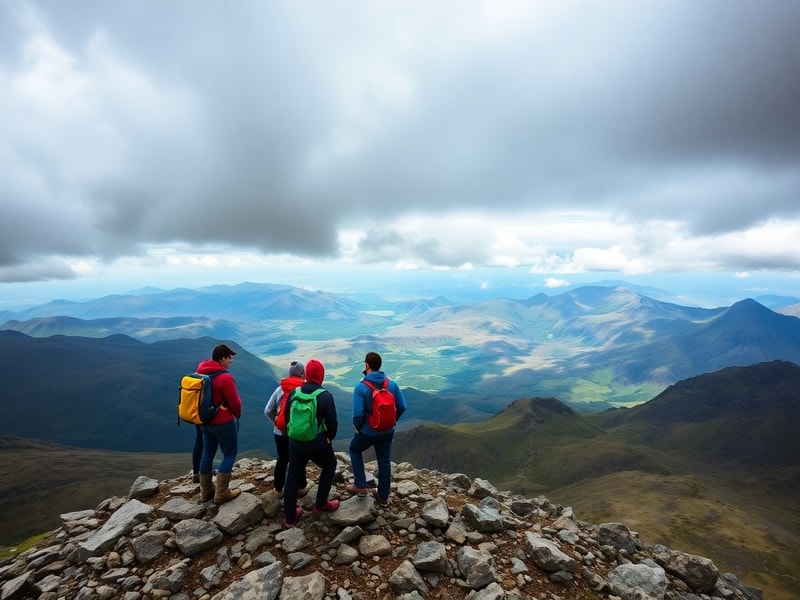
The National Three Peaks Challenge is one of Britain’s most iconic endurance events, drawing thousands of participants each year to tackle the highest mountains in England, Scotland, and Wales in a single push. The route covers 421 miles of road travel and 30,000 feet of ascent, culminating in the summits of Ben Nevis, Scafell Pike, and Snowdon. Unlike multi-day trekking challenges, the Three Peaks is typically completed within 24 hours, pushing even seasoned hikers to their limits.
What makes this challenge so compelling is its blend of physical endurance, logistical planning, and mental resilience. Participants traverse diverse landscapes—from the rugged highlands of Scotland to the rolling peaks of the Lake District and the dramatic cliffs of Snowdonia. For many, it’s not just about reaching the summits but proving they can endure the grueling travel and sleep deprivation that comes with the territory. Weather plays a critical role, too, with conditions often shifting from calm to extreme within hours, adding an unpredictable element to the challenge.
Over the years, the Three Peaks has evolved from a niche mountaineering test into a mainstream endurance event, attracting charity fundraisers, corporate teams, and solo adventurers alike. Its accessibility—no technical climbing skills are required—has broadened its appeal, though the physical demands remain formidable. Whether you’re a first-timer or a seasoned peak bagger, the challenge offers a chance to push boundaries while experiencing some of the UK’s most breathtaking scenery.
The origins and evolution of the Three Peaks Challenge
The National Three Peaks Challenge traces its roots back to the early 20th century, when British mountaineers began exploring the idea of summiting the highest peaks in each of the three nations. The concept gained traction in the 1950s and 1960s as a way to test endurance and stamina without the need for extreme alpine climbing. By the 1970s, organized events started emerging, with clubs and societies formalizing the route and time constraints.
Originally, the challenge was more of a personal test than a competitive event. Hikers would complete it over several days or even weeks, allowing time to recover between peaks. However, as its popularity grew, so did the pressure to finish within a tighter window. Today, most participants aim to complete the challenge in under 24 hours, a feat that requires meticulous planning, teamwork, and sheer determination.
The event’s shift toward charity fundraising in the 1990s and 2000s further cemented its place in British culture. Groups began organizing sponsored treks, raising millions for causes ranging from cancer research to mental health awareness. This transformation turned the Three Peaks from a niche adventure into a widely recognized endurance challenge, with hundreds of events held annually.
Despite its mainstream appeal, purists argue that the commercialization of the challenge has diluted its original spirit. Some traditionalists prefer the slower, more contemplative approach of tackling each peak separately, allowing time to appreciate the journey rather than rushing from one summit to the next. Yet, there’s no denying that the modern iteration has introduced the challenge to a much wider audience.
What to expect on the route: A breakdown of the peaks and logistics
The Three Peaks Challenge follows a strict order: Ben Nevis in Scotland, Scafell Pike in England, and Snowdon in Wales. This sequence is designed to minimize travel time between peaks, though the road miles still add up to a staggering 421. Most teams break the journey into three legs, each with its own set of challenges.
Here’s a breakdown of what participants can expect:
- Ben Nevis (1,345m / 4,413ft) – The highest peak in the UK, located in the Scottish Highlands. The ascent typically takes 7-9 hours via the Mountain Track, with steep, rocky terrain. Weather conditions can change rapidly, from clear skies to blizzard-like winds. The descent is equally demanding, with loose scree slowing progress.
- Scafell Pike (978m / 3,209ft) – England’s highest mountain, situated in the Lake District. The route often follows the Mickledore route, which involves scrambling over rocks and a narrow ridge. The terrain here is more technical than Ben Nevis, requiring careful footwork. The descent is steep and can be slippery, even in dry conditions.
- Snowdon (1,085m / 3,560ft) – The highest peak in Wales, found in Snowdonia National Park. The Llanberis Path is the most popular route, offering a steady but long ascent. Weather here is notoriously unpredictable, with cloud cover reducing visibility to near zero. The final push to the summit can feel like a race against time, especially if teams are running behind schedule.
Between peaks, teams must account for travel time, which can stretch into the early hours of the morning. The drive from Ben Nevis to Scafell Pike alone takes around 5-6 hours, while the journey from Scafell Pike to Snowdon can take up to 7 hours. Factor in rest stops, meal breaks, and potential delays, and it’s clear why sleep deprivation is a common issue.
Logistics are just as critical as physical preparation. Teams must decide whether to tackle the challenge in a single push or split it into two days, with an overnight rest in between. Some opt for a hybrid approach, summiting two peaks in one day and the third the next. However, this increases the risk of fatigue setting in before the final climb.
For those considering the challenge, travel guides and route-planning resources are invaluable. Understanding the terrain, weather forecasts, and road conditions can mean the difference between success and failure.
The physical and mental demands of the challenge
Completing the Three Peaks Challenge is as much a mental battle as it is a physical one. The cumulative effect of 30,000 feet of ascent, 421 miles of driving, and minimal sleep creates a unique form of exhaustion. Most participants report hitting a wall at some point, whether it’s during the ascent of Ben Nevis or the final push up Snowdon.
Physical preparation is non-negotiable. A typical training plan spans 8-12 weeks, focusing on endurance, strength, and hill walking. Many participants incorporate long-distance hikes into their routine, such as the South West Coast Path or the Pennine Way, to build stamina. Strength training for the legs and core is also essential, as the descent from peaks can be just as taxing as the ascent.
Mental resilience is equally important. The challenge forces participants to confront fatigue, doubt, and even fear—especially when weather conditions deteriorate. Some teams use strategies like breaking the route into smaller, manageable segments or setting mini-goals to stay motivated. Others rely on camaraderie, with groups supporting each other through the toughest sections.
Sleep deprivation is another major hurdle. Most teams get only 2-3 hours of sleep between peaks, often in cramped vehicles or rest stops. This lack of rest impairs decision-making and reaction times, increasing the risk of accidents on the trail. Some participants use caffeine or energy supplements to stay alert, though these come with their own drawbacks.
Injuries are also a common issue. Blisters, twisted ankles, and muscle strains are frequent occurrences, particularly on the technical sections of Scafell Pike. Proper footwear, trekking poles, and first-aid kits are essential to mitigate these risks. Many teams also carry spare socks and blister plasters, knowing that foot care can make or break their attempt.
Despite the challenges, the sense of achievement upon completing the Three Peaks is unparalleled. Crossing the finish line—whether it’s the summit of Snowdon or the final mile of the drive home—often brings a mix of relief, euphoria, and exhaustion. For many, it’s a life-changing experience that fosters a deeper appreciation for the outdoors and the limits of human endurance.
Controversies and ethical considerations
The National Three Peaks Challenge has not been without its controversies. Environmentalists have long criticized the event for its impact on fragile ecosystems, particularly in Snowdonia and the Lake District. The sheer volume of participants—estimated at over 40,000 annually—leads to erosion, littering, and disturbance to wildlife. Some conservation groups argue that the challenge should be restricted or even banned to protect these areas.
Another point of contention is the commercialization of the challenge. Many events are organized by companies that charge fees for participation, often in the hundreds of pounds. Critics argue that these events prioritize profit over safety, with some groups cutting corners on training or equipment to meet fundraising targets. In 2022, emergency services in Snowdonia reported a surge in callouts during peak challenge season, with many incidents involving ill-prepared participants.
Ethical concerns also arise around the use of vehicles for the road sections of the challenge. While teams are required to carpool to reduce emissions, the carbon footprint of 421 miles of driving per participant is substantial. Some environmental groups advocate for a more sustainable approach, such as completing the peaks over a longer period or using public transport where possible.
Despite these issues, the challenge continues to grow in popularity. Proponents argue that the physical and mental benefits—along with the fundraising potential—outweigh the drawbacks. However, there’s a growing movement within the outdoor community to promote more responsible forms of the challenge, such as the “Three Peaks in Three Days” approach, which spreads the effort over a longer period and reduces environmental impact.
For those considering taking on the challenge, it’s worth reflecting on these ethical considerations. Supporting local conservation efforts, minimizing waste, and ensuring proper training can help mitigate some of the negative impacts. After all, the goal should be to celebrate the beauty of Britain’s mountains—not to exploit them.
The National Three Peaks Challenge is more than just a test of endurance; it’s a rite of passage for many adventurers. Whether you’re drawn to the physical challenge, the fundraising opportunities, or the sheer beauty of the landscapes, completing the Three Peaks is an experience that stays with you long after the drive home. But as with any challenge, success depends on preparation, respect for the environment, and a deep appreciation for the journey itself.