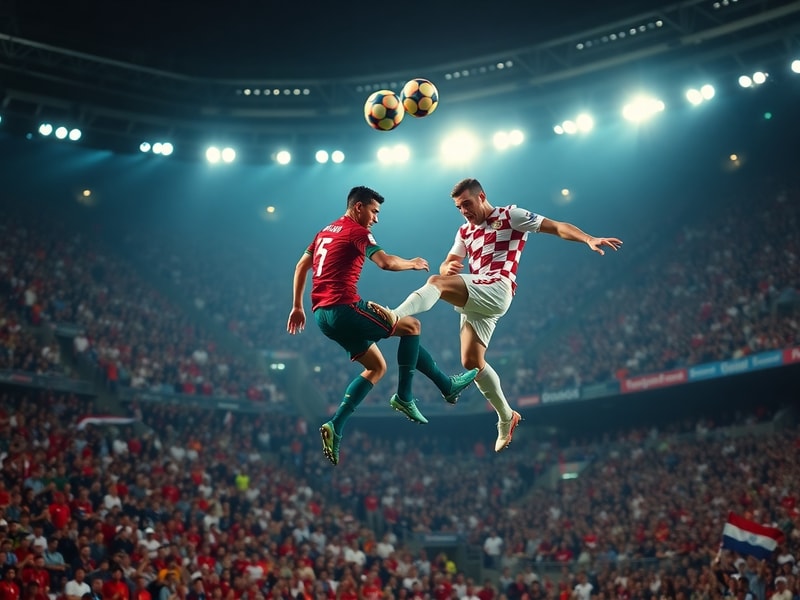
When Portugal and Croatia take the pitch, football fans aren’t just watching a match—they’re witnessing a clash between two distinct footballing identities forged over decades. Both nations have punched above their weight on the global stage, yet their paths to success couldn’t be more different. Portugal, the land of Cristiano Ronaldo, Eusébio, and a golden generation of technical playmakers, has built its reputation on creativity and flair. Croatia, meanwhile, is a side that has thrived through resilience, tactical discipline, and an unshakable collective spirit.
These two nations have met 10 times in competitive fixtures, with Portugal holding a slight edge, but the encounters have often been tight and decided by fine margins. Their most recent meeting in the UEFA Nations League in June 2023 ended 4-4 after extra time, a pulsating draw that underscored the intensity of their rivalry. Beyond the scoreboard, the matchup carries cultural and historical undertones, reflecting broader narratives about national identity, migration, and football’s role in shaping global narratives.
What makes the Portugal vs Croatia rivalry particularly compelling is how it mirrors the evolution of modern football. Portugal’s rise has been driven by investment in youth academies and the export of world-class talent, while Croatia’s achievements have come despite limited resources and a population smaller than many European cities. This contrast offers a fascinating lens through which to view football’s global dynamics, where ambition and pragmatism often collide.
The footballing philosophies: Beauty vs steel
Portugal’s football identity is synonymous with elegance and individual brilliance. The country’s footballing philosophy has long emphasized technical skill, fluid attacking play, and the cultivation of creative midfielders and forwards. Legends like Eusébio and Luís Figo embodied this tradition, and today, players such as Bruno Fernandes and Rafael Leão carry its torch. Portugal’s success in major tournaments—culminating in the 2016 European Championship and the 2019 UEFA Nations League—has been built on a foundation of technical mastery and tactical versatility.
Croatia, on the other hand, has built its reputation on structure, work rate, and collective resilience. The nation’s footballing culture emerged from a turbulent historical context, with many of its greatest players—from Davor Šuker to Luka Modrić—coming from communities shaped by conflict and migration. Their style reflects this background: disciplined, hardworking, and adaptable. Croatia’s third-place finish at the 2018 FIFA World Cup was not just a sporting achievement but a cultural statement, proving that a nation of just four million could compete with footballing superpowers.
The contrast in styles was evident during their Nations League clash in 2023. Portugal dominated possession, sprayed passes across the pitch, and unleashed waves of attacking pressure. Croatia absorbed the pressure with a compact defensive shape, absorbed the blows, and struck on the counter. The match ended in a thrilling draw, but it highlighted a deeper truth: in modern football, both approaches can coexist—and sometimes, they collide spectacularly.
This duality is not just about tactics; it reflects broader cultural values. Portuguese football often feels Mediterranean—sunlit, expressive, and improvisational. Croatian football, by contrast, carries a Central European edge: disciplined, strategic, and resilient. These cultural undercurrents make every match between the two a microcosm of their national identities.
A rivalry with global resonance
The Portugal vs Croatia rivalry has grown in significance as both nations have become central figures in European football. Their encounters draw audiences from Lisbon to Zagreb, from Rio de Janeiro to Tokyo, reflecting football’s global reach. But the rivalry’s appeal extends beyond the pitch. It touches on themes of migration, identity, and cultural exchange—issues that resonate deeply in today’s interconnected world.
Portugal has long been a magnet for migrants from former colonies such as Brazil, Angola, and Cape Verde, and this diversity is reflected in its national team. Players like Pepe and Danilo have enriched the squad with their backgrounds, while the influence of Brazilian football is evident in the technical style. Croatia, meanwhile, has seen waves of emigration, particularly during and after the Homeland War in the 1990s. Many Croatian players developed their careers abroad, in leagues like Germany, Italy, and England, bringing back tactical knowledge and discipline.
This shared experience of migration has created a subtle but meaningful connection between the two nations. Both have used football as a bridge, a way to project their identities onto the global stage. When Portugal and Croatia face off, it’s not just two teams competing—it’s two cultures engaging, sometimes clashing, and always evolving.
In 2022, a survey by UEFA revealed that football is the most popular sport in both countries, with over 70% of respondents in Portugal and Croatia citing it as their favorite. The passion is palpable, from the bustling cafés of Lisbon’s Alfama district to the open-air markets of Zagreb’s Dolac. Football is woven into the social fabric, a language that unites generations.
Key moments and turning points
The history between Portugal and Croatia is rich with pivotal moments that have shaped their rivalry. Let’s look at some of the most defining encounters:
- UEFA Euro 1996 Qualifier: Croatia’s first competitive match after independence ended in a 0-0 draw with Portugal. It was a symbolic moment—two young nations forging their identities on the international stage.
- FIFA World Cup 2014 Qualifier: Portugal won 4-2 on aggregate, with Cristiano Ronaldo scoring three goals. The tie showcased Ronaldo’s dominance and Portugal’s ability to grind out results in high-pressure moments.
- UEFA Euro 2016 Round of 16: Portugal defeated Croatia 1-0 in extra time, with the only goal scored by Ricardo Quaresma. The match was tense, physical, and decided by a moment of individual brilliance.
- UEFA Nations League 2022-23: The 4-4 thriller in June 2023 was a masterclass in attacking football, with both teams scoring late goals to force extra time. It was a match that captured the imagination of fans worldwide.
These fixtures are more than just results; they are chapters in a larger story. Each match builds on the previous one, creating a narrative arc that fans eagerly anticipate. The rivalry has matured over time, shifting from cautious respect to outright intensity, with both teams now viewing each other as legitimate rivals rather than mere opponents.
The psychological edge in this rivalry has also shifted. Portugal once held the upper hand, but Croatia’s consistency in major tournaments—including reaching the World Cup semifinals in 2018 and 2022—has levelled the psychological playing field. Today, neither team enters the fixture with a clear advantage. It’s a rivalry defined by parity and unpredictability.
Beyond the pitch: Cultural and social impact
The Portugal vs Croatia rivalry is more than a sporting contest; it’s a cultural dialogue. Football serves as a lens through which both nations project their identities, ambitions, and values. For Portugal, football is a celebration of creativity, diversity, and joy. The national team’s style reflects the country’s vibrant culture, its music, and its history as a global crossroads.
Croatia, meanwhile, uses football to assert its place on the world map. The success of the national team has become a source of national pride, especially in a country still healing from war and economic challenges. Football provides a narrative of resilience and hope—a way to tell the world that Croatia is more than its size or history.
This cultural dimension is evident in how both nations celebrate their footballing heroes. In Portugal, Cristiano Ronaldo is a global icon, his image plastered on billboards from Porto to Praia. In Croatia, Luka Modrić is revered not just for his skill but for his embodiment of Croatian grit and determination. Both players transcend sport, becoming symbols of national identity.
The rivalry has also fostered a sense of mutual respect. Players from both sides often speak highly of their opponents, acknowledging the quality and spirit that define each team. After the 2023 Nations League draw, both captains—Bruno Fernandes and Luka Modrić—praised the intensity of the match and the sportsmanship shown by their teams.
This respect extends to the fans. Portuguese supporters are known for their passion and creativity, often filling stadiums with colourful displays and chants. Croatian fans, meanwhile, bring a disciplined, organized energy, creating an electric atmosphere wherever they travel. The mutual admiration between the fanbases adds another layer to the rivalry, making it one of football’s most harmonious in terms of spirit.
A rivalry with a future
As we look ahead, the Portugal vs Croatia rivalry shows no signs of fading. With both nations continuing to produce world-class talent and both managers—currently Roberto Martínez and Zlatko Dalić—committed to building competitive sides, future encounters promise to be just as compelling.
Portugal’s golden generation, now in its prime, is set to dominate European football for years to come. With players like Bernardo Silva, João Félix, and Gonçalo Ramos maturing, the Seleção das Quinas is poised for another assault on major trophies. Croatia, meanwhile, is transitioning to a new era, with young stars like Joško Gvardiol and Mateo Kovačić leading the next generation.
The next chapter of this rivalry may well be written in the UEFA Euro 2024 tournament, where both teams are expected to feature prominently. Given their recent form and track records, a potential quarterfinal or semifinal clash between Portugal and Croatia is one of the fixtures fans are most eagerly anticipating.
Beyond the tournament stage, the rivalry serves as a reminder of football’s power to unite and inspire. In a world often divided by borders and politics, Portugal and Croatia show how sport can foster understanding, respect, and shared passion. Their matches are not just games; they are cultural exchanges, moments of collective joy, and testaments to the enduring appeal of football.
As the two nations continue to write their footballing stories, one thing is certain: whenever Portugal and Croatia meet, the world watches. And the world is richer for it.