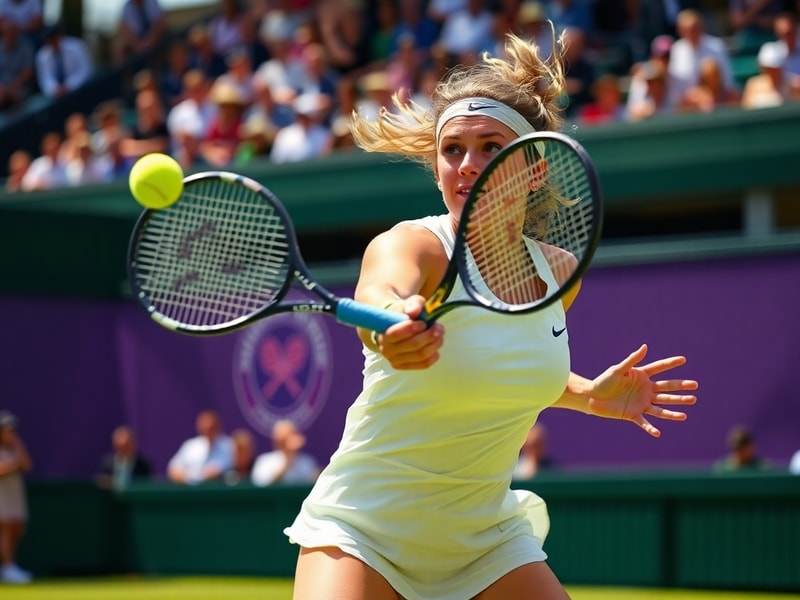
Harriet Dart: The British Tennis Player Redefining Consistency
Harriet Dart’s career trajectory reads like a study in quiet determination meeting opportunity at the right moment. At 27, the British tennis player has clawed her way from junior circuits to the WTA Tour’s upper echelons, her game built on relentless defense and a serve that belies her 5’9″ frame. Dart’s breakthrough came not with a single explosive moment but through incremental progress—qualifying for Grand Slams, breaking into the top 100, and most recently, cracking the top 50. These milestones are more than rankings; they’re proof that consistency, when paired with tactical intelligence, can outlast fleeting flashes of brilliance.
Her 2024 season alone tells a story of resilience. After a first-round exit at Wimbledon in 2023, Dart returned to the All England Club in July with renewed focus. While she fell to a seeded opponent in the second round, the match was a statement—she pushed a top-20 player to three sets, showcasing the strides she’d made in matchplay under pressure. That tournament followed a strong clay-court swing in Charleston, where she reached the quarterfinals, her best result at a WTA 500 event. These performances weren’t outliers; they were the result of a training regimen overseen by coach Jeremy Bates and a physical profile optimized for endurance.
From Junior Standout to Tour Professional
Dart’s journey began on indoor hard courts in London, where she trained at the National Tennis Centre. By 14, she was competing in Grade 1 tournaments, her forehand and two-handed backhand already drawing comparisons to contemporaries like Heather Watson. But it wasn’t raw power that set Dart apart early on—it was her ability to absorb pace and redirect it. This trait would later become her signature, a defensive gameplan that frustrates opponents who rely on aggression.
Her first major junior title came at the 2014 European Junior Championships, where she defeated future WTA mainstay Olesya Pervushina. That victory earned her a wildcard into Wimbledon’s junior event, where she reached the semifinals. By 2016, Dart had turned professional, but the transition from junior to senior circuits is notoriously brutal. She spent years grinding through ITF events, her progress documented in the tournament archives of lower-tier circuits where rankings are won and lost in best-of-three sets.
The 2019 US Open marked a turning point. As a qualifier, Dart stunned 25th seed Zhang Shuai in the first round, a win that announced her arrival on the sport’s biggest stage. That match—played under the lights in Arthur Ashe Stadium—highlighted her mental fortitude. Down a set and a break, she reeled off six consecutive games to close it out, a display of clutch serving and tactical patience that would become familiar. It was a glimpse of the player she was becoming: not a powerhouse, but a problem.
The Playing Style That Defies Expectations
Dart’s game is a study in contrasts. Her serve, clocking in around 100 mph, lacks the blistering pace of a Madison Keys or Coco Gauff, but its placement and slice variations make it a weapon. She often serves wide on the deuce court, pulling opponents off the court and opening up the middle for her two-handed backhand down the line. Her return of serve is where matches are often decided. Dart stands deep in the court, reading the server’s toss and timing her swing to redirect pace back toward the server’s weaker side. This approach forces errors and shortens points, a strategy that frustrates opponents who expect baseline rallies to dictate tempo.
Her groundstrokes are textbook. The forehand, hit with a compact motion, generates surprising depth, while the backhand is a mix of topspin and slice, used to change rhythm or finish points at the net. Dart’s net play is underrated; she volleys cleanly and moves well for a player her size, a legacy of her early training in doubles. In fact, her best doubles results—including a title at the 2022 Nottingham Open with Heather Watson—showcase a more aggressive side of her game that she occasionally unleashes in singles.
The numbers back up her style’s effectiveness. In 2023, Dart ranked in the top 20 on the WTA Tour for return games won, a metric that reflects her ability to break serve consistently. Her first-serve percentage hovers around 60%, but her second-serve return points won percentage is a stellar 55%, a figure that underscores her return game’s impact. These aren’t just stats; they’re evidence of a player who has refined her craft to exploit the margins in professional tennis.
The Mental Game: Composure Under Pressure
Tennis is as much a mental sport as a physical one, and Dart’s ability to thrive in tight moments has defined her career. Consider her 2024 Australian Open run, where she battled through three-set wins in the first two rounds before falling to eventual quarterfinalist Zheng Qinwen. In the second-round match against Jule Niemeier, Dart saved three match points in the second set tiebreak, her serve holding firm under pressure. That resilience isn’t accidental; it’s the result of work with sports psychologist Dr. Josie Perry, who has helped Dart develop routines to manage pre-match nerves and stay present during rallies.
Her on-court demeanor is calm, almost stoic. She doesn’t pump her fist after winners or berate herself after errors. Instead, she channels emotion into her footwork, her focus narrowing with each point. This mental discipline was evident in her 2021 WTA 125 title in Chicago, where she defeated the higher-ranked Magdalena Frech in the final. The match lasted two hours and 15 minutes, a slog through blistering Chicago humidity. Dart’s final hold of the match came on a 13-minute game, during which she saved three break points and closed it out with a backhand down the line that Frech could only watch.
Off the court, Dart is known for her dry wit and refusal to engage in the drama that often surrounds women’s tennis. She’s candid about the challenges of life on tour—lonely hotel rooms, the grind of travel, and the pressure to perform. In a 2023 interview with The Guardian, she described the WTA Tour as “a bubble where everyone is trying to outwork each other.” This honesty resonates with fans who appreciate her lack of pretense. She’s not here to be a viral sensation; she’s here to win matches, one point at a time.
What’s Next for Harriet Dart?
The next phase of Dart’s career will be defined by her ability to convert near-misses into victories. She’s reached the third round of all four Grand Slams, but a fourth-round appearance—or better—remains elusive. Her path forward may lie in refining her serve and return game further, perhaps adding more variety to her serve motion to keep opponents guessing. She’s also shown flashes of attacking tennis, particularly when she steps inside the baseline to take the ball early. If she can blend this aggression with her defensive strengths, she could become a consistent threat at the business end of tournaments.
Her 2024 schedule includes a return to the clay courts of Roland Garros, where she’s shown steady progress. Last year’s second-round appearance was her best yet at the French Open, and with a favorable draw, she could make a deeper run. Her grass-court season, culminating in Wimbledon, will be another barometer. Dart has never advanced past the second round at the All England Club, but her game—built on patience and precision—is tailor-made for the slower grass of recent years.
Beyond results, Dart’s influence on British tennis is worth noting. She’s part of a cohort of British players, including Katie Boulter and Jodie Burrage, who are pushing to return the nation’s women’s tennis to its former prominence. Their success could inspire a new generation of players, much like the “Battle of the Brits” era of the 2010s. Dart’s role in this narrative isn’t as a leader but as a steady hand, a player who leads by example rather than flash.
As for the future, Dart has hinted at exploring opportunities beyond singles. She’s expressed interest in doubles, where her net skills could thrive alongside a partner who complements her game. There’s also the possibility of representing Great Britain in the Billie Jean King Cup, an event that would allow her to wear the national colors in a team setting. Whatever path she chooses, one thing is clear: Harriet Dart is no longer an up-and-comer. She’s a mainstay, and her best tennis may still be ahead of her.