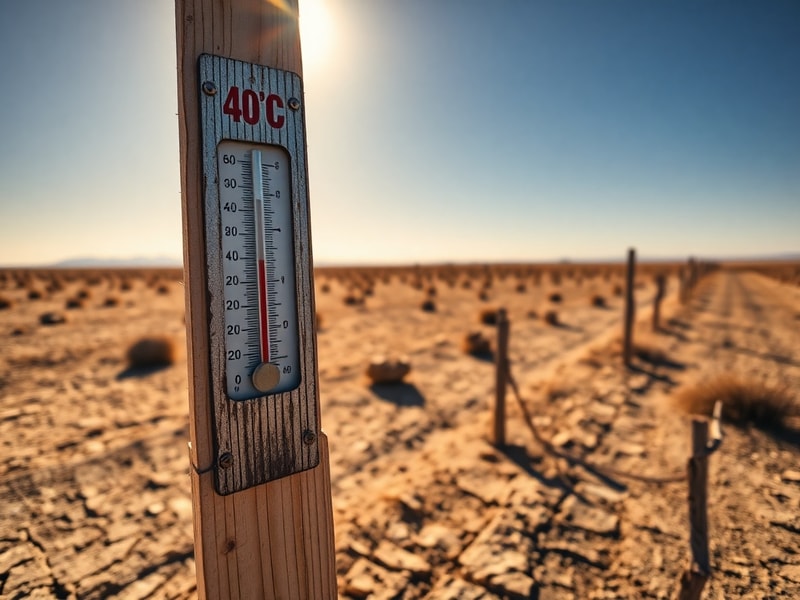
Forty degrees Celsius isn’t just a number—it’s a threshold where heat stops being an abstract concept and becomes a daily reality. The human body isn’t built to thrive in such temperatures, and our cities, economies, and ecosystems certainly aren’t either. When the mercury climbs this high, the distinction between comfort and crisis begins to fade, revealing vulnerabilities in infrastructure, health systems, and even social behavior.
The science behind 40°C: why it matters
At 40°C, the body’s cooling mechanisms are pushed to their limits. Sweating becomes less effective as humidity rises, and prolonged exposure can lead to heat exhaustion within minutes. Core body temperature above 39°C triggers a cascade of stress responses: increased heart rate, dehydration, and impaired cognitive function. According to the World Health Organization, heat-related deaths spike sharply once temperatures exceed 35°C in many regions, and 40°C is where the curve steepens dramatically.
From a meteorological standpoint, 40°C represents a rare but increasingly frequent event in temperate zones. Historically confined to deserts and tropical belts, such extremes now appear in unexpected places—London hit 40°C for the first time in 2022, and cities like Seattle and Hamburg have recorded similar peaks in recent years. These aren’t anomalies; they’re indicators of a warming baseline. The Intergovernmental Panel on Climate Change warns that every degree of global warming increases the likelihood of extreme heat events by roughly 10%, making 40°C days less of a shock and more of a norm.
What’s often overlooked is how 40°C interacts with urban environments. Concrete and asphalt absorb and radiate heat, creating “urban heat islands” that can be 5–10°C hotter than surrounding areas. Public health experts call this the “double jeopardy” of heat: the weather is already extreme, but the built environment amplifies the danger.
Real-world consequences: health, infrastructure, and inequality
The impact of sustained 40°C heat isn’t evenly distributed. Vulnerable populations—older adults, outdoor workers, and low-income communities—bear the brunt. During Europe’s 2022 heatwave, Spain and Portugal reported over 60,000 excess deaths, many in cities where elderly residents lacked access to air conditioning. Meanwhile, in South Asia, brick kiln laborers and farmers face the paradox of working outdoors to survive in temperatures that can exceed 45°C.
Infrastructure strains too. Railways warp under thermal expansion, forcing speed restrictions that delay commuters. Electrical grids falter as air conditioners run nonstop, leading to blackouts during peak demand. In 2021, California’s power grid operator issued rotating outages during a 40°C heat wave, a scenario likely to repeat as climate change intensifies. Water systems also buckle: reservoirs shrink, pipes burst from thermal stress, and water quality degrades as algae blooms thrive in warmer conditions.
Agriculture is another casualty. Heat stress reduces crop yields, particularly for staple grains like wheat and maize. In India, where 40°C days now arrive weeks earlier than in the 1980s, farmers report up to 30% losses in wheat harvests during extreme heat events. These losses ripple through food markets, driving up prices and deepening food insecurity in regions already vulnerable to drought.
The social fabric frays as well. Studies from the Urban Institute show that violent crime and domestic disputes rise during prolonged heatwaves, likely due to stress, sleep deprivation, and reduced economic productivity. Public spaces empty out during peak heat hours, shifting social interactions indoors and altering community dynamics. In some cities, this has led to the emergence of “night economies,” where life resumes after sunset to avoid the worst of the day’s heat.
Adaptation and resilience: can we live with 40°C?
Cities are experimenting with solutions, but progress is uneven. Green roofs, reflective pavements, and expanded urban forests can reduce local temperatures by several degrees. Barcelona’s “superblocks” program, which converts car-centric streets into pedestrian zones with shade trees, has shown promise in lowering ambient heat. Similarly, Melbourne’s urban forest strategy aims to double canopy cover by 2040 to combat the urban heat island effect.
Yet these measures require sustained investment and political will. In many developing nations, funding for adaptation lags behind the pace of climate change. Public health campaigns, such as India’s “Beat the Heat” initiative, distribute oral rehydration salts and advise outdoor workers to rest during peak hours, but enforcement is patchy. Heat action plans exist in over 500 cities worldwide, but only about 20% have been fully implemented, according to the Nature Conservancy.
Technology offers partial relief. Advances in cooling systems—such as evaporative and radiant cooling—are making buildings more energy-efficient. In Dubai, where summer temperatures regularly exceed 45°C, developers use seawater cooling systems to maintain comfort in skyscrapers. However, these innovations are energy-intensive and often inaccessible to low-income households. Solar-powered air conditioning, while promising, remains a niche solution due to high upfront costs.
Behavioral adaptation is equally critical. Many cultures have long-standing traditions for coping with heat—siestas in Spain, for example, or the Japanese practice of opening windows at night to flush out daytime heat. Modern urban life has eroded some of these practices, but a revival is underway. Cities like Athens and Tel Aviv now encourage “cool hours” during heatwaves, urging residents to limit outdoor activity between 11 a.m. and 4 p.m.
What’s next: preparing for a hotter planet
The question isn’t whether we’ll see more 40°C days—it’s how we’ll respond. The most immediate step is acknowledging that heat is a public health crisis, not just a weather event. Heatwaves kill more people annually than floods, hurricanes, or wildfires combined, yet they receive far less attention. Governments must integrate heat risk into urban planning, healthcare systems, and emergency response protocols.
On a personal level, individuals can take steps to mitigate the impact. Simple measures—such as staying hydrated, wearing breathable fabrics, and using window coverings—can reduce heat stress. Community organizations can establish cooling centers and check on elderly neighbors during heatwaves. Employers, particularly in outdoor industries, must enforce heat safety standards, including mandatory rest breaks and shaded rest areas.
Long-term, the focus must shift to mitigation. Reducing greenhouse gas emissions remains the only way to prevent 40°C days from becoming the new normal. The Paris Agreement targets aim to limit warming to 1.5°C, but current policies put the world on track for nearly 3°C by 2100. Even under the most optimistic scenarios, 40°C will become more common, meaning adaptation isn’t optional—it’s essential.
As temperatures rise, so too must our collective response. The challenge isn’t just about surviving the heat; it’s about reimagining cities, economies, and societies to thrive in a hotter world. Forty degrees Celsius isn’t a distant threat—it’s a present reality, and the time to act is now.