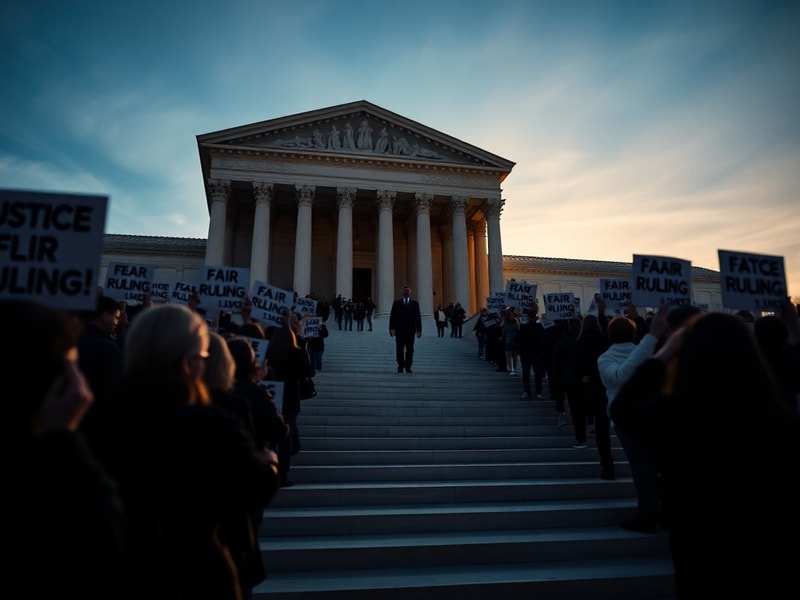
The Supreme Court stands as the final interpreter of the U.S. Constitution, shaping the legal landscape with decisions that echo through generations. These rulings influence everything from civil rights to corporate regulations, often sparking intense public debate. Unlike legislative bodies, the Court’s authority is unique—its interpretations of the law are binding, and its reasoning becomes part of the nation’s legal fabric. Understanding how these decisions are made, their historical impact, and the controversies they ignite offers a window into America’s evolving values and governance.
How Supreme Court Decisions Shape the Nation
At its core, the Supreme Court’s power lies in its ability to interpret the Constitution and federal laws. When justices rule on a case, their decisions set precedents that lower courts must follow. This principle, known as stare decisis, ensures stability in the legal system but also means that past rulings can be overturned—sometimes dramatically. For example, the 1954 decision in Brown v. Board of Education dismantled racial segregation in public schools, reshaping American society. Similarly, Roe v. Wade (1973) established a constitutional right to abortion, a ruling that remained in place for nearly 50 years until it was overturned in 2022.
The Court’s influence extends beyond individual cases. Landmark decisions often redefine the balance of power between federal and state governments, between individual rights and government authority, and between different branches of government. For instance, United States v. Nixon (1974) reinforced the principle that no person, not even the president, is above the law. Meanwhile, Citizens United v. FEC (2010) expanded corporate political spending, altering the dynamics of election financing. These cases demonstrate how the Court’s interpretations can redefine the rules of the game for everyone, from everyday citizens to powerful institutions.
The process of selecting which cases the Court hears is as strategic as the rulings themselves. The justices receive thousands of petitions annually but grant review to fewer than 100. The Court typically takes on cases that involve novel legal questions, conflicting rulings among lower courts, or issues of national importance. This selective approach ensures that the Court’s docket remains manageable, but it also means that many pressing legal questions are left unanswered—sometimes for decades. For those interested in exploring how these cases wind up before the Court, Dave’s Locker offers resources on legal analysis that break down the intricacies of the judicial process.
The Controversies Surrounding Judicial Appointments
Supreme Court justices serve for life, a provision designed to insulate them from political pressure. However, this lifetime tenure has turned judicial appointments into high-stakes battles, particularly in recent decades. Presidents and senators alike recognize that a single appointment can shift the Court’s ideological balance for generations. The confirmation process has become increasingly contentious, with partisan tensions often overshadowing the qualifications of the nominees. For example, the 2016 nomination of Merrick Garland was blocked by Senate Republicans, who argued that the vacancy should be filled by the next president. When Donald Trump assumed office, he nominated Neil Gorsuch instead, solidifying a conservative majority that has since steered the Court in a distinctly rightward direction.
The politicization of the Court was further exposed during the confirmation hearings of Brett Kavanaugh in 2018. Accusations of sexual misconduct, partisan attacks, and emotional testimony dominated the proceedings, culminating in a narrowly confirmed justice. The episode underscored how deeply personal and ideological divisions have seeped into the judicial selection process. Similarly, the rushed confirmation of Amy Coney Barrett in October 2020—just weeks before a presidential election—sparked accusations of hypocrisy from Democrats who had previously argued that a vacancy should not be filled so close to an election.
Public opinion polls consistently show that Americans are deeply divided over the Court’s role and the legitimacy of its justices. A 2023 Gallup poll found that only 40% of Americans approve of the Supreme Court’s job performance, the lowest rating in decades. Critics argue that the Court’s conservative supermajority has overreached, undermining precedents on issues like abortion, affirmative action, and environmental regulations. Others contend that the Court is merely correcting what they see as past overreach by liberal justices. Regardless of perspective, the controversies surrounding judicial appointments reflect broader societal divisions about the proper role of the judiciary in a democratic society.
Landmark Cases That Redefined American Society
A handful of Supreme Court decisions have left an indelible mark on American life, often altering the trajectory of civil rights, privacy, and governance. One of the most consequential was Loving v. Virginia (1967), which struck down state laws banning interracial marriage. The ruling was a victory for the civil rights movement and a reaffirmation of the principle that marriage is a fundamental right. Another pivotal case, Griswold v. Connecticut (1965), established a constitutional right to privacy, paving the way for Roe v. Wade and later cases involving LGBTQ+ rights. The Court’s reasoning in these cases hinged on the idea that certain freedoms are so fundamental that they must be protected from government intrusion.
The Court’s impact on criminal justice has also been profound. In Miranda v. Arizona (1966), the justices ruled that police must inform suspects of their rights before questioning them, a decision that led to the now-famous “Miranda rights.” This ruling aimed to protect individuals from coercive interrogations and has since become a cornerstone of criminal procedure. Conversely, the Court has also issued decisions that critics argue have weakened constitutional protections. For example, District of Columbia v. Heller (2008) established that the Second Amendment protects an individual’s right to bear arms, striking down a handgun ban in Washington, D.C. The ruling has since been used to challenge a wide range of gun regulations, illustrating how a single decision can ripple through society in unpredictable ways.
While some cases are celebrated for their progressiveness, others highlight the Court’s willingness to defer to government power. In Korematsu v. United States (1944), the Court infamously upheld the internment of Japanese Americans during World War II, a decision later widely condemned as a grave injustice. More recently, the Court’s ruling in Trump v. Hawaii (2018) upheld the travel ban targeting several predominantly Muslim countries, a decision that drew sharp criticism for its perceived Islamophobic intent. These cases serve as stark reminders that the Court, like all institutions, is not immune to the prejudices and blind spots of its era.
What’s Next for the Supreme Court?
The Supreme Court of the near future is likely to remain a flashpoint in American politics, with several contentious issues already on the horizon. One of the most closely watched areas is abortion rights. Since the overturning of Roe v. Wade, states have enacted a patchwork of laws, with some banning the procedure almost entirely and others protecting access. The Court is expected to weigh in on further challenges, potentially clarifying the limits of state power over reproductive rights. Another major battleground is the balance between religious freedom and LGBTQ+ rights. The Court’s conservative majority has already sided with religious objectors in cases like Masterpiece Cakeshop v. Colorado (2018), and similar disputes over discrimination and free exercise of religion are likely to reach the justices soon.
The Court’s approach to administrative law is also drawing attention. In a series of recent rulings, the justices have limited the authority of federal agencies to interpret ambiguous laws, a doctrine known as the major questions principle. This shift could significantly curb the federal government’s regulatory power, affecting everything from environmental protections to workplace safety standards. Critics argue that such rulings undermine the executive branch’s ability to address complex, modern challenges, while supporters contend that they restore balance to a system that has grown too centralized.
Beyond these specific issues, the Court faces broader questions about its own legitimacy. Public trust in the institution has eroded, fueled by perceptions of partisan decision-making and the lack of term limits for justices. Reform proposals range from adding justices to imposing 18-year term limits, but none have gained significant traction. Meanwhile, the Court’s conservative majority continues to issue rulings that align with long-held Republican priorities, from striking down affirmative action to expanding gun rights. Whether these decisions will further polarize the public or eventually be accepted as settled law remains an open question. One thing is certain: the Supreme Court will remain a central—and often divisive—force in American life for years to come.
The judiciary’s role in a democracy is complex, balancing stability with adaptability. While the Supreme Court’s decisions can feel distant from everyday life, their impact is anything but abstract. From the rights we take for granted to the policies that shape our communities, the Court’s rulings are woven into the fabric of society. As the nation grapples with new challenges—from artificial intelligence to climate change—the Court’s interpretations of the Constitution will continue to define what is possible, what is permissible, and what is just. Understanding these decisions is not just an academic exercise; it is a civic necessity for anyone who seeks to navigate the legal and political landscape of modern America.