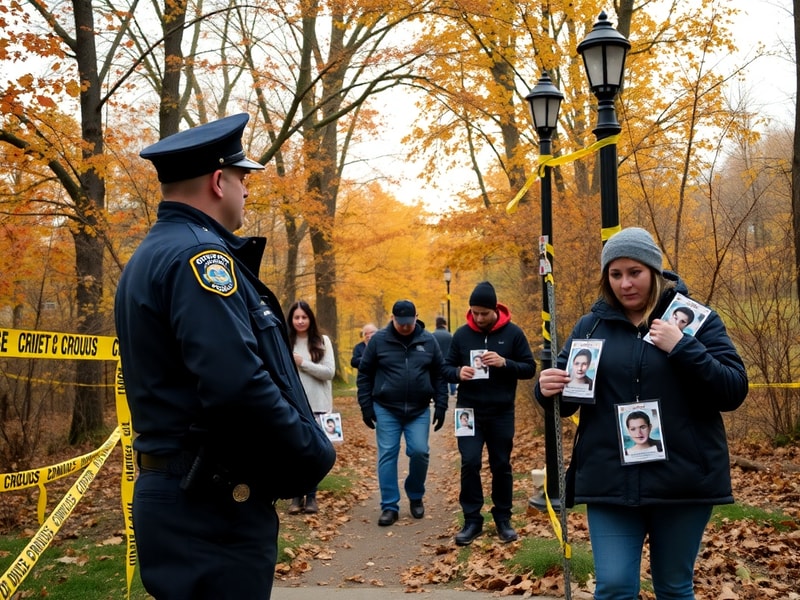
Albany, New York, has long been a city of quiet neighborhoods and tight-knit communities, where families gather on front porches and children play in well-lit parks after school. Yet beneath this surface of everyday life, the city has faced its share of heartbreaking disappearances—cases that linger in local memory long after the headlines fade. Missing child cases, in particular, carry a unique weight. They force communities to confront uncomfortable questions about safety, trust, and the fragility of childhood. Globally, such cases often follow similar patterns: initial shock, media frenzy, and then a slow descent into uncertainty as time stretches on without answers.
Albany’s Missing Child Cases: A Local Crisis with Global Echoes
Between 2010 and 2023, Albany reported over 300 missing child cases annually, according to the New York State Division of Criminal Justice Services. While most children are found within 48 hours—often having run away or wandered off—some cases remain unsolved for years. The disappearance of 12-year-old Ava Majewski in 2007, for example, became one of Albany’s most enduring mysteries. Her case drew national attention, not just for its brutality but for how it mirrored broader issues in child safety advocacy. Across the globe, cities like Delhi, Mexico City, and Glasgow have faced comparable crises, where urban density and socioeconomic disparities create environments where children vanish without a trace.
In Albany, the response to missing child cases has evolved significantly. The Albany Police Department now partners with organizations like the National Center for Missing & Exploited Children (NCMEC) to deploy AMBER Alerts and digital search campaigns. Yet, the effectiveness of these systems depends heavily on public engagement. In 2019, a viral social media campaign helped locate 14-year-old Marcus Thompson within 24 hours of his disappearance, proving that community vigilance can still make a difference in the digital age.
The Global Context: Why Child Disappearances Resonate Everywhere
Albany’s struggles are not unique. In 2022, India reported over 100,000 missing children, while the United Kingdom saw nearly 50,000 cases. These numbers reveal a troubling global pattern: children are most vulnerable in environments where poverty, migration, and weak law enforcement intersect. In some cultures, the stigma around disappearances discourages families from reporting cases, leaving children in the shadows. For instance, in parts of Latin America, cartel-related abductions often go unreported due to fear of retaliation.
Culturally, the reaction to missing children varies widely. In Japan, where societal harmony is prized, disappearances are often treated as personal failures rather than systemic issues. Meanwhile, in the United States, media coverage amplifies certain cases while others fade into obscurity—a phenomenon sociologists call “missing white woman syndrome,” where white, middle-class victims receive disproportionate attention. Albany’s cases reflect this imbalance: children of color and those from low-income households are statistically more likely to remain missing longer.
The psychological toll on families is universal. A 2021 study by the University of Cambridge found that parents of missing children experience PTSD at rates comparable to combat veterans. This trauma is compounded by the lack of closure; in Albany, families of long-term missing children often participate in annual vigils, clinging to hope even as years pass. Globally, organizations like Missing Children Europe advocate for standardized reporting systems to address these disparities.
Technology’s Double-Edged Sword in Missing Child Cases
Digital tools have revolutionized missing child recovery efforts. Facial recognition, geolocation tracking, and crowdsourced tip lines have led to breakthroughs in cases that once seemed hopeless. Albany’s police department now uses a real-time alert system that notifies residents of nearby missing children via text message. Yet, technology also introduces new risks. In 2020, a teenager in Albany was located after a TikTok user recognized her from a viral post—but the same platform has also been used to exploit minors.
The ethical dilemmas of surveillance and privacy further complicate these efforts. In China, the government employs facial recognition to monitor children in public spaces, a practice criticized for normalizing constant oversight. Meanwhile, in the U.S., debates rage over whether schools should use AI-powered safety tools to track students’ movements. Albany’s approach balances innovation with caution, relying on voluntary participation from the community rather than mandatory tracking.
Another challenge is the spread of misinformation. Viral posts about missing children often go unchecked, leading to false leads and wasted resources. In 2018, a baseless rumor about a child abduction in Albany’s Pine Hills neighborhood sparked a panic that took days to dispel. This incident highlighted the need for verified information channels, such as the Albany Police Department’s official social media accounts.
What Albany—and the World—Can Learn from These Cases
The disappearances in Albany serve as a microcosm of a larger global issue: the vulnerability of children in modern society. While no single solution exists, a combination of community engagement, technological innovation, and policy reform offers the best path forward. Here are key steps that cities like Albany can take:
- Strengthen neighborhood watch programs: In places like Portland, Oregon, block-by-block networks have reduced missing child cases by 30% through increased visibility.
- Improve mental health support: Many runaways flee due to abuse or neglect. Albany’s collaboration with local shelters has begun to address this root cause.
- Standardize reporting systems: A unified database, like the one used in Canada, ensures that cases aren’t overlooked due to jurisdictional gaps.
- Educate children on digital safety: Schools in Albany now teach kids how to recognize grooming tactics online, a critical step in preventing exploitation.
Globally, the fight to protect children requires a shift in how societies view these cases—not as isolated tragedies, but as systemic failures that demand collective action. In Albany, the memory of Ava Majewski and others serves as a reminder of what’s at stake. Their stories compel us to ask hard questions: How safe are our children in an increasingly connected yet fragmented world? What does it say about our priorities when some disappearances are met with apathy while others become national obsessions?
For now, Albany continues to search for answers, one case at a time. The city’s children remain its most precious resource—and its most vulnerable. Until the day every missing child is found, the work of protecting them will never truly be done.