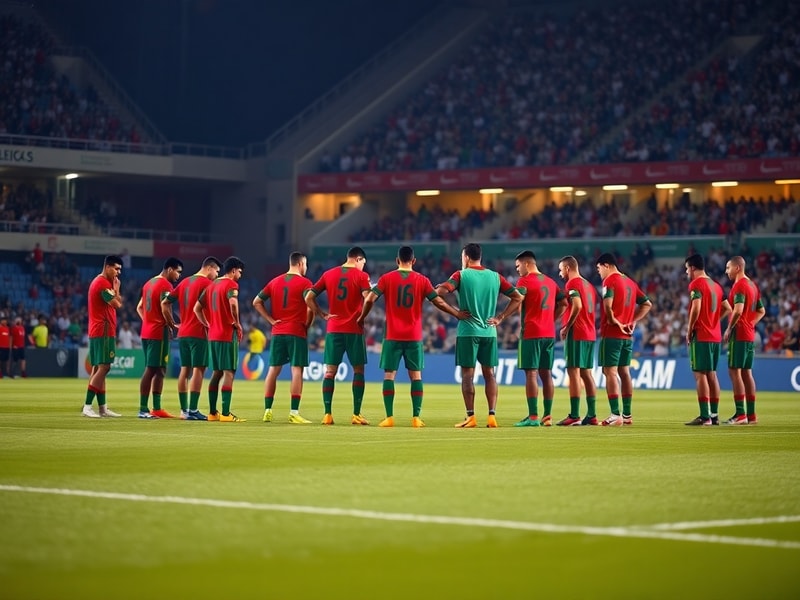
The Moroccan national football team has long been a rising force in African football, but in recent years, they’ve transformed into a genuine contender on the global stage. With a squad brimming with talent, tactical discipline, and an unmistakable identity, Morocco’s roster has become a source of pride for the nation and a team to watch in every major tournament. From their historic 2022 FIFA World Cup run to consistent performances in the Africa Cup of Nations, the Atlas Lions continue to defy expectations.
What makes Morocco’s current roster so compelling isn’t just the individual skill of its players but the way they blend European-based professionals with homegrown talent. This fusion creates a dynamic and adaptable team capable of competing against the world’s best. Their journey reflects broader trends in African football, where players trained in European academies bring back technical sophistication to elevate domestic leagues and national teams alike.
The backbone of the Atlas Lions: Key players who define the roster
At the core of Morocco’s success is a deep and versatile squad, where every position boasts players capable of stepping up when called upon. The backbone of the team rests on the shoulders of several standout performers who have become household names both in Africa and across Europe.
One of the most influential figures is Achraf Hakimi, the Inter Milan right-back whose blistering pace and crossing ability have made him a constant threat down the flanks. Hakimi’s offensive contributions go beyond traditional defending; he regularly delivers dangerous crosses and even chips in with goals, embodying the modern full-back role. His partnership with wingers like Sofiane Boufal and Amine Adli provides Morocco with a potent counterattacking threat.
In midfield, the trio of Azzedine Ounahi, Sofyan Amrabat, and Bilal El Khannouss has formed the engine of the team. Ounahi, the dynamic Marseille midfielder, combines vision with pressing intensity, while Amrabat’s physical presence at Barcelona allows him to dominate duels and break up opposition play. El Khannouss, the youngest of the group, brings creativity and flair from Genk, offering a different dimension as a playmaker.
Up front, Youssef En-Nesyri remains Morocco’s most reliable striker, with a knack for scoring crucial goals in big matches. His aerial ability and movement in the box make him a constant danger, while his experience at Sevilla provides stability to the attack. Supporting him is the versatile Walid Cheddira, who can operate as a false nine or a target man, adding tactical flexibility to the front line.
In goal, the experienced Yassine Bounou continues to be a reassuring presence between the posts. His reflex saves and command of the area were instrumental during Morocco’s 2022 World Cup campaign, where they became the first African and Arab nation to reach the semifinals. With his leadership and composure, Bounou anchors a defense that has grown more resolute with each passing year.
From European leagues to the Atlas Lions: The diaspora effect
Morocco’s roster is a testament to the power of the football diaspora, with over two-thirds of the squad plying their trade in Europe’s top leagues. This global exposure has transformed how the team plays and prepares, allowing players to absorb different tactical philosophies and training regimes. Clubs in Spain, France, England, and Italy have become second homes for many Moroccan stars, who bring back invaluable experience to the national team.
The influence of the diaspora is evident in the team’s technical proficiency and tactical awareness. Players like Hakimi, Amrabat, and Ounahi have honed their skills in high-pressure environments, learning to adapt to different styles of play. This exposure has made Morocco less predictable and more tactically flexible, allowing them to switch between possession-based football and quick counterattacks depending on the opponent.
Moreover, the diaspora effect extends beyond individual development. It fosters a sense of unity and pride among Moroccan communities abroad, who view the national team as a symbol of their heritage. Matches involving Morocco often draw large crowds in cities across Europe, from Paris to Brussels, where fans gather to support their dual identities. This cultural connection reinforces the team’s motivation and adds an extra layer of significance to their performances.
While the diaspora provides talent and experience, Morocco has also prioritized developing homegrown players to ensure a sustainable pipeline. Clubs like Wydad Casablanca and Raja Casablanca continue to produce technically gifted players who can thrive alongside their European-based counterparts. This balance between imported skill and local talent creates a squad that is both competitive and representative of Moroccan football’s depth.
Tactical evolution: How Morocco adapts to modern football
Under the guidance of coach Walid Regragui, Morocco has embraced a tactical identity that blends structure with spontaneity. Regragui, a former defender with a pragmatic approach, has instilled a system that prioritizes defensive solidity while allowing creative players to express themselves in attack. This balance has been key to Morocco’s recent successes, particularly in high-stakes tournaments.
The team’s preferred formation often shifts between a 4-2-3-1 and a 4-3-3, depending on the opponent and the available personnel. The double pivot in midfield—typically featuring Amrabat and Ounahi—provides both defensive cover and progressive passing options. This setup allows the full-backs, like Hakimi and Noussair Mazraoui, to push high up the pitch, creating width and overloading the wings.
In possession, Morocco favors patient build-up play, using short passes and quick combinations to advance the ball. Their ability to retain possession under pressure has improved significantly, allowing them to control the tempo of matches. Defensively, they employ a high press when possible, led by forwards like En-Nesyri and Boufal, who harry opposition defenders into mistakes.
One of the most impressive aspects of Morocco’s tactical evolution is their adaptability. They can switch to a more direct style against stronger opponents, relying on the physicality of players like Cheddira and the pace of Hakimi to exploit counterattacking opportunities. This versatility makes them a nightmare for opponents who struggle to pin down their game plan.
Morocco’s tactical approach also reflects a broader shift in African football, where teams are increasingly prioritizing organization and pressing over raw athleticism. This evolution has been driven by the continent’s young, ambitious coaches who study the game at the highest level and implement modern strategies. Regragui’s success with Morocco has earned him praise from peers across Africa, positioning him as a role model for the next generation of African tacticians.
Looking ahead: The future of Morocco’s golden generation
With several key players in their prime, Morocco’s current roster represents the core of what could be a golden generation. The Atlas Lions have already achieved historic milestones, including their World Cup semifinal run in 2022 and consistent deep runs in the Africa Cup of Nations. The question now is how far they can go in the coming years, particularly in the 2026 FIFA World Cup, which will be co-hosted by Morocco, the United States, and Canada.
The team’s success has sparked a football revolution in Morocco, with increased investment in youth academies and infrastructure. The Moroccan Football Federation has launched initiatives to improve grassroots development, aiming to produce more homegrown talent capable of competing at the highest level. This long-term vision ensures that the country’s footballing culture continues to thrive, even as the current generation of stars begins to age.
For the players themselves, the opportunity to compete on the world stage is a chance to cement their legacies. Achraf Hakimi, Youssef En-Nesyri, and Sofyan Amrabat have already achieved more than most Moroccan players in history, but the hunger for further success remains. Whether it’s winning the Africa Cup of Nations or making a deep run in the 2026 World Cup, the Atlas Lions have the talent and ambition to aim higher.
Morocco’s story is one of resilience, ambition, and cultural pride. Their roster is more than just a collection of talented players; it’s a reflection of a nation’s dreams and a testament to the power of football to unite and inspire. As they continue to break barriers and challenge conventions, Morocco is not just competing in football—they’re redefining what African teams can achieve.
For fans around the world, Morocco’s journey offers a compelling narrative of progress and possibility. Whether you’re a follower of sports or simply someone who appreciates the beauty of the game, the Atlas Lions are a team worth watching. Their rise to prominence is a reminder that football is not just about talent—it’s about belief, strategy, and the relentless pursuit of greatness.