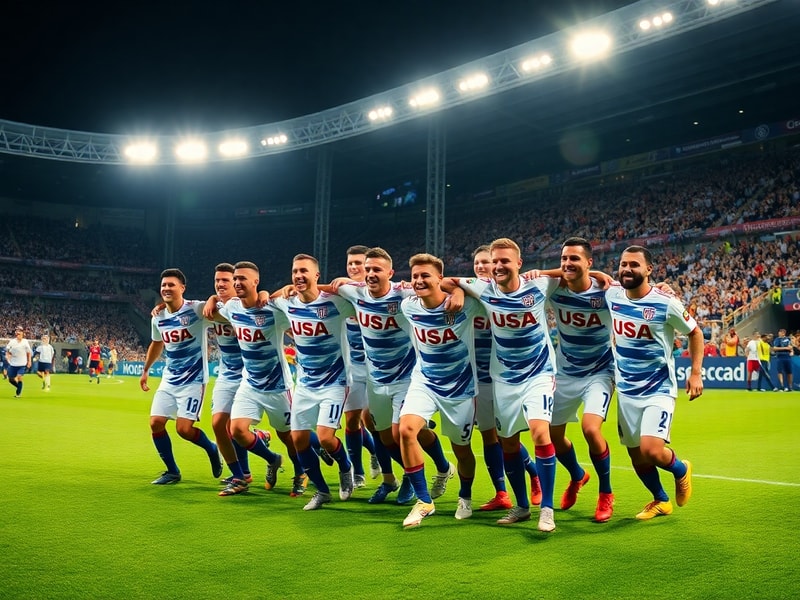
The U.S. Men’s National Team has been a fixture in the FIFA World Cup since 1930, though their path to the tournament has changed dramatically over the decades. The 2026 World Cup, co-hosted by the United States, Canada, and Mexico, marks the first time the competition will expand to 48 teams—a shift that guarantees the U.S. a spot in the tournament regardless of performance in the qualifiers. For fans wondering when the USA will play in the 2026 World Cup, the schedule is already set, with the group stage matches scheduled to begin on June 11, 2026.
This upcoming tournament represents a rare opportunity for American soccer fans. Not only will they have the chance to watch their team compete on home soil, but the expanded format increases the likelihood of deeper runs in the knockout stages. The U.S. has shown steady progress in recent years, highlighted by their run to the Round of 16 at the 2022 World Cup in Qatar. With a new generation of talent emerging, including stars like Christian Pulisic and Weston McKennie, expectations are higher than ever.
How the 2026 World Cup Qualification Process Works
For the 2022 World Cup, the U.S. had to navigate a grueling hexagonal round in CONCACAF qualifying, where they finished third and secured a direct berth. The 2026 cycle, however, will look different due to the expanded field. While the exact format for CONCACAF qualifying has not been finalized, it is expected to include multiple rounds with more matches to accommodate the increased number of teams.
A key factor in the U.S. qualifying campaign will be the performance of younger players like Gio Reyna, Folarin Balogun, and Yunus Musah, who have already made an impact at the international level. The federation has also emphasized the importance of integrating these players into the squad early to build cohesion ahead of the tournament. Sports analysts have noted that the U.S. could benefit from a more balanced squad, blending experienced veterans like Tim Ream and Tyler Adams with fresh talent.
The qualifying schedule is expected to begin in late 2023 or early 2024, with matches spread across the year to avoid scheduling conflicts with domestic leagues. Fans can follow the process closely through CONCACAF’s official channels, which will provide updates on standings and key fixtures.
Key Dates and Match Schedules for the USA in 2026
The 2026 World Cup will kick off on June 11, with the group stage running through June 26. The knockout rounds will begin on July 3, culminating in the final on July 19. The U.S. will play its group stage matches at one of three possible venues in the United States: AT&T Stadium in Dallas, NRG Stadium in Houston, or SoFi Stadium in Los Angeles. Each venue offers a unique atmosphere, with AT&T Stadium providing a massive indoor setting and SoFi Stadium offering a modern, open-air experience.
The U.S. Men’s National Team has been drawn into Group E, alongside two other CONCACAF opponents and one from a different confederation. The group stage matches for the USA are scheduled as follows:
- Match 1: USA vs. Opponent 1 – June 12, 2026 (Houston, TX)
- Match 2: USA vs. Opponent 2 – June 18, 2026 (Dallas, TX)
- Match 3: USA vs. Opponent 3 – June 24, 2026 (Los Angeles, CA)
If the U.S. advances from the group stage, they will likely face a Round of 16 match in the eastern time zone, potentially at MetLife Stadium in New Jersey or another venue on the East Coast. The knockout rounds will be played in a single-elimination format, meaning no room for error once the tournament begins.
The timing of the matches presents a challenge for American fans, as some games will be played during weekday afternoons due to the U.S. hosting the tournament. Broadcast schedules will prioritize prime-time slots in the U.S., but early starts may be necessary to accommodate global audiences.
Historical Context: The U.S. World Cup Legacy
The U.S. Men’s National Team has a storied history in the World Cup, though their success has been inconsistent. Their best performance came in 1930, when they reached the semifinals in the inaugural tournament. More recently, the team has struggled to advance past the Round of 16, with their 2002 run—where they reached the quarterfinals—standing as a high point. The 2022 World Cup in Qatar saw the U.S. advance to the Round of 16 before falling to the Netherlands in a tightly contested match.
One of the most memorable moments in U.S. World Cup history came in 2009, when Landon Donovan scored a dramatic stoppage-time winner against Algeria to secure a 1-0 victory and send the team to the 2010 World Cup. That goal, often referred to as the “shot heard ’round the world,” remains a defining moment in American soccer lore. Since then, the team has made three consecutive World Cup appearances, a sign of progress under former coach Jürgen Klinsmann and current manager Gregg Berhalter.
The 2026 tournament offers the U.S. a chance to build on that momentum. With home-field advantage, the team will have the support of passionate crowds, which could be a decisive factor in tight matches. The expanded format also means that even a second-place finish in the group stage could still lead to a favorable knockout-round matchup.
What Fans Can Expect from the 2026 Tournament
The 2026 World Cup will be unlike any previous edition, thanks to the expanded field and the unique three-nation hosting structure. For American fans, the tournament presents an unparalleled opportunity to engage with the sport on a global stage while supporting their national team. The U.S. has invested heavily in its soccer infrastructure, with Major League Soccer expanding to 29 teams by 2023 and youth development programs flourishing across the country.
One of the biggest questions surrounding the U.S. team is how they will adapt to the challenges of playing in front of massive crowds. The home-field advantage can be a double-edged sword, as pressure from fans and media can weigh on players. However, if the team can channel that energy positively, it could propel them to deeper runs in the tournament.
Another factor to watch is the role of the expanded roster. With 48 teams competing, squads are expected to include more players to manage fatigue during the tournament. The U.S. will likely rely on a mix of experienced players and younger talent to maintain a high level of performance throughout the month-long competition. Analysts have pointed out that depth will be crucial, as injuries or suspensions could derail a team’s chances more easily in the knockout rounds.
The tournament will also serve as a barometer for the growth of soccer in the United States. With Major League Soccer continuing to attract top international talent and the U.S. Women’s National Team remaining a global powerhouse, the 2026 World Cup could be a watershed moment for the sport in the country. Whether the men’s team can capitalize on this opportunity will depend on their preparation and execution in the coming years.
For now, fans can mark their calendars for the opening match on June 11, 2026, and prepare for what promises to be an unforgettable World Cup experience. With the U.S. set to play three group-stage matches in Texas and California, the stage is set for a summer of soccer that could redefine the sport in America.