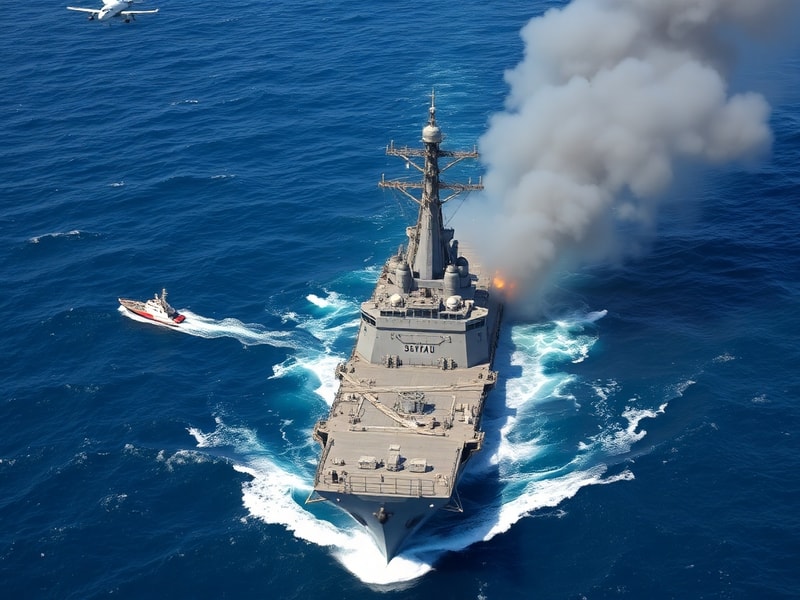
The U.S. Navy’s recent Valiant Shield exercise culminated in a dramatic and symbolic event: the sinking of the decommissioned USS Juneau during a live-fire exercise. This SINKEX (sinking exercise) was not merely a training drill but a carefully orchestrated operation reflecting broader themes in modern naval warfare, environmental stewardship, and geopolitical signaling.
The USS Juneau, a multi-purpose amphibious assault ship of the Wasp-class, served the U.S. Navy for over three decades before being retired in 2021. Its final mission was to serve as a target vessel during Valiant Shield 2024—a joint military exercise involving forces from the U.S., Japan, Australia, and Canada. Held across the Indo-Pacific, Valiant Shield is one of the largest annual military drills in the world, designed to enhance interoperability and demonstrate combined combat readiness in response to regional security challenges.
SINKEX operations like this one are conducted under strict environmental and legal guidelines. The Navy coordinates with the Environmental Protection Agency (EPA) and follows protocols outlined in the Marine Protection, Research, and Sanctuaries Act. The goal is to ensure that the ship’s sinking does not pose risks to marine ecosystems or commercial shipping lanes. In the case of the USS Juneau, the vessel was thoroughly cleaned of hazardous materials, including asbestos and fuel residues, before being towed to a designated deep-water site in the Pacific.
This kind of exercise is more than tactical training—it carries significant strategic weight. The Indo-Pacific region remains a focal point of global geopolitics, particularly with rising tensions around Taiwan, maritime disputes in the South China Sea, and North Korea’s missile provocations. By conducting large-scale exercises like Valiant Shield, the U.S. and its allies send a clear message: they are prepared to operate together in contested waters and maintain freedom of navigation.
Why SINKEX Matters in Modern Naval Strategy
The practice of using decommissioned ships as targets in live-fire exercises has evolved over decades. Originally, such drills were primarily about testing weapon systems and crew proficiency. Today, they also serve as a cost-effective alternative to building expensive replica targets. The Navy estimates that a single SINKEX saves millions compared to constructing a mock-up vessel.
Moreover, these operations help validate new technologies. During the USS Juneau exercise, the Navy tested upgraded anti-ship missiles, electronic warfare suites, and sensor integration across allied platforms. The data collected—from missile accuracy to sensor tracking—is fed into training simulations and future system upgrades.
But the symbolic power of these events should not be underestimated. A sinking ship embodies the finality of military service. It’s a visual statement: equipment that once projected power is now reduced to a reef-like structure on the ocean floor, fostering marine life in controlled environments. Over time, such wrecks become artificial reefs, supporting ecosystems and even becoming dive sites. The USS Juneau, once a symbol of American naval might, is now transitioning into a different kind of legacy—one of ecological renewal.
Environmental and Ethical Considerations
Despite the operational benefits, SINKEX operations have faced scrutiny from environmental groups. Concerns typically focus on potential leaks of residual contaminants, impacts on marine biodiversity, and the precedent of using the ocean as a disposal site. In response, the Navy has increased transparency. Public environmental assessments are now conducted prior to each exercise, and independent monitoring is often included.
The USS Juneau’s sinking was conducted at least 18,000 feet deep, far from coral reefs, shipping lanes, and fishing grounds. The Navy confirmed that all hazardous materials were removed and that the site was chosen in consultation with marine biologists to minimize ecological disruption. Still, critics argue that even with precautions, the long-term effects remain uncertain.
There’s also an ethical dimension. Some veterans and historians view the practice as disrespectful to the ship and its crew. The USS Juneau itself has a storied past—it was named after the Battle of Guadalcanal, where three Sullivan brothers, all serving on a previous USS Juneau, perished in 1942. While the current ship is not the same vessel, the name carries heavy historical weight. The Navy, however, emphasizes that the ship’s service life has ended, and its transformation into an artificial reef honors its final mission.
Global Reactions and Geopolitical Echoes
The sinking of the USS Juneau did not go unnoticed internationally. Chinese state media criticized the exercise as “provocative,” framing it within a broader narrative of U.S. military expansion in the Pacific. Meanwhile, allies like Japan and Australia reiterated their commitment to a “free and open Indo-Pacific,” a phrase increasingly used in diplomatic communiqués.
In the Philippines, where territorial disputes with China continue, the exercise was seen as a stabilizing factor. The Philippines has allowed increased U.S. military access under the Enhanced Defense Cooperation Agreement (EDCA), signaling growing alignment with Washington’s regional strategy.
Even in Europe, where attention is often focused on the war in Ukraine, analysts noted the symbolic timing. The Valiant Shield exercise began just days after NATO’s 75th anniversary summit in Washington, D.C., where allies reaffirmed their collective defense posture. The juxtaposition of a wartime alliance celebration and a large-scale naval drill underscored the interconnectedness of global security architectures.
From a cultural perspective, the sinking of a warship evokes strong imagery—one that resonates across history. It echoes ancient naval battles, Cold War exercises, and even modern video games where players sink virtual fleets. In a world where military power is increasingly mediated through simulations and digital warfare, a physical SINKEX serves as a tangible reminder of the enduring reality of armed conflict and deterrence.
Legacy Beyond the Waves
The USS Juneau is now resting on the ocean floor, its hull encrusted with marine life. Within years, it will likely become a thriving artificial reef, attracting fish, coral, and divers. For the Navy, the exercise validated new systems and reinforced alliance cohesion. For the environment, it offers a controlled experiment in marine restoration. For history, it marks another chapter in the lifecycle of a warship—from commissioning to retirement to rebirth.
As geopolitical tensions rise and naval technology advances, exercises like Valiant Shield—and the SINKEXs that conclude them—will remain a critical component of military readiness. They are not just about destroying old ships. They are about preparing for new threats, strengthening partnerships, and navigating the complex intersection of power, ecology, and memory.
In an era where digital warfare dominates headlines, the physical act of sinking a ship grounds the conversation in reality. It reminds us that behind every radar blip or satellite image is a crew, a command structure, and a nation ready to defend its interests. The USS Juneau may be gone, but its legacy—both as a warship and as an artificial reef—will endure, silently serving a new purpose beneath the waves.