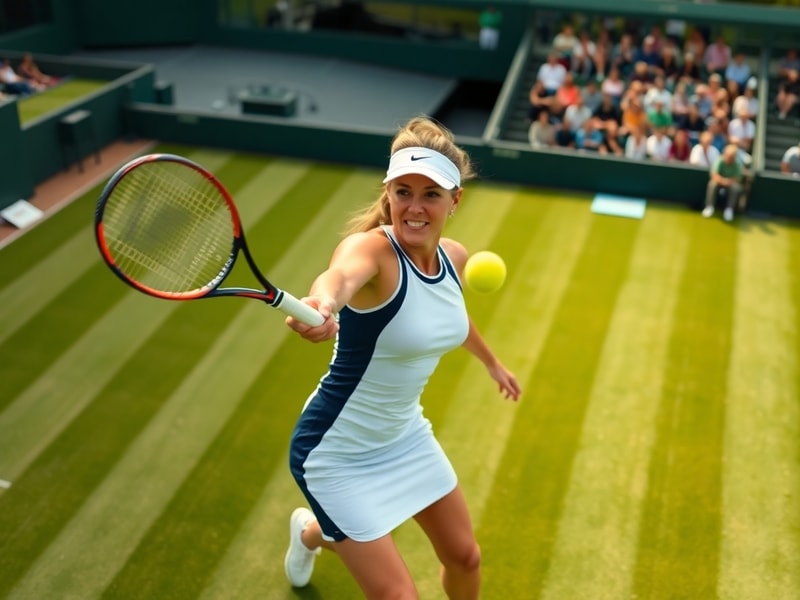
Katie Swan’s journey through professional tennis has been defined by resilience, adaptability, and a quiet determination that often flies under the radar in a sport dominated by headline-grabbing stars. Born in Bristol, England, in 1999, Swan turned professional in 2015 at just 16 years old, stepping into a competitive landscape where youth and potential are both assets and pressures. Her career has unfolded in phases—marked by early promise, setbacks, and incremental progress—each step shaping her into a player who understands the mental and physical toll of elite sports. Swan’s story isn’t one of overnight success, but rather a testament to persistence in an era where young athletes are often rushed into the spotlight without adequate support.
The making of a British tennis prospect
Swan’s introduction to tennis came early. She picked up a racket at age six, quickly displaying the hand-eye coordination and competitive drive that would define her junior career. By 13, she was training at the prestigious National Tennis Centre in Roehampton, where British tennis has cultivated much of its recent talent. Her rapid rise through the junior ranks culminated in a career-high ITF Junior World No. 3 ranking in 2016, a year that also saw her capture the prestigious Orange Bowl title. These achievements placed her firmly on the radar of tennis analysts and coaches who saw in her the makings of a future WTA contender.
Yet, the transition from junior to senior tennis is notoriously difficult, and Swan’s early years on the WTA Tour reflected that harsh reality. She entered her first Grand Slam main draw at Wimbledon in 2016, becoming the youngest British woman to play in the tournament since 1990. While the match was a loss, it was a symbolic moment—one that underscored both her promise and the long road ahead. Injuries, including a stress fracture in her back in 2017, further complicated her development, forcing her to rebuild her game and her confidence.
Key milestones in Swan’s early career
- 2015: Turns professional at 16, begins competing on the ITF Women’s Circuit.
- 2016: Wins the Orange Bowl, reaches ITF Junior World No. 3 ranking.
- 2017: Makes Wimbledon main draw debut as a wildcard; suffers back injury.
- 2019: Wins first $60K ITF title in Les Franqueses del Vallès, Spain.
What stands out in Swan’s early trajectory is not just the titles or rankings, but the way she navigated adversity. Injuries in tennis are career-altering events, especially for young players still refining their physical and mental approach. Swan’s ability to return to competition—and to do so with a more mature game—demonstrates a level of discipline that separates those who merely survive the tour from those who thrive on it.
The evolution of Swan’s playing style and mental game
Over time, Swan’s game has evolved into something more purposeful and sustainable. Initially known for a powerful serve and aggressive baseline play, she has gradually refined her style to incorporate greater tactical variety and shot selection. Her backhand, once a liability, has become a reliable weapon, while her net play has improved significantly—evidence of her willingness to adapt under the guidance of coaches like Nigel Sears.
Perhaps more impressive than her technical development is Swan’s mental resilience. Tennis at the highest level is as much a psychological battle as it is a physical one, and Swan’s ability to weather losses and setbacks without losing sight of her long-term goals speaks volumes about her character. She has spoken openly about the challenges of maintaining motivation during long stretches away from home, the pressure of representing Great Britain in Fed Cup ties, and the loneliness that can accompany life on tour.
“Every match is a chance to learn, whether I win or lose. The key is to stay present and not dwell on the past.” — Katie Swan, in a 2022 interview with The Tennis Podcast
This mindset has not only helped her survive in a crowded field but has allowed her to carve out a niche. Swan doesn’t rely on raw power alone. Instead, she uses angles, pace variation, and strategic depth to outmaneuver opponents. In an era where many players aim to overpower their rivals with 120mph serves and 80-shot rallies, Swan’s style is a refreshing reminder that tennis can still be won through intelligence and adaptability.
Broader implications: What Swan’s career reveals about British tennis
Swan’s career unfolds against the backdrop of British tennis’s broader resurgence—a narrative often dominated by the Williams sisters’ dominance and the meteoric rise of Emma Raducanu. While Raducanu’s 2021 US Open victory captured global attention, Swan’s steady progress offers a quieter but equally important perspective on the state of British women’s tennis. Her career highlights both the strengths and weaknesses of the UK’s tennis infrastructure.
On one hand, Britain has invested heavily in player development through initiatives like the LTA’s Pro-Scholarship Programme, which provides financial and coaching support to promising juniors. Swan has been a beneficiary of this system. On the other hand, the path from junior success to consistent WTA success remains perilous, especially for players who don’t have the financial backing of corporate sponsors early in their careers.
Swan’s journey underscores a critical challenge: the need for sustained support beyond the initial stages of development. While Raducanu’s breakthrough was transformative for British tennis’s visibility, it also created a spotlight effect that can distort expectations. Not every young player can win a Grand Slam at 18. Swan’s career is a reminder that progress in tennis is often nonlinear—and that stability, not just stardom, should be the goal of national governing bodies.
How Swan fits into the next generation of British talent
Alongside Swan, a cohort of British players—including Jodie Burrage, Harriet Dart, and Sonay Kartal—are pushing for top-100 rankings and beyond. This group represents a generational shift, one that could see Britain return to the upper echelons of women’s tennis for the first time since Virginia Wade and Sue Barker. Swan, now in her mid-20s, sits at the intersection of experience and rising potential. She has already served as a mentor to younger players on tour, a role that reflects her growing influence within the British camp.
Her presence in the locker room, combined with her on-court craft, makes her a vital link between the old guard and the new. In a sport where continuity is rare, Swan’s consistency—both in results and attitude—positions her as a model for what a professional tennis career can look like when built on solid foundations.
Looking ahead: Swan’s path to sustained success
At 25, Swan is entering the prime years of a professional tennis career. Her current ranking—fluctuating around the top 150—places her in a challenging but achievable range: close enough to the top 100 to believe in the possibility, yet far enough to require focused, deliberate improvement. Her next goals are clear: break into the top 100, secure direct entry into Grand Slams, and finally claim a WTA Tour title.
To achieve this, Swan will need to continue refining her serve, improving her return game, and building the physical resilience required to compete in best-of-three and best-of-five matches. Equally important will be her ability to manage her schedule, avoid burnout, and select tournaments that offer both competitive depth and developmental value. The modern WTA Tour rewards specialization—players who peak at the right moments. Swan’s challenge is to become that kind of specialist.
There’s also the question of legacy. Beyond rankings and titles, Swan has the opportunity to redefine what it means to be a professional British tennis player in the post-Raducanu era. She can serve as a bridge between generations, a steady hand in a sport often defined by volatility. In doing so, she could help shift the narrative from one of fleeting stardom to one of sustained excellence.
As the 2025 tennis season approaches, all eyes will be on the next generation of British players. But those paying close attention will also be watching Katie Swan—not for the flashy upsets or viral moments, but for the quiet accumulation of experience, skill, and poise that could one day place her among the sport’s most respected figures.