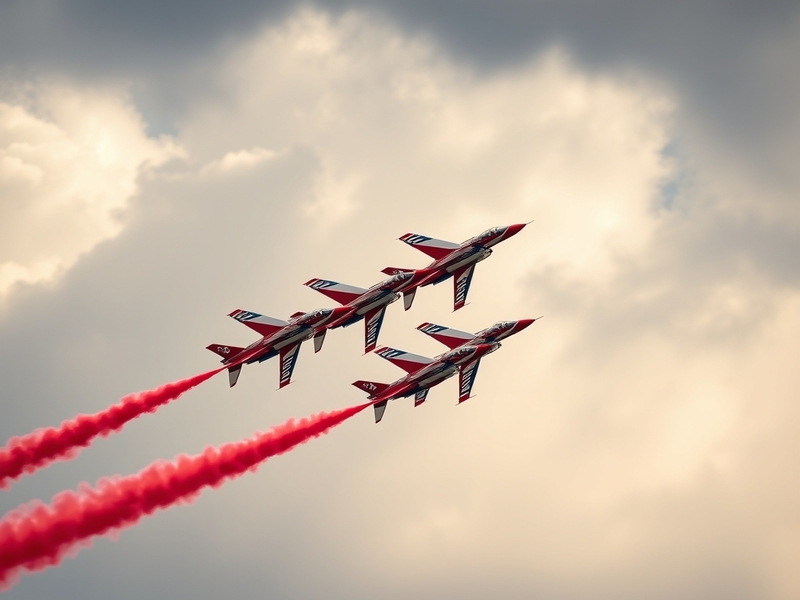
The Royal Air Force Aerobatic Team, better known as the Red Arrows, represents one of the most recognizable symbols of British precision, teamwork, and aerial mastery. Since their formation in 1964, the Red Arrows have not only thrilled audiences across the United Kingdom but also built a global reputation as ambassadors of British aviation excellence. Their signature nine-ship formation, combined with dynamic maneuvers and vivid red smoke trails, has made them a staple at air shows worldwide, blending military precision with artistic flair.
The birth of a legend: origins and early years
The Red Arrows emerged from the ashes of an earlier RAF aerobatic team, the Black Arrows, who had gained fame in the 1950s for their daring barrel rolls and loops in their de Havilland Venom jets. When the Royal Air Force decided to retire the Venom and adopt the Folland Gnat trainer aircraft, a new team was formed in 1964 at RAF Little Ridding. The name “Red Arrows” was chosen to honor both the black jets of the past and the red livery that would become iconic.
The team’s first public display took place on May 6, 1965, at RAF Little Rissington. With just seven pilots and no prior formation experience on the Gnat, they quickly established a reputation for tight, synchronized flying. The formation evolved into the nine-ship ensemble we recognize today, a structure that balances both visual impact and aerodynamic safety. Early performances emphasized vertical rolls, loops, and diamond formations, setting the foundation for the Red Arrows’ signature style.
By the late 1960s, the Red Arrows had begun touring internationally, performing in Europe and the Middle East. Their reputation grew not only for their skill but for their ability to adapt to diverse airspaces and weather conditions, earning respect from both military and civilian audiences.
Global ambassadors: cultural diplomacy in the sky
The Red Arrows are more than just a military aerobatic team—they are cultural envoys. Over the past six decades, they have flown in over 50 countries, from the United States to China, from the United Arab Emirates to Canada. Each performance is carefully choreographed to reflect the host nation’s values, often incorporating local elements into their routines. This adaptability has made them a bridge between military aviation and global diplomacy.
In 2019, for example, the team performed at the Royal International Air Tattoo in the UK, drawing over 150,000 spectators from 40 nations. Their presence at events like the Farnborough Airshow and the Paris Air Show reinforces the UK’s role in international aerospace collaboration. Even during geopolitical tensions, the Red Arrows have maintained a presence, symbolizing continuity and cooperation.
The team’s role in cultural diplomacy extends beyond air shows. They participate in state visits, military exchanges, and educational programs, often flying alongside allied aerobatic teams such as the Italian Frecce Tricolori or the French Patrouille de France. These joint displays are carefully planned to avoid political implications while celebrating shared aviation heritage. The Red Arrows’ red, white, and blue livery has become a visual shorthand for British precision and professionalism across continents.
The anatomy of a display: choreography and technology
A Red Arrows performance is a carefully orchestrated ballet of speed, altitude, and coordination. Each routine is built around a series of standard maneuvers, known as the “Diamond Nine,” which includes the “Loop,” “Rollbacks,” “Teardrop,” and “Corkscrew.” These moves are not just visually stunning—they require intense physical training and split-second timing from the pilots, who fly at speeds up to 400 mph with wingtips just 3 feet apart.
The team operates nine BAE Systems Hawk T1 jets, each modified with smoke generators that produce the iconic red, white, and blue trails. The smoke is generated by injecting diesel into the jet exhaust, creating a visible plume that enhances the visual impact of each maneuver. The color sequence—red for the lead aircraft, white for the inner and outer sections, and blue for the soloists—helps spectators track the formation in real time.
Behind every display is months of rehearsal. Pilots train for up to 12 months before joining the team, learning not only to fly in formation but to respond instantly to radio commands from the team leader, known as the “Boss.” The team’s ground crew, engineers, and support staff play an equally vital role, ensuring that each jet is mission-ready. This level of preparation has made the Red Arrows one of the most reliable aerobatic teams in the world, with a safety record unmatched in military aviation.
Beyond the display: legacy and influence
The Red Arrows’ influence extends far beyond the air show circuit. They have inspired generations of pilots, engineers, and aviation enthusiasts. Many former Red Arrows pilots have gone on to lead major aerospace programs, including roles at BAE Systems, the RAF, and even commercial aviation. Their legacy is also visible in the proliferation of aerobatic teams worldwide, from the Japanese Blue Impulse to the South African Silver Falcons, all of which cite the Red Arrows as a model of excellence.
The team has also become a symbol of British resilience. During the COVID-19 pandemic, when air shows were canceled worldwide, the Red Arrows adapted by performing flypasts over hospitals and communities, offering hope and solidarity. Their 2020 “Heroes Flight” series, where they saluted frontline workers, was broadcast globally and reinforced their role as national symbols of gratitude and service.
Today, the Red Arrows remain a cornerstone of RAF tradition and a global ambassador for British aviation. Their story is one of discipline, innovation, and cultural exchange, proving that precision flying can be both a military necessity and a public spectacle. As they prepare for their next international tour, one thing is certain: the Red Arrows will continue to captivate audiences, one loop at a time.