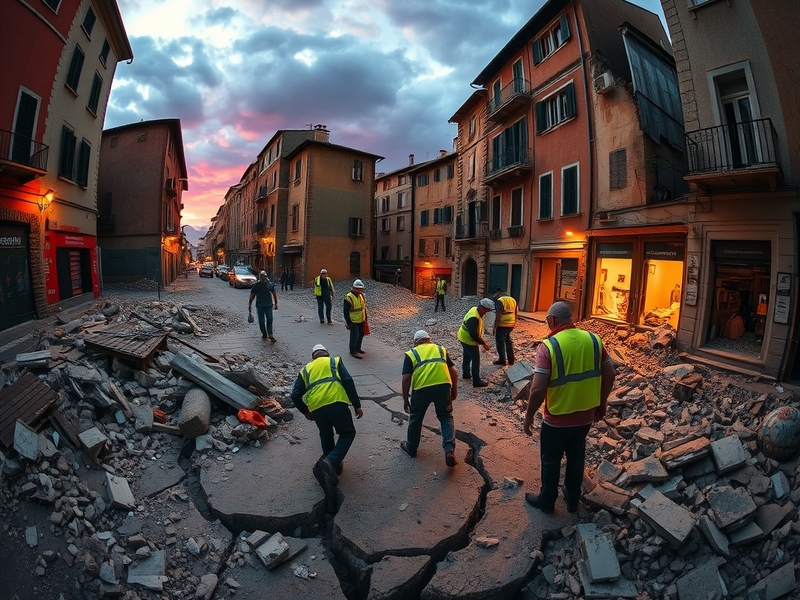
Earthquakes, or terremotos as they’re known in Spanish-speaking regions, are among nature’s most sudden and destructive forces. These seismic events can transform landscapes in seconds, leaving behind a trail of damage and reshaping communities. Unlike slow-moving disasters such as droughts or erosion, earthquakes strike with little warning, their energy released from deep within the Earth’s crust. Their unpredictability makes them particularly terrifying, as even the most prepared regions can face devastation when the ground begins to shake.
The science behind earthquakes is rooted in plate tectonics. The Earth’s outer shell, or lithosphere, is divided into massive plates that float on the semi-fluid asthenosphere beneath them. When these plates grind against each other, pull apart, or collide, stress builds up along their boundaries. Eventually, that stress overcomes the friction holding the plates in place, causing a sudden release of energy—an earthquake. The point where this release occurs underground is called the focus, while the point directly above it on the surface is the epicenter. The closer a location is to the epicenter, the stronger the shaking typically feels.
Not all earthquakes are equal
Earthquakes vary widely in strength and impact. The most common measurement used to describe their size is magnitude, determined by the Richter scale or the more modern moment magnitude scale (Mw). A magnitude 2.0 or lower earthquake is usually imperceptible to people, while a magnitude 7.0 can cause severe damage over large areas. The most powerful earthquakes ever recorded, like the 1960 Valdivia earthquake in Chile (magnitude 9.5), release energy equivalent to thousands of atomic bombs.
Beyond magnitude, the depth of an earthquake’s focus plays a crucial role in its destructiveness. Shallow earthquakes, occurring within 70 kilometers of the surface, tend to cause more damage because their energy doesn’t dissipate as much before reaching populated areas. Deep-focus earthquakes, on the other hand, originate much farther down and often lose intensity by the time their waves reach the surface. For example, the 2013 Okhotsk Sea earthquake, which struck at a depth of 609 kilometers, caused minimal damage despite its magnitude 8.3 rating.
Where the ground shakes most often
Certain regions are far more prone to earthquakes due to their proximity to tectonic plate boundaries. The Pacific Ring of Fire, a horseshoe-shaped zone encircling the Pacific Ocean, is the most seismically active area on Earth. It includes countries like Japan, Indonesia, the Philippines, and the west coasts of North and South America. The 2011 Tōhoku earthquake in Japan, which triggered a devastating tsunami and the Fukushima nuclear disaster, is a stark reminder of the Ring of Fire’s destructive potential.
Other high-risk zones include the Alpine-Himalayan belt, stretching from the Mediterranean through Turkey, Iran, and the Himalayas into Southeast Asia. The 2005 Kashmir earthquake and the 2015 Nepal earthquake are tragic examples of how densely populated regions in this belt can suffer catastrophic losses. Closer to home, California’s San Andreas Fault is one of the most studied seismic zones, where the Pacific Plate and North American Plate slide past each other. Scientists estimate that a major earthquake along this fault, dubbed the “Big One,” could strike within the next few decades.
Not all earthquake-prone areas are on plate boundaries. Intraplate earthquakes, which occur within a tectonic plate rather than at its edges, can also cause significant damage. These events are less frequent but often catch communities off guard. The 1811–1812 New Madrid earthquakes in the central United States, for instance, were so powerful that they temporarily reversed the flow of the Mississippi River and were felt as far away as Boston. Such quakes highlight the need for earthquake preparedness even in regions not traditionally considered high-risk.
Measuring and predicting earthquakes
Modern seismology relies on a global network of seismometers to detect and measure earthquakes. These instruments record the ground motion caused by seismic waves, allowing scientists to pinpoint an earthquake’s location and magnitude. The U.S. Geological Survey (USGS) and other agencies provide real-time earthquake data through online portals, enabling rapid response efforts when disasters strike. For example, after the 2023 Turkey-Syria earthquakes, seismologists used data from thousands of seismometers to issue early warnings within seconds, potentially saving countless lives.
Despite advances in technology, predicting earthquakes remains an elusive goal. Unlike weather forecasting, which can provide days of advance notice, seismic prediction is still in its infancy. Some researchers focus on identifying precursors—unusual phenomena that sometimes occur before an earthquake, such as changes in groundwater levels, radon gas emissions, or animal behavior. However, these signs are inconsistent and often unreliable. The 2009 L’Aquila earthquake in Italy tragically illustrates this challenge. Days before the quake, a local technician recorded unusual gas emissions, but officials dismissed the warnings, leading to widespread criticism after the disaster.
Instead of prediction, scientists emphasize forecasting, which estimates the probability of earthquakes occurring over longer time frames. For example, the USGS predicts a 75% chance of a magnitude 7.0 or greater earthquake striking the San Francisco Bay Area within the next 30 years. These forecasts help governments and communities prepare by updating building codes, retrofitting infrastructure, and conducting emergency drills. In Japan, where earthquake preparedness is a way of life, schools regularly hold drills, and buildings are equipped with advanced damping systems to absorb seismic energy.
The human cost of earthquakes
The impact of earthquakes extends far beyond the initial shaking. Collapsed buildings, ruptured gas lines, and broken water pipes can lead to fires, flooding, and landslides, compounding the destruction. In densely populated cities, even moderate earthquakes can result in thousands of casualties. The 2010 Haiti earthquake, a magnitude 7.0 event, killed an estimated 220,000 people and displaced 1.5 million more. The country’s poor infrastructure and lack of building regulations exacerbated the disaster, turning a natural event into a humanitarian catastrophe.
Earthquakes also have long-term economic consequences. The 1995 Great Hanshin earthquake in Japan caused an estimated $100 billion in damages, while the 2011 Tōhoku earthquake resulted in $360 billion in losses—making it the costliest natural disaster in history. Rebuilding efforts can take decades, and the psychological toll on survivors often lingers for generations. In some cases, entire communities never fully recover. The 1985 Mexico City earthquake, for example, left behind abandoned buildings and displaced families who never returned to their homes.
Children are among the most vulnerable groups during earthquakes. Schools in high-risk areas are particularly dangerous, as poorly constructed buildings can collapse easily. The 2008 Sichuan earthquake in China, which killed over 5,000 students, led to widespread reforms in school construction standards. Organizations like UNICEF now prioritize earthquake-resistant school designs in disaster-prone regions, ensuring safer learning environments for millions of children.
Can we prepare for the next big one?
Preparation is the most effective defense against earthquakes. In Japan, buildings are constructed with flexible materials and shock absorbers to withstand tremors. In Chile, strict seismic codes have reduced earthquake-related deaths despite the country’s frequent quakes. Even in the U.S., cities like Los Angeles and San Francisco have retrofitted vulnerable structures, such as unreinforced masonry buildings and older bridges, to improve their resilience.
Individuals and families can also take steps to prepare. The Federal Emergency Management Agency (FEMA) recommends creating an emergency kit with water, food, first-aid supplies, and a flashlight. Identifying safe spots in your home, such as under sturdy furniture or against interior walls, can reduce injury risks. Practicing drop, cover, and hold on drills ensures that everyone knows how to react when the ground starts shaking. For those in high-risk areas, investing in earthquake insurance may provide financial protection against the worst-case scenarios.
Technology is playing an increasingly important role in earthquake preparedness. Early warning systems, like Japan’s Earthquake Early Warning (EEW) system and Mexico’s SASMEX, provide seconds to minutes of advance notice before shaking reaches populated areas. While these systems can’t prevent damage, they can give people time to take cover, stop trains, or pause surgeries in hospitals. In 2023, California launched its own early warning system, ShakeAlert, which sends alerts to mobile phones when an earthquake is detected.
International cooperation is another critical component of earthquake resilience. Organizations like the Red Cross and the United Nations Office for Disaster Risk Reduction (UNDRR) coordinate global response efforts when major earthquakes occur. After the 2023 Turkey-Syria earthquakes, search-and-rescue teams from over 20 countries deployed to the region, saving thousands of lives. These efforts highlight the importance of collaboration in mitigating the human cost of seismic disasters.
Earthquakes are a reminder of nature’s power and our vulnerability as humans. While we may never fully control their impact, advancements in science, engineering, and preparedness can reduce their toll. From stricter building codes to early warning systems, progress is being made—but the work is far from over. As urbanization and climate change reshape our world, the threat of earthquakes will only grow. The key to survival lies in staying informed, investing in resilience, and never underestimating the ground beneath our feet.