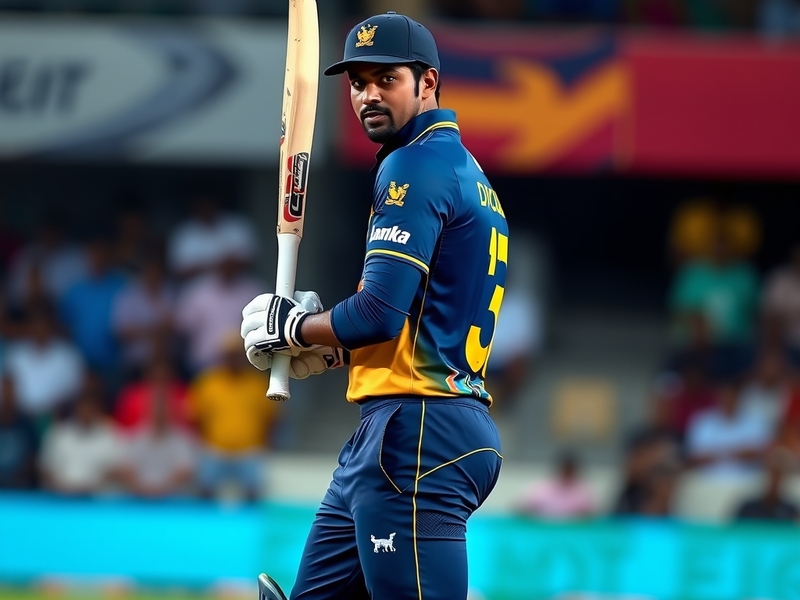
Niroshan Dickwella has carved out a reputation as one of cricket’s most dynamic wicketkeepers, known for his explosive batting and lightning reflexes behind the stumps. Born on June 23, 1993, in Kandy, Sri Lanka, Dickwella rose through the ranks with a style that blended aggression with flair. His journey from local club cricket to the international stage reflects both personal determination and a broader shift in how wicketkeepers are perceived in modern cricket.
Dickwella’s breakthrough came during Sri Lanka’s tour of South Africa in 2016–17, where he announced himself with a blistering 68-ball 80 in a losing cause at Wanderers Stadium. That innings symbolized his approach: high-risk, high-reward, and unapologetically entertaining. Since then, he has become a mainstay in Sri Lanka’s limited-overs setups, particularly in T20s and ODIs, where his ability to accelerate innings and effect run-outs has made him invaluable.
But Dickwella’s career is more than just statistics. It mirrors the evolution of wicketkeeper-batsmen in global cricket, a role that now demands multifaceted contributions. From India’s Rishabh Pant to England’s Jos Buttler, the archetype has shifted from pure glovework to all-round impact. Dickwella fits squarely into that mold, representing a generation of players who refuse to be pigeonholed.
Early Life and Domestic Rise
Growing up in Kandy, Dickwella was immersed in the rhythms of Sri Lankan domestic cricket. His father, a former club cricketer, recognized his talent early and encouraged him to pursue the game seriously. Dickwella honed his skills at the prestigious St. Anthony’s College, where he developed a reputation for aggressive stroke play and sharp wicketkeeping. By his late teens, he was already representing Sri Lanka in youth internationals, catching the eye of selectors with his fearless approach.
His domestic career took off with the Sinhalese Sports Club, where he became known for innings that turned games on their head. In 2014, he scored a century against Colts Cricket Club in just 74 balls—an innings that showcased his talent but also hinted at the volatility that would define parts of his career. Dickwella’s domestic numbers were impressive: over 2,500 first-class runs by age 23 and more than 150 dismissals as a wicketkeeper, a clear sign of his dual capability.
International Breakthrough and Style of Play
Dickwella made his ODI debut in 2015 against Pakistan, but it wasn’t until the following year that he truly announced himself on the global stage. His ability to play unorthodox shots—reverse sweeps, scoops, and lofted drives over cover—made him a nightmare for bowlers in the death overs. Unlike traditional wicketkeepers, Dickwella embraced chaos, often treating bowling attacks with disdain and turning matches in mere overs.
His wicketkeeping wasn’t just about clean catches either. Dickwella developed a reputation for effecting sharp run-outs, particularly with direct hits from close range. In a 2019 ODI against New Zealand, he ran out Martin Guptill with a throw that traveled nearly 100 meters—an example of his arm strength and tactical awareness. These attributes made him a key player in Sri Lanka’s limited-overs strategies, where every run and every dismissal counted.
Yet, his style has drawn criticism as well. Dickwella’s high-risk approach has led to frequent dismissals, sometimes in crucial moments. Critics argue that his aggression borders on recklessness, particularly in Test cricket, where patience is often rewarded. Despite this, he remains a fan favorite, especially in T20 leagues around the world, where his entertainment value is unmatched.
Global Presence and T20 Leagues
Dickwella’s talents have made him a sought-after player in franchise cricket. He has played in leagues across the globe, from the Caribbean Premier League (CPL) to the Indian Premier League (IPL). In the IPL, he represented the Delhi Capitals in 2021, where his cameo against Royal Challengers Bangalore—a 21-ball 43—helped secure a thrilling win. His performances in the Big Bash League (BBL) for the Melbourne Renegades further cemented his reputation as a T20 specialist.
Playing in these leagues has not only boosted his profile but also allowed him to adapt his game to different conditions and bowling attacks. In Australia’s bouncy pitches, for instance, Dickwella refined his pull shots and cutters, while in the Caribbean, he mastered the art of pacing an innings in high-pressure chases. This adaptability is rare among wicketkeeper-batsmen and speaks to his cricketing intelligence.
Cultural Impact and Representation
Beyond his on-field contributions, Dickwella represents a cultural shift in Sri Lankan cricket. Traditionally, Sri Lankan cricket has been associated with spin bowling and flair batting, epitomized by legends like Muttiah Muralitharan and Sanath Jayasuriya. Dickwella, however, embodies a newer, more aggressive paradigm—one that prioritizes entertainment and instant results.
His rise coincides with the global rise of T20 cricket, a format that thrives on spectacle. In many ways, Dickwella is a product of this evolution, a player who understands that cricket is as much about storytelling as it is about technique. His celebrations—elaborate high-fives, chest bumps, and even the occasional moonwalk—have made him a social media darling, particularly among younger fans who crave authenticity and personality.
In Sri Lanka, where cricket is more than a sport—it’s a unifying force—Dickwella’s journey resonates deeply. He has become a symbol of resilience, bouncing back from setbacks and rejections with performances that remind fans why they love the game. His story is also a reflection of Sri Lanka’s broader cricketing culture, where talent is nurtured in humble surroundings and success is measured not just in trophies but in moments of brilliance.
Challenges and Controversies
Of course, Dickwella’s career has not been without its controversies. In 2021, he was involved in a heated altercation with India’s Ravindra Jadeja during a Test match in Colombo. The incident, which saw Dickwella exchange words with Jadeja near the stumps, highlighted the intensity that often defines his play. While some defended his passion, others criticized him for crossing the line, arguing that such behavior tarnished the spirit of the game.
Dickwella has also faced scrutiny over his fitness and commitment, particularly in Test cricket. Critics point to his high strike rates in limited-overs cricket as evidence of his unsuitability for the longest format. In 2022, he was dropped from Sri Lanka’s Test squad, a decision that sparked debate about the future of wicketkeeper-batsmen in Test cricket. Some argued that his aggressive style was ill-suited to the demands of Test cricket, while others felt he was unfairly judged.
Yet, Dickwella has consistently responded with performances that silence doubters. In a 2023 ODI series against Afghanistan, he scored a crucial 50 in a high-pressure chase, demonstrating his ability to deliver when it mattered most. His resilience suggests that his career is far from over, even as he navigates the challenges of modern cricket.
Legacy and Future
As Dickwella approaches the latter stages of his international career, his legacy is already secure. He is one of the few wicketkeeper-batsmen to have scored over 2,000 runs in both ODIs and T20Is, with strike rates that rival those of the format’s most explosive players. His influence extends beyond numbers, however. He represents a new breed of cricketer—one who blends athleticism, audacity, and personality in a way that captivates audiences worldwide.
Looking ahead, Dickwella’s focus will likely shift toward T20 leagues and franchise cricket, where his skills are in high demand. He may also take on mentorship roles, guiding younger players who aspire to follow in his footsteps. In Sri Lanka, there is hope that he will inspire a new generation of wicketkeeper-batsmen, players who can combine glovework with explosive batting and redefine what it means to be a modern cricketer.
Ultimately, Niroshan Dickwella’s story is one of adaptation and evolution. From the streets of Kandy to the world’s biggest cricketing stages, he has redefined the role of the wicketkeeper-batsman. His journey reminds us that cricket is not just a game of technique and tradition but also one of creativity and courage. As the sport continues to change, players like Dickwella will shape its future, ensuring that it remains as thrilling to watch as it is to play.