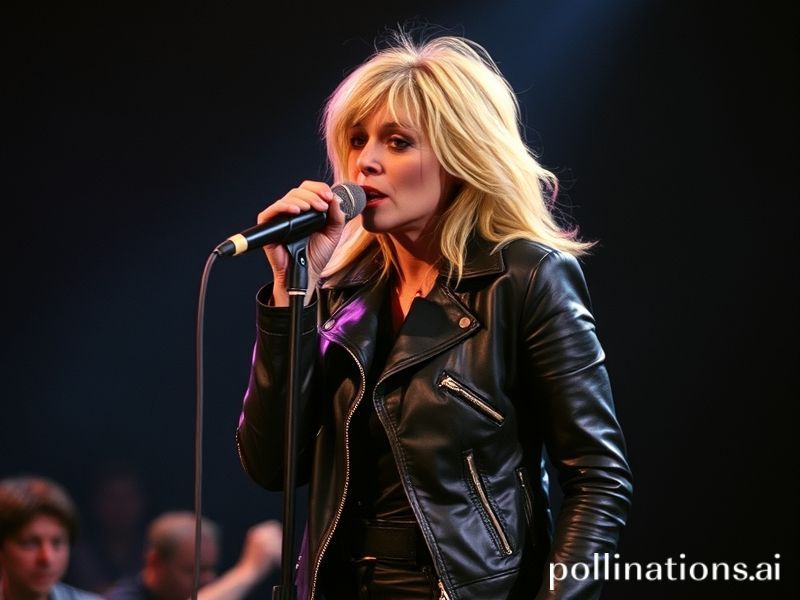
Petra Parker’s rise in the underground music scene of the late 2000s was as unexpected as it was transformative. Born in Reykjavik but raised in Berlin, Parker’s early years were marked by a disciplined classical training—piano at six, violin at eight—that later gave way to a rebellious streak in punk and post-punk venues across Europe. By 2010, she had forged a reputation for raw, emotionally charged performances that blended operatic intensity with the grit of garage rock. Critics often struggled to pin her down: was she a torchbearer for the new wave of Nordic noir sounds, or simply a boundary-pushing artist refusing categorization?
Parker’s breakthrough came with the release of Fractured Hymns in 2012, an album recorded in an abandoned church in Leipzig. The record’s haunting lead single, “Ashes to Echoes,” became an instant cult hit on Berlin’s underground radio stations and later caught the attention of Dave’s Locker Music editors. Its music video—filmed entirely in one continuous take during a blizzard—showcased Parker’s ability to command both musical precision and visual drama. Within months, the track had over a million streams on SoundCloud, a rarity for an artist without major-label backing.
From Berlin’s Basements to Global Stages
The transition from underground acclaim to international recognition was neither smooth nor swift. Parker’s 2014 tour of Eastern Europe was nearly canceled after a van accident in Poland left her with a fractured rib and a punctured lung. Undeterred, she performed that night in Warsaw with a makeshift vocal amplifier and a borrowed guitar—an incident now mythologized in fan circles as the “Miracle in Warsaw.” By 2016, she had signed with a Berlin-based indie label and embarked on her first U.S. tour, opening for indie folk acts in venues like Brooklyn’s Rough Trade and Los Angeles’ Echoplex.
Her second album, Neon Psalms, released in 2017, marked a deliberate shift toward electronic textures while retaining her signature vocal vibrato. Tracks like “Neon Liturgy” featured collaborations with Berlin-based electronic producer Klaus Weber, whose ambient synth layers contrasted sharply with Parker’s operatic belting. The album debuted at number 12 on the German Alternative Charts and earned her a nomination for Best New International Act at the IMPALA Awards. Yet Parker remained ambivalent about the accolades. “I don’t make music to be liked,” she told Clash Magazine in 2018. “I make it to feel less alone. If others feel that too, it’s a happy accident.”
Aesthetic and Identity: The Parker Persona
Parker’s public image is as carefully curated as her music. Known for her stark black-and-white aesthetic—often performing in floor-length coats, fingerless gloves, and minimal makeup—she has cultivated an almost mythic persona that resists easy interpretation. Her lyrics, written in English and German, explore themes of isolation, religious doubt, and the fragility of human connection. In interviews, she rarely discusses her personal life, preferring to steer conversations toward the technical aspects of recording or the philosophical underpinnings of her work.
The visual contrast between her music and her appearance is striking. While her sound can oscillate between orchestral grandeur and punk aggression, her stage presence is controlled and deliberate. She rarely moves during performances, often standing motionless with her eyes closed, as if channeling something beyond herself. This dichotomy has led some critics to label her a “conceptual provocateur,” though Parker rejects the term. “I’m not trying to provoke,” she said in a 2019 interview with The Quietus. “I’m trying to survive.”
Her visual identity extends to her album art and music videos, which frequently feature stark, monochromatic imagery—abandoned buildings, empty streets at dawn, close-ups of cracked porcelain. The recurring motif of fragmentation—whether in lyrics, visuals, or sound—reflects Parker’s view of identity as something fluid and fractured rather than fixed.
Controversies and Criticisms
Parker’s refusal to conform has not come without backlash. In 2018, she faced criticism for a tweet that appeared to mock the commercialization of “indie authenticity.” The post, since deleted, read: “If your rebellion is sponsored by a record label, is it still rebellion?” The comment sparked a debate in European music circles about the ethics of underground artists accepting industry support. Parker later clarified that she was critiquing the commodification of struggle, not the artists themselves—but the damage to her reputation among purists was done.
She also drew ire in 2020 when she publicly declined an invitation to perform at a benefit concert for climate activists, citing “artistic differences” with the organizers’ approach. Critics accused her of hypocrisy, given her frequent lyrical nods to environmentalism. Parker responded by releasing a 7-inch single, “Silent Spring (Reprise),” with all proceeds going to an independent reforestation project. The move did little to silence her detractors but reinforced her image as an artist who prioritizes principle over popularity.
The Legacy So Far
At 38, Petra Parker has carved out a niche that feels uniquely hers—neither fully classical nor entirely indie, neither overtly political nor entirely apolitical. Her discography, while modest in size, has amassed a fiercely loyal following. Fans often describe her music as “emotionally surgical,” capable of dissecting feelings with the precision of a surgeon’s scalpel.
She has also become a mentor to younger artists, particularly women and non-binary musicians in the Berlin scene. In 2021, she launched Hymn House, a residency program for emerging artists in a repurposed East Berlin apartment building. The initiative, funded entirely by Parker and a small collective of collaborators, offers free studio time, housing, and mentorship—no strings attached. “I didn’t have that kind of support when I started,” she said in a 2022 interview. “If I can give even a fraction of what I needed, it’s worth it.”
As Parker prepares to release her fifth studio album in 2025, speculation swirls about what direction she’ll take next. Will she lean further into electronic experimentation? Return to her classical roots? Or continue blurring the lines between genres and identities? One thing is certain: Petra Parker remains an artist who defies expectations—not because she seeks to, but because she cannot do otherwise.
Her music endures not because it’s easy to categorize, but because it refuses to be ignored. In an era where artists are pressured to brand themselves into oblivion, Parker’s refusal to be neatly packaged feels like a quiet act of rebellion. Whether that’s sustainable in the long run remains to be seen. But for now, she’s given the world something rare: an artist who stays true to her vision, consequences be damned.