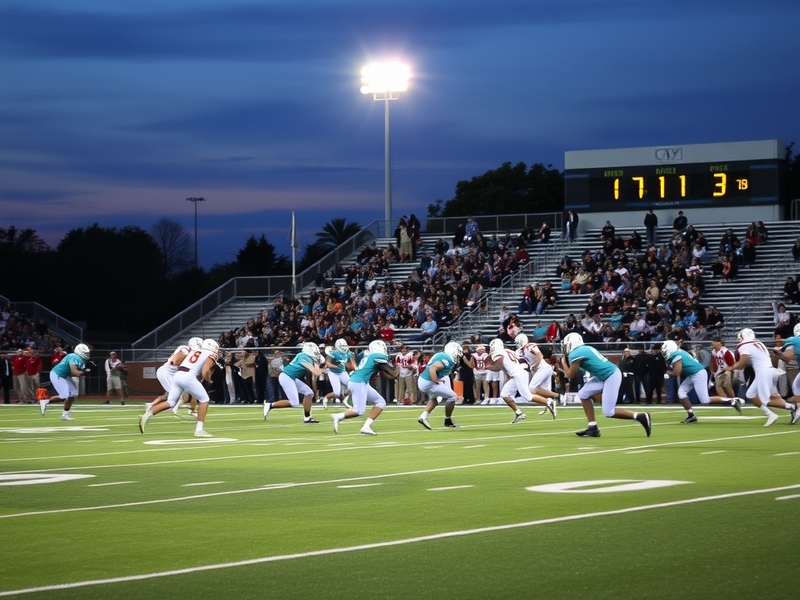
High school football in Michigan isn’t just a sport—it’s a cultural institution, a Friday night ritual that binds communities together across the Great Lakes State. From the bright Friday night lights of Detroit’s stadiums to the frozen fields of the Upper Peninsula, football scores in Michigan high schools reflect far more than wins and losses. They reveal the pulse of small towns, the pride of urban districts, and the dreams of student-athletes chasing college opportunities.
Michigan’s high school football scene is deeply rooted in tradition, with a history stretching back over a century. The state has produced NFL legends like Dan Dierdorf and Charles Woodson, and its high school ranks remain one of the most competitive in the nation. The Michigan High School Athletic Association (MHSAA) oversees the sport, organizing state championships that draw thousands of fans each November. But beyond the headlines and playoff brackets, the weekly release of Michigan high school football scores tells a story of perseverance, community investment, and athletic ambition.
How scores are tracked and shared across Michigan
Tracking and sharing high school football scores in Michigan has evolved dramatically over the years. In the early 20th century, fans relied on local newspapers, radio broadcasts, and word of mouth. Today, scores spread in seconds through digital platforms, social media, and dedicated sports apps. The MHSAA’s official website remains the gold standard for verified results, posting scores within hours of games ending. Local media outlets like MLive and the Detroit Free Press also maintain live scoreboards and postgame recaps.
Social media has transformed how scores are consumed. Twitter accounts run by local journalists, school boosters, and fan pages update in real time during games. Platforms like Hudl and MaxPreps streamline score entry and allow fans to follow their teams even when they can’t attend. Meanwhile, fantasy football-style platforms have emerged, letting fans track player stats across multiple games and seasons.
- Official sources: MHSAA website, school athletic departments
- Local media: MLive, Detroit Free Press, Grand Rapids Press
- Digital platforms: Hudl, MaxPreps, GameChanger, Hudl Assist
- Social media: Twitter/X accounts, Facebook groups, Instagram pages
The accessibility of scores has democratized fandom. A parent in Marquette can follow their child’s game in Lansing via live stats. Coaches in rural areas access video breakdowns within minutes of the final whistle. This transparency has strengthened fan engagement and elevated the profile of high school football beyond its traditional strongholds.
The role of football in Michigan’s cultural identity
Football in Michigan is more than a game—it’s woven into the state’s social fabric. In towns like Warren, where the football team is the heart of Friday night, scores are shared over church suppers and at diners. In Detroit, where high school football has long been a pathway to opportunity for inner-city athletes, scores carry extra significance, symbolizing resilience and hope.
The sport also reflects Michigan’s economic and demographic shifts. As manufacturing jobs declined, football fields became places of pride and purpose. Programs in Flint, Benton Harbor, and Saginaw often serve as community anchors, drawing volunteers, donors, and spectators who might otherwise have few outlets for local pride. The scores from these districts aren’t just athletic updates—they’re indicators of community health.
Michigan’s football culture is also shaped by geography. The Upper Peninsula, with its harsh winters and tight-knit communities, has a rugged football tradition. Teams like Ishpeming and Marquette often battle in blizzard conditions, testing endurance as much as skill. Scores from these games are celebrated not just for the win, but for the grit it took to earn it. Meanwhile, in the suburbs of Oakland County, high school football is often tied to college recruitment pipelines, with scores closely monitored by scouts and recruiters.
This blend of urban, rural, and suburban experiences makes Michigan’s high school football landscape uniquely diverse. Scores from one region can tell a story of economic struggle, while scores from another reflect elite athletic development. Together, they form a mosaic of what it means to be a Michigander.
Key trends in Michigan high school football scores and performance
Over the past decade, several trends have emerged in Michigan high school football scores and outcomes. One of the most notable is the increasing parity among teams. Historically, powerhouse programs like Detroit Catholic Central, De La Salle, and East Lansing dominated the landscape. While these schools remain competitive, smaller schools and those from less affluent districts have closed the gap, thanks to better coaching, nutrition programs, and offseason training.
Another trend is the rise of seven-on-seven tournaments and 7v7 leagues, which have changed how players develop and how scores are anticipated. These offseason events, often played in spring and summer, allow coaches to scout talent and fans to follow rising stars before official scores are even tallied. The growing influence of private training facilities and AAU-style football has also shifted the balance, with some athletes entering high school already scouted by colleges.
According to MHSAA data from the 2022–2023 season:
- Over 300,000 students participated in high school football across Michigan.
- More than 1,600 varsity teams competed in 11-man football.
- The average margin of victory in playoff games was under 14 points, down from 18 points a decade ago.
- Over 40% of teams advanced to the playoffs each year, reflecting increased competitiveness.
Technology has also impacted how scores are interpreted. With tools like Hudl’s video analysis, coaches can break down opponents’ tendencies and adjust strategies mid-season. This has led to more evenly matched games and, in some cases, lower final scores in high-scoring matchups as defenses adapt. The result? More upsets and fewer blowouts—something long-suffering fan bases in places like Saginaw and Pontiac celebrate.
Another cultural shift is the growing emphasis on player safety, which has indirectly influenced scoring trends. Stricter concussion protocols and limits on full-contact practices have led some programs to adopt more conservative offensive schemes. While this has sparked debate among purists, it has also extended careers and improved long-term athlete health—factors that matter just as much as final scores.
Why scores matter beyond the field
For many communities, the Friday night football score is a barometer of civic pride. When a small-town team like Rogers City or Mio-AuSable wins a playoff game, the victory is broadcast on local radio, plastered on storefront windows, and shared in group chats. The score becomes a rallying point, a reason to gather, and a source of hope during tough economic times.
Scores also serve as a recruiting tool for colleges. Programs like Michigan State and Western Michigan rely heavily on in-state talent, and high school stats—including scores and stats—are closely monitored. A standout performance in a game with a high score differential can put a player on a scout’s radar overnight. This pipeline has made Michigan one of the top football talent-producing states in the Midwest.
Moreover, the emotional weight of scores extends to families. A touchdown in the fourth quarter can mean a college scholarship. A last-second loss can end a season and a player’s high school career. For parents, teachers, and classmates, the score isn’t just a number—it’s a memory, a lesson in resilience, or a moment of pride that will be retold for years.
In urban areas, football scores have become symbols of resistance and opportunity. Programs like Martin Luther King Jr. High School in Detroit have used football to keep students engaged in school and out of trouble. When their teams win, the community celebrates not just the score, but the message it sends: that talent and discipline can break cycles of poverty.
The future of Michigan high school football scores
The way scores are tracked and shared will continue to evolve. Artificial intelligence and predictive modeling are beginning to appear in high school sports, with platforms using historical scores to forecast outcomes. While these tools remain controversial, they hint at a future where fans can not only see scores but also simulate entire seasons based on past performance.
Another frontier is esports-style streaming of high school games. Already, some schools partner with local broadcasters or use YouTube channels to livestream games, complete with play-by-play commentary. This has expanded the audience for high school football, especially in rural areas where travel to games can be difficult. Scores are no longer confined to local newspapers—they’re streamed globally, connecting Michigan athletes with fans in Europe, Asia, and beyond.
Yet, amid all this innovation, the soul of Michigan football remains unchanged. It’s still played under the Friday night lights, still cheered by families in bleachers, and still decided by the grit of teenagers on a field. The scores will keep coming—some dramatic, some routine—but each one carries a piece of the state’s identity.
Whether you’re checking the MHSAA website after kickoff or scrolling through Twitter for the final score, remember: behind every stat is a story. It’s the story of a running back from Flint chasing a dream, a lineman from the UP who never misses a block, or a community that finds hope in a single touchdown. In Michigan, football scores aren’t just numbers. They’re the heartbeat of a state.